

Catsup started out with no tomatoes anywhere near it. The word comes from ke-tsiap, a term in the Hokkien dialect of southeastern China for a fermented fish sauce made in port towns along the South China Sea, mixed from salted anchovies and left to cure for months before it ever got near a plate. Malay traders in the 1600s and 1700s picked up the term as kicap, and that’s the version British sailors ran into and began anglicizing into catsup and ketchup.
Those British sailors spent the next century trying to recreate the sauce back home, swapping in what they had on hand — mushrooms, walnuts, oysters, anchovies — since tomatoes weren’t part of the picture yet. Catsup recipes started showing up in British cookbooks by the early 1700s, and colonists carried them across the Atlantic. So by the time tomatoes entered the recipe, the name and the basic idea of a savory, spiced sauce were already well established.

Tomatoes joined the recipe surprisingly late. Philadelphia horticulturalist James Mease published the first known tomato catsup recipe in 1812, made with what people at the time still called love apples. His version used brandy rather than vinegar, and like most home recipes of the era, it spoiled fast. Families fermented their own batches through the 1800s, and a well-made one could actually keep for one to seven years, but the flavor swung wildly from sour to sweet depending on whose kitchen it came from.
Henry J. Heinz brought order to that chaos in 1876, when his company started bottling tomato catsup made with vinegar instead of fermentation, which meant a shelf life you could count on. Heinz spelled it “ketchup” to set his product apart from the catsup brands already crowding grocery shelves, and the distinct spelling stuck for his company even as plenty of competitors kept the C. By the early 1900s Heinz was also using sodium benzoate as a preservative, standard practice across the industry at the time.
That changed because of a government chemist named Harvey Washington Wiley, who ran a series of federal safety trials nicknamed the Poison Squad and came out convinced benzoate posed real health risks. Heinz sided with him, a rare move for a food manufacturer being scrutinized, and spent years reformulating a benzoate-free ketchup using riper tomatoes, more pulp and a stronger vinegar content. The timing lined up with the 1906 Pure Food and Drug Act, and the thicker, more acidic ketchup that came out of that effort is close to what still ships today.

By the mid-20th century, ketchup had edged out catsup as the more common spelling on store shelves, even as some brands kept the older name on the label for decades. The photos and vintage ads collected below span that stretch, from 1930s glass bottles to the crowded catsup aisle of the 1950s and 60s, when a dozen regional brands still competed for space next to Heinz.
Editor’s note: Some period sources, including the information provided by Del Monte for the 1976 Tampa Bay Times article reprinted elsewhere on this page, claim tomatoes entered catsup while it was still in Asia, carried there by Portuguese traders. That timeline doesn’t appear in independent food history research, which places tomatoes joining the recipe in 1812, in Philadelphia.
Fun fact: As of 2020, the top brands were Heinz, Hunt’s, various store brands (generics), Del Monte… and then all the rest combined.
A history of catsup (1976)
From the Tampa Bay Times (Florida) September 9, 1976
Some people say “it’s just not a meal without ketchup.” While enjoying the tomatoey goodness of ketchup, did you ever wonder where it all came from and when it got started?
Well, according to the Del Monte Corporation, “it’s a secret from the Far East.” Catsup (different brands have different spellings) originated in Asia, where its name was derived from “ket-tsiap” (Chinese), “ketchup” (Malayan), or “kachiap” (Thai), meaning a spicy sauce of or for fish. History indicates Portuguese traders took tomato seeds to Macao, a southeast island of China.
Tomatoes then traveled either to Malaya or to China next, where they were first used as an ingredient and later evolved into the condiment, catsup. Soon catsup became a well-known favorite in every household, yet each family kept its own secret recipe.
Catsup left Southeast Asia and went on to India via China expatriates. As this popular condiment made its way to England from India, further adaptations were made by English cooks.
The Brits tried to imitate the blend of tangy, oriental flavors with fish, brine, herbs and spices. In turn, their recipes were borrowed and adapted by American settlers when they reached the New World.
The British called the sauce “ketchup,” and it became a national favorite. A “Housekeepers Pocketbook” of 1748 warned readers not to be without this condiment, while writers Charles Dickens and Lord Byron sang its praises in their writings.
Sea captains from Maine acquired a taste for ketchup and took it back to New England, where it was used to sauce codfish cakes. They brought tomato seeds from Spain and Cuba, and by the 1700s, tomato catsup, was reinstated.

MORE: 26 ways to serve an old favorite: Hot dogs
Due to the unavailability of tomatoes in America, catsup was first made from walnuts and mushrooms, and from just about any berry or fruit that was available.
The original American catsups were also made without sugar, and were usually spicy and tart. The American demand for a less tart catsup eventually had its way, however, and by 1886, a sweeter catsup was firmly established.
Originally, catsup was used extensively in cooking, with cooks adding it as flavoring to fish, vegatable and meat dishes. Today’s American dictionaries still define catsup as a condiment which is used to enhance the flavor of food.
When the H. J. Heinz Company was founded in 1876, ketchup — or catsup, as it is often called in America — became a popular company product. Today marketing surveys show it is the favorite American condiment. Catsup is found in the homes of 98 out of 100 families and is sold around the world.
So, come on and enhance your meal with catsup or ketchup. No matter how you spell it, It still makes a lot of foods taste better. Add ketchup to a recipe and discover a totally new flavor.
Ketchup history adapted from articles in The Press Democrat (Santa Rosa, California) Jan 22, 1958; The Indiana Gazette (Indiana, Pennsylvania) Nov 1, 1976; and the Tampa Bay Times (Florida) September 9, 1976.
Vintage Del Monte Barbecue flavor catsup (1966)

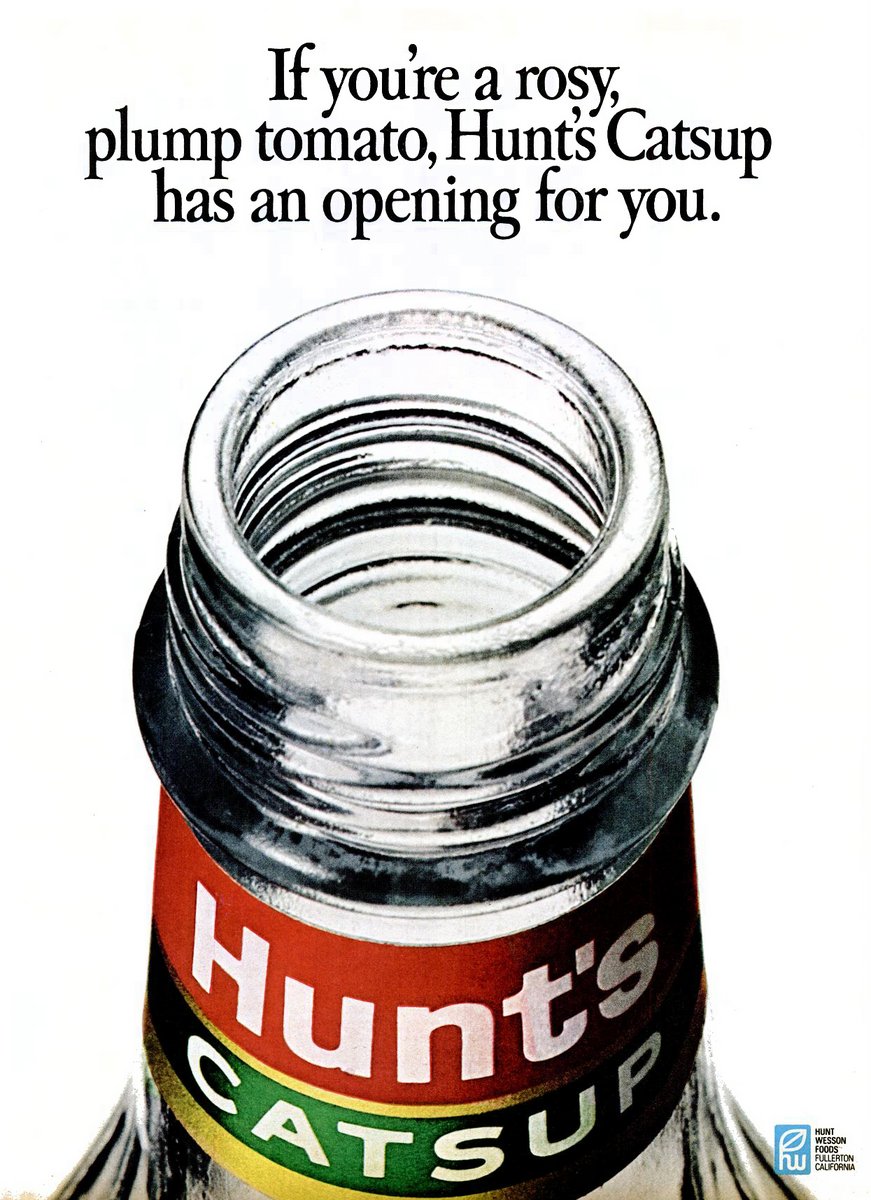
If you’re a rosy, plump tomato, Hunt’s Catsup has an opening for you (1968)
The catsup bottle
Shake and shake
The catsup bottle.
None’ll come —
And then a lot’ll.
– Going to Extremes, Richard Armour (1949)
Catsup from the ’50s: Sexton, NAAS, Donald Duck, Del Monte

White Swan, Standby, Flotill, Hunt’s tomato catsup

History of catsup: Heinz ketchup, Snider’s, Stokely’s Finest, Dennison’s

Paramount ketchup, Red Wing, Frost, S&W tomato catsup

ALSO SEE: Vintage McDonald’s menus & food: See 5 decades of the famous fast food chain’s history
Snider’s vintage catsup, made real country-style (1946)

Hunt’s catsup in flavors: Hickory & Pizza (1965)

It’s Hunt’s… It’s got sweet-spice flavor… just what a steak sandwich needs (1956)

ALSO SEE: 14 retro hamburger recipes for some differently delicious dinners






3 Responses
Did DelMonte have a different flavor over the last 70 years?
What about BLOOMDALE Ketchup???
It would be interesting to hear from us baby boomers which brand we remember our parents buying in the 50s. My mom’s choice was Hunts. I believe Heinz was more expensive so she chose the less expensive.