The drink had roots in West Germany, where Coca-Cola had developed a lemon-lime soda called Fanta Klare Zitrone — essentially “Clear Lemon Fanta” — in 1959. By 1960, the company was quietly test-marketing a version under the Sprite name in Sandusky, Ohio, and Lansing, Michigan, pitching it as both a standalone soft drink and a mixer.
An Atlanta Constitution report from September 1960 noted that Coca-Cola described the new drink as having “its own distinctive taste experience… with special appeal to the young adult group.” The green bottles were deliberately chosen to stand out on shelves. After the market tests cleared, Sprite went national in 1961.

The name itself had existing brand equity. Coca-Cola had used a Sprite Boy mascot in its advertising during the 1950s — a cheerful, elfin character associated with Coke’s playful side — and the company acquired rights to the Sprite name in 1960 from a Houston-based bottler who had used it for a line of fruit-flavored drinks. The lemon-lime soda slipped neatly into that identity. Early slogans like “Taste Its Tingling Tartness” leaned into what set it apart from sweeter competitors: a tarter, sharper flavor profile that the 1964 ads on this page summed up plainly as “for adult tastes.”
Growth came steadily through the 1960s, backed by Coca-Cola’s massive bottler network. By 1967, Sprite was available to roughly 85 percent of the U.S. population and sold in at least 39 countries. That infrastructure — the same system that distributed Coke — gave Sprite a reach its competitors couldn’t easily match. By 1978, Sprite had overtaken 7-Up to become the top-selling lemon-lime soda in the United States.

The brand’s identity shifted considerably in the 1980s and into the ’90s. What had been pitched to young adults as a sophisticated, tart mixer evolved into a fixture of teen culture. In 1994, Sprite became the official soft drink of the NBA and launched the “Obey Your Thirst” campaign — a pointed, self-aware effort featuring NBA stars and hip-hop artists that explicitly told viewers not to buy something just because a celebrity endorsed it. The full tagline read: “Image is nothing. Thirst is everything. Obey your thirst.” By the end of the decade, the campaign had helped triple sales and land Sprite a dominant share of the citrus soda category.
VIDEO | “Obey your thirst” Grant Hill commercial (1995)

Today Sprite is sold in more than 190 countries and ranks as the third most consumed soda in the world, behind Coke and Pepsi. The green bottle that debuted in those Ohio test markets in 1960 finally disappeared in 2022, when Coca-Cola switched to clear plastic.
The vintage ads and archival materials collected on this page capture the drink’s early years, when the pitch was sophistication and tartness, and the green glass bottle was still new enough to be a selling point. Here’s a look at how it all began!

- Experience the crisp taste of Sprite lemon-lime flavored sodas
- Boldly refreshing soft drinks made with 100% natural flavors and no caffeine, ever
- Deliciously cool lemon-lime flavor to keep you inspired

The birth of Sprite: Coke test-marketing lemon-lime soft drink (1960)
By Jim Montgomery – The Atlanta Constitution (Atlanta, Georgia) September 29, 1960
The Coca-Cola Co. is preparing to bring out a new lemon-lime flavored soft drink and mixer beverage called Sprite, The Constitution learned Wednesday.
A company spokesman here verified that bottlers have just begun test-marketing the new specialty drink at two locations in the Midwest — Sandusky, Ohio, and Lansing, Mich.
Sprite apparently is intended to compete with such beverages as Seven-Up, consumed both as a soft drink and a mixer of highballs.
The new Coca-Cola line is being test-marketed in both capacities in two sizes — seven-ounce and 12-ounce green bottles with applied color labels.
The company said a permanent bottle design will be adopted if the market tests indicate that general distribution is warranted.

It described the new drink as having “its own distinctive taste experience… with special appeal to the young adult group.”
A spokesman said Sprite is not like the lemon-lime flavored drink in the company’s Fanta group of fruit-flavored soft drinks.
He also said Sprite is not related to the Fanta line, which is expected to gain general nationwide distribution during the spring and summer months of 1961.
Originally developed in Europe, Fanta has been sold overseas since 1955.
Sprite was developed here prior to Coca-Cola’s recent move to acquire Minute Maid Corp., but it is indicated that a target date for general distribution of Sprite will depend on the outcome of the market tests just now getting started.
Sprite is for adult tastes. Naturally tart. And not so sweet.

A product of the Coca-Cola company
Sprite with vodka (1963)

Natural Sprite soda (1960s)

Sprite in a Mad Russian drink (1964)


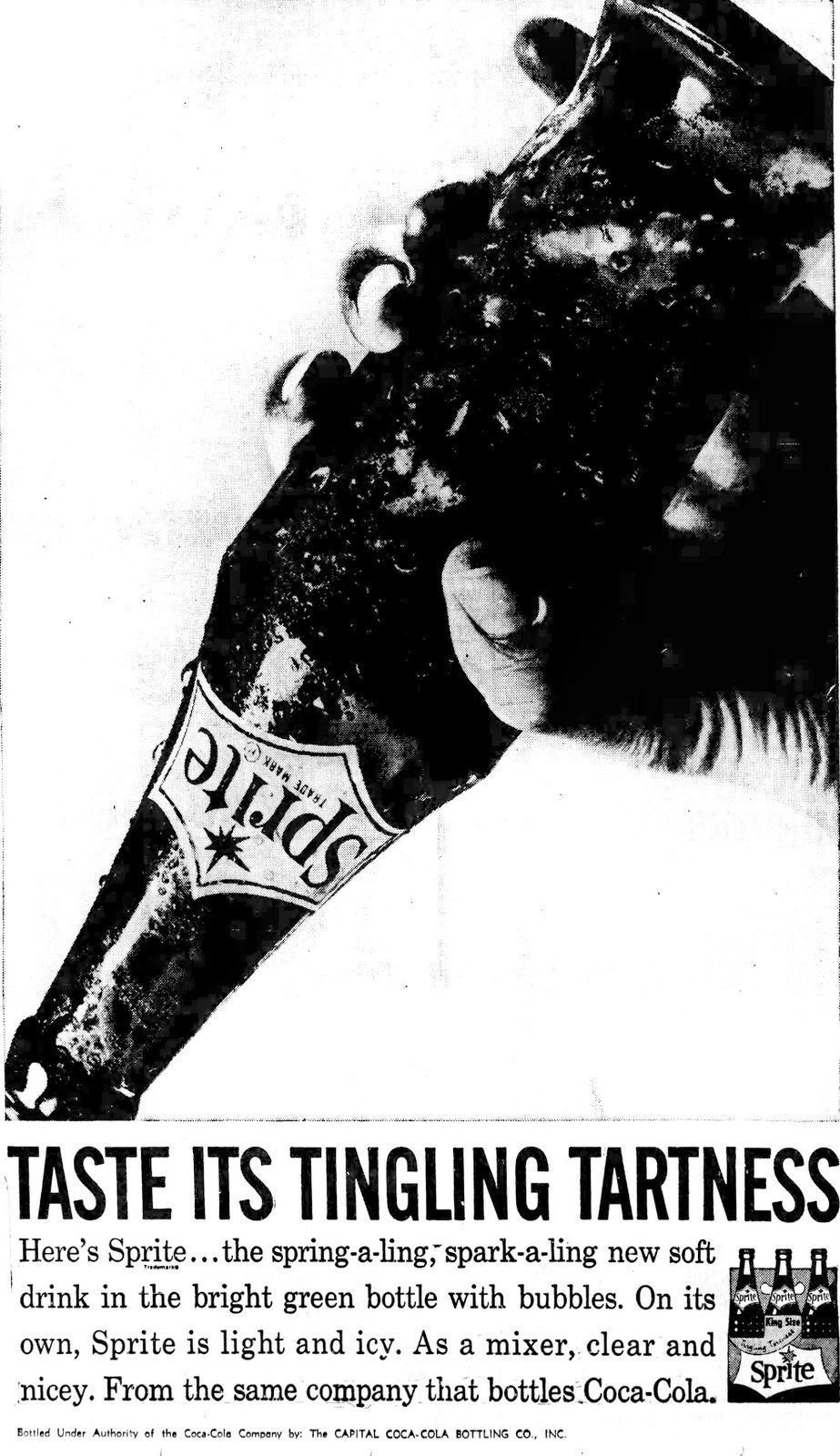
Taste its tingling tartness (1964)
Here’s Sprite…the spring-a-ling, spark-a-ling new soft drink in the bright green bottle with bubbles.
On its own, Sprite is light and icy. As a mixer, clear and nicey. From the same company that bottles Coca-Cola.
Sprite melon ball punch recipe (1964)

Sprite with rum and pineapple (1965)

ALSO SEE: Bubble Up lemon-lime soda: The old soft drink with a surprisingly long history
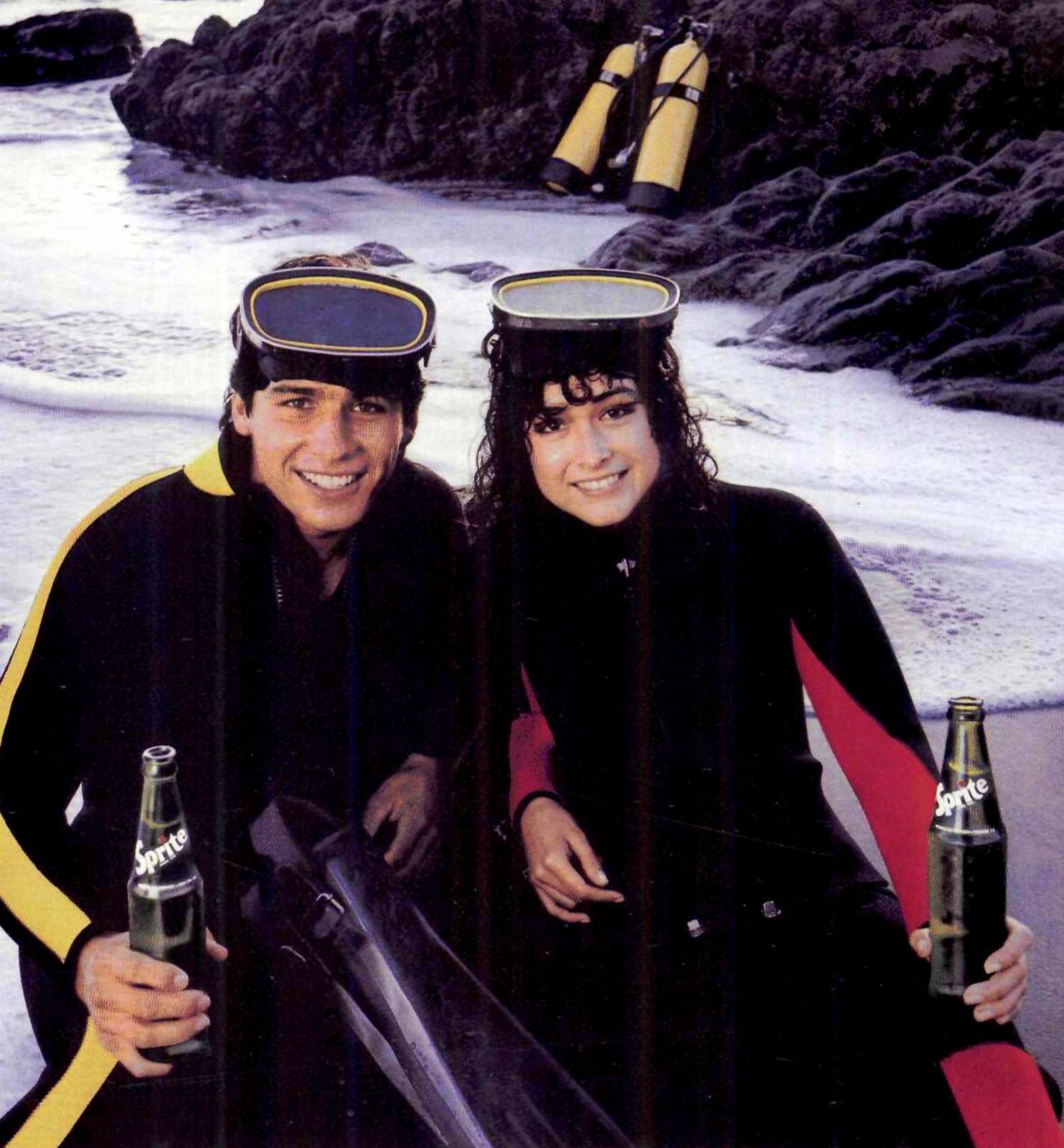
Scuba diving with Sprite (1984)
Trendy eighties girls roller skate with Sprite (1985)

Diet Sprite looking better than ever (1985)

Diet Sprite vs Diet 7-UP (1986)

Hip exercising people drinking Sprite soda (1985)

Sprite Soul Train sweepstakes (1992)