

The idea goes back to 1950, when Zenith introduced its first remote, a wired device called the Lazy Bones. It let viewers change channels from their seats, which was the point, but it connected to the TV by a long cable snaking across the floor — a reliable way to trip and sprain an ankle!
The wireless breakthrough came in 1955, when Zenith engineer Eugene Polley developed the Flash-Matic, which used a flashlight-style beam aimed at photo cells in the corners of the screen. The concept worked, mostly. The problem was that the TV couldn’t tell Polley’s beam from sunlight or a stray lamp, which meant channels could flip on their own whenever conditions were bright enough.

Robert Adler, another Zenith engineer, solved it a year later with a completely different approach. His 1956 Space Command remote had no batteries, no electronics and no light. Instead, it contained small aluminum rods that, when struck by tiny hammers inside the unit, produced ultrasonic tones — frequencies high enough that the TV’s receiver could hear them but humans generally couldn’t.
The whole thing weighed 8 ounces and fit in the palm of your hand. Adding the Space Command system to a Zenith set required six extra vacuum tubes in the television and pushed the retail price up by roughly 30 percent, which kept it firmly in premium territory for years. Still, the technology worked well enough that it became an industry standard, and more than nine million ultrasonic remote control TVs were sold before infrared technology arrived in the 1980s.
Through the 1960s and into the 1970s, manufacturers refined the ultrasonic design. Transistors replaced vacuum tubes, which allowed for battery-powered handsets and dropped the cost. Danish firm Bang & Olufsen introduced remotes with haptic cues on the buttons — concave for down, convex for up — so users could operate them in the dark without fumbling. But the remote stayed a premium feature through most of this period. As late as 1979, only about 17 percent of American households had one.
VIDEO | 1961 RCA Victor color TV with wireless remote
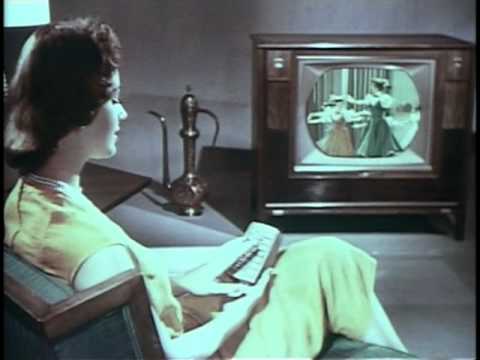
It was the arrival of cable and satellite TV in the 1970s and 1980s that finally made the remote genuinely useful for a mass audience. Suddenly there were dozens of channels to cycle through instead of three or four, and getting up to do it every time was a real inconvenience.
Infrared technology, which used invisible light pulses instead of sound, took over the market by around 1983 — cheaper to produce, more reliable and less prone to interference from ambient noise. VCRs arrived around the same time and brought their own remotes, as did cable boxes and stereo systems.
By the mid-1980s, a typical household might have separate controllers for the TV, cable converter, VCR and a disc player, all of which looked roughly the same and did completely different things. That pile-up pushed the development of the universal remote, with Philips releasing the first commercially successful version in 1985.

- 【Compatible Devices】Universal replacement remote control is compatible with TV brands for Samsung, LG, Vizio, Sony, Hisense, Onn, Sharp, RCA, Element, Westinghouse, Sanyo, Emerson, Philips, JVC...
- 【NOT Compatible Devices】Universal remote is Not compatible with Roku Streaming Sticks, Roku Sound Bar, TLC Sound Bar, Hisense Sound Bar, Anker Sound Bar, Klipsch Sound Bar, All Fire TV, All TV...
- 【Simple Setup】Step 1: Find the device type you need in the code list. Then find and circle all the codes for the brand. Step 2: Press and hold down the (SETUP) button for 3 seconds until the red...
Steve Wozniak, who left Apple in the mid-1980s specifically to tackle the problem, introduced a fully programmable universal remote called the CL 9 CORE in 1987. Early versions cost around $150 and required patience to set up; eventually they came preprogrammed and dropped to single-digit prices.
Adler and Polley were jointly awarded an Emmy in 1997 by the National Academy of Television Arts and Sciences for their pioneering work on wireless remote controls — a fitting recognition for two engineers whose invention reshaped how Americans spent their evenings. Here, we’ve collected vintage Zenith Space Command ads and photos from the 1950s and 1960s, back when the remote was still a selling point novel enough to put in the headline.
See these vintage TV remote controls from the fifties & sixties
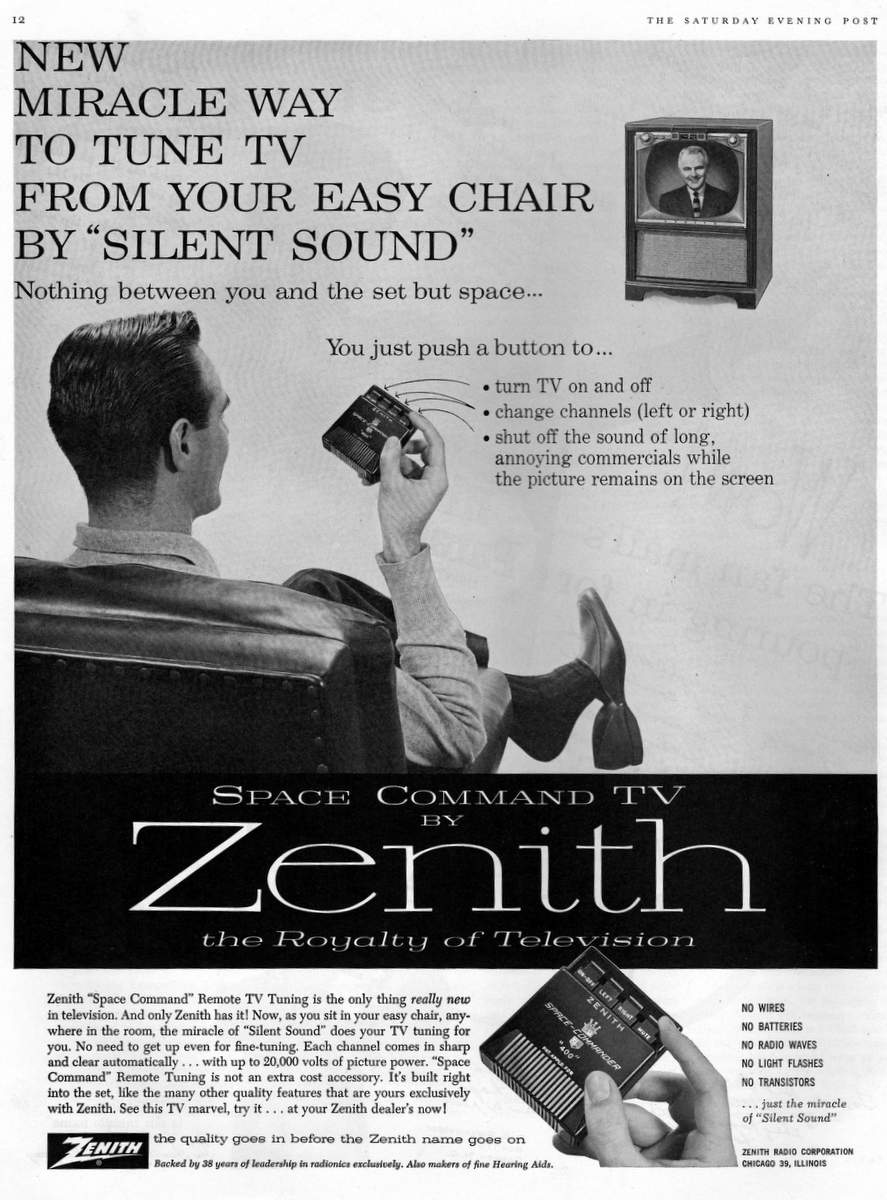
Silent Sound: New miracle way to tune TV from your easy chair
Nothing between you and the set but space…
You just push a button to…
— turn TV on and off
— change channels (left or right)
— shut off the sound of long, annoying commercials while the picture remains on the screen
Zenith “Space Command” Remote TV Tuning is the only thing really new in television. And only Zenith has it! Now, as you sit in your easy chair, anywhere in the room, the miracle of “Silent Sound” does your TV tuning for you. No need to get up even for fine-tuning.
Each channel comes in sharp and clear automatically with up to 20,000 volts of picture power. Space Command Remote Tuning is not an extra cost accessory. It’s built right into the set, like the many other quality features that are yours exclusively with Zenith.
See this TV marvel, try it… at your Zenith dealer’s now!
No wires – No batteries – No radio waves – No light flashes – No transistors
1950s TV remote control: It’s magic! The one and only thing NEW in television! (1956)
Only Zenith has the Space Command tuner
You don’t have to shut off annoying commercials while you answer the phone unless you want to!
Yours today! The television performance of the future! ZENITH TV “SPACE-COMMAND” TUNER
ZENITH’S new “Space-Commander” is a revolutionary TV remote tuner, compact enough to hold in the palm of your hand.
Without batteries, electricity, light or radio waves, the device enables you to operate a TV receiver across the room, or even from the next room. You can turn it on or off, dial right or left to bring in the desired channel, and even silence commercials. You don’t even have to point it!
It weighs only 8 ounces. It cannot interfere with your neighbor’s set. It emits no harmful radiations. There’s nothing between you and the set but “SPACE” — nothing for you to do but give a silent “COMMAND” with your fingertip on the “Space-Commander” box.
It’s the only wireless complete remote control! And only Zenith has it! You have to try it to believe it! See this exciting new tuner at your Zenith dealer’s — and try it yourself!
See “Space-Command” Tuner demonstrated on NCAA football telecasts.
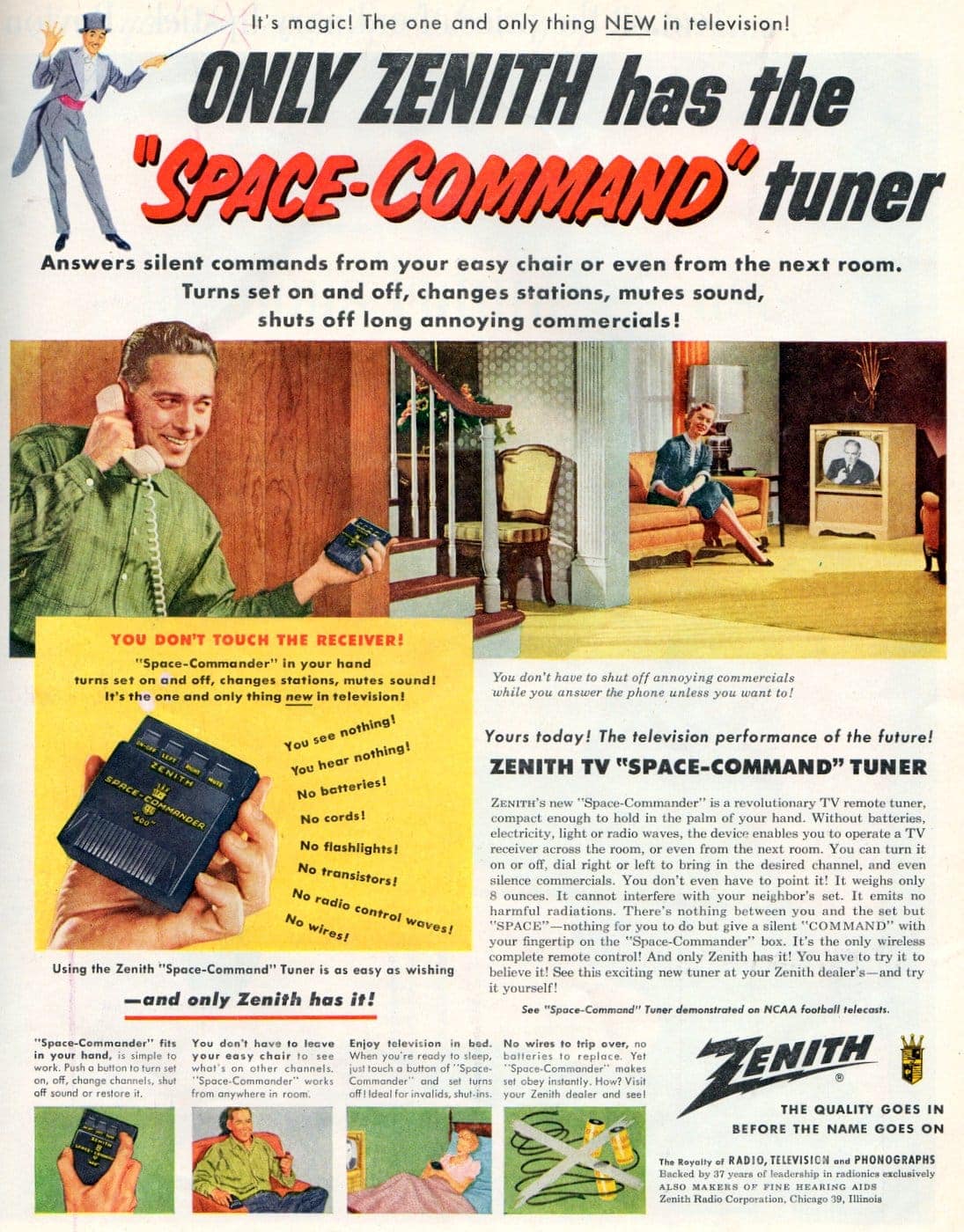
Zenith Space Commander remote control (1956)
You don’t get up — if it’s a Zenith
Turn TV on, change channels and volume, from your easy chair
Zenith Space Command Remote Control television tuning has no wires or cords to bother with, no batteries to replace.
Just touch a button on the control unit you hold in your hand, and Space Command tunes your Zenith TV for you. Does it from across the room with Silent Sound.
Created by Zenith, patented by Zenith, it’s the most convenient kind of television you can own. And it’s the finest quality, too. The Zenith television chassis is hand-crafted and it has no printed circuits. This means more dependability, less service headaches.
See Zenith Space Command TV — in magnificent fine-furniture cabinets — at your Zenith dealer’s.
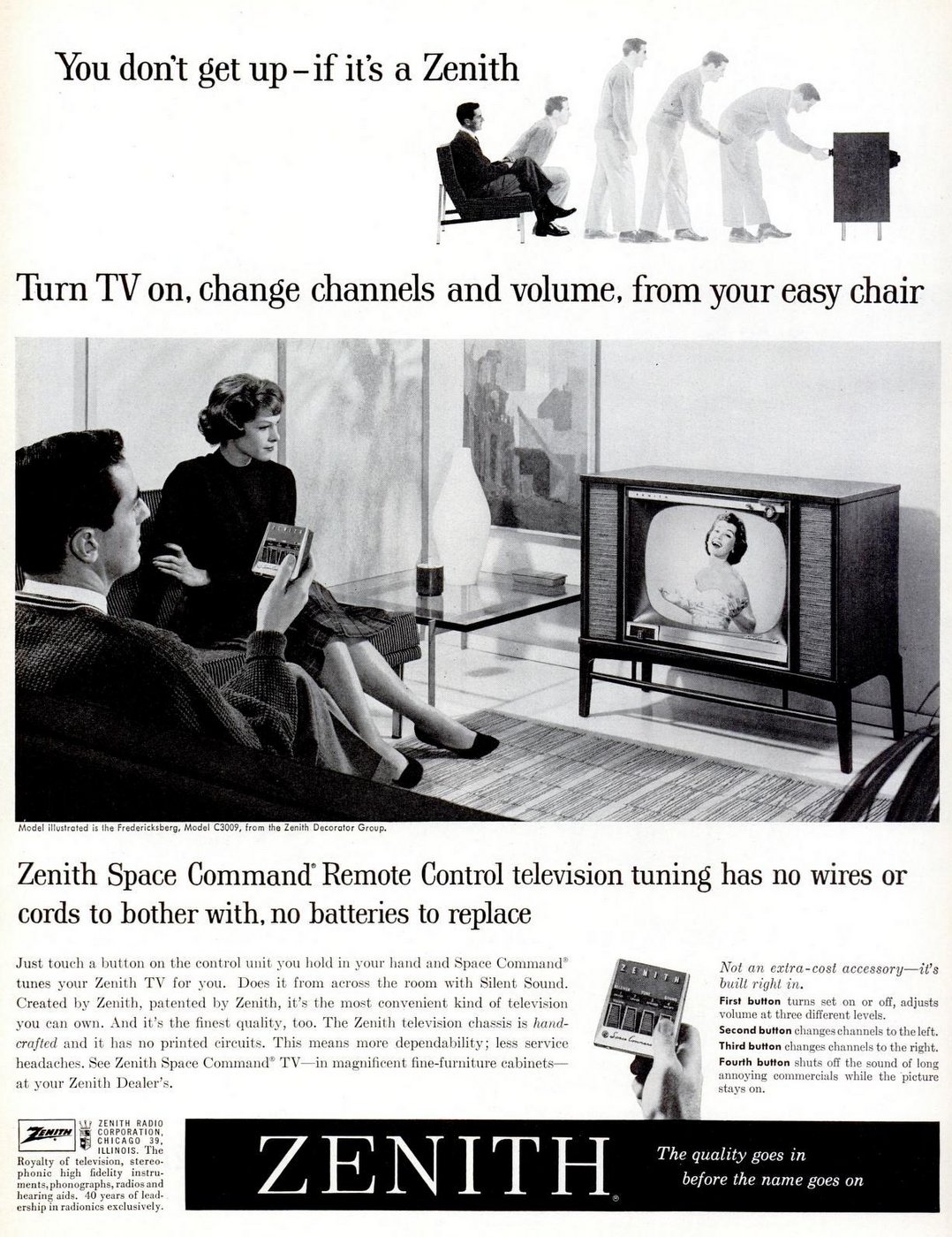
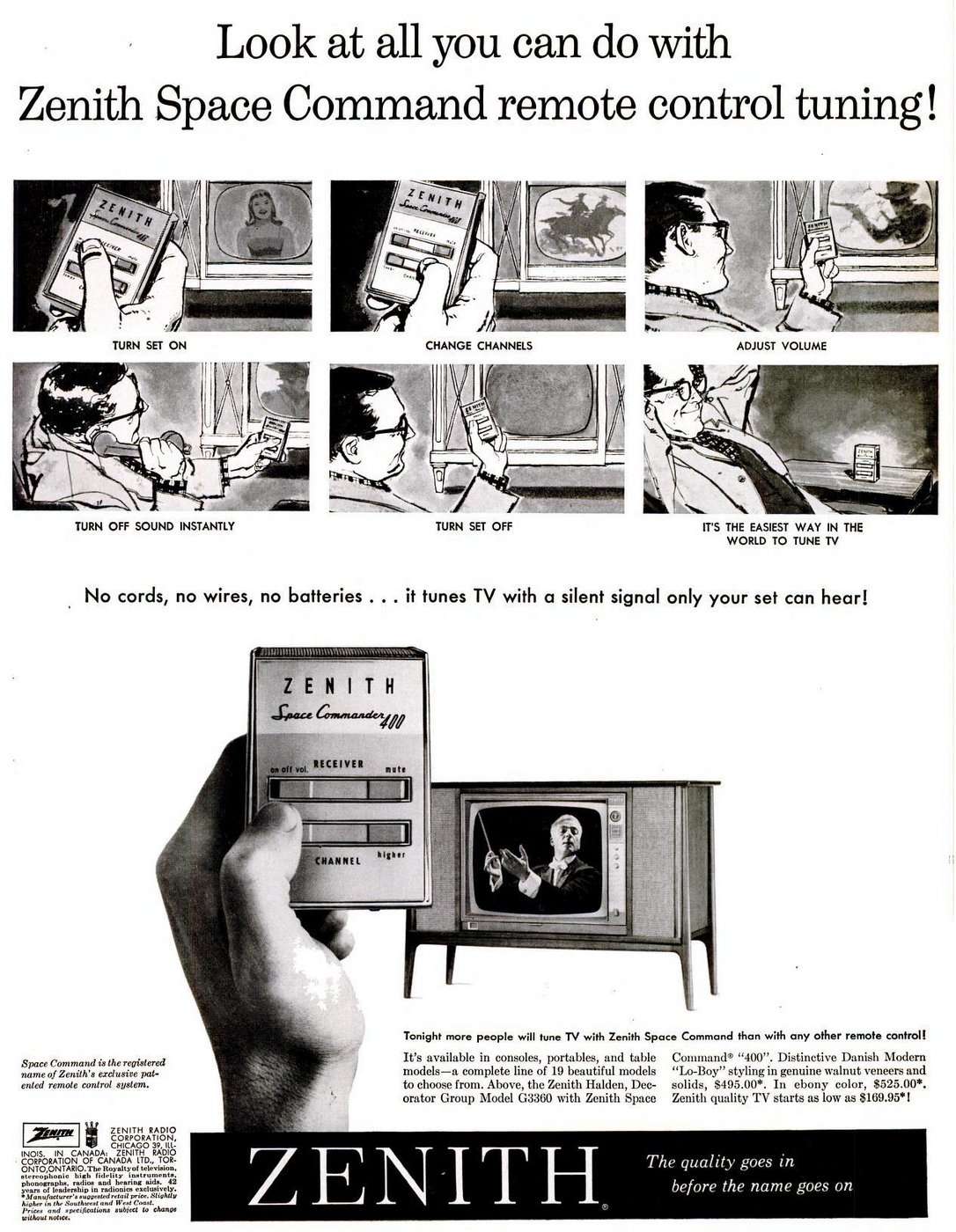
Look at all you can do with Zenith Space Command TV remote control tuning! (1961)
— TURN SET ON
— CHANGE CHANNELS
— ADJUST VOLUME
— TURN OFF SOUND INSTANTLY
— TURN SET OFF
IT’S THE EASIEST WAY IN THE WORLD TO TUNE TV
No cords, no wires, no batteries . . . it tunes TV with a silent signal only your set can hear!
Tonight more people will tune TV with Zenith Space Command than with any other remote control!
1961 Zenith TV: New performance features









One Response
I had a universal remote in the 1990s to control the TV, cable box, and VCR, and I loved that. But now I wonder how that would fly with smart TVs with wifi and bluetooth capabilities, not to mention frequent system updates. You’d have to reprogram everything and then replace the remote when it becomes obsolete. I’m back to three remotes again-TV, Blu-Ray/DVD player, and receiver.