Welk’s parents were ethnic Germans who had emigrated from Odessa in the Russian Empire, and he grew up in a German-speaking community in the North Dakota plains. He didn’t learn English until adulthood, and never fully lost the accent — which, oddly, became part of his appeal. In the 1920s he led dance bands across the Dakotas under names like the Hotsy Totsy Boys and the Honolulu Fruit Gum Orchestra, and his group became the station band for WNAX radio in Yankton, South Dakota, launching a daily radio show that ran from 1927 to 1936.
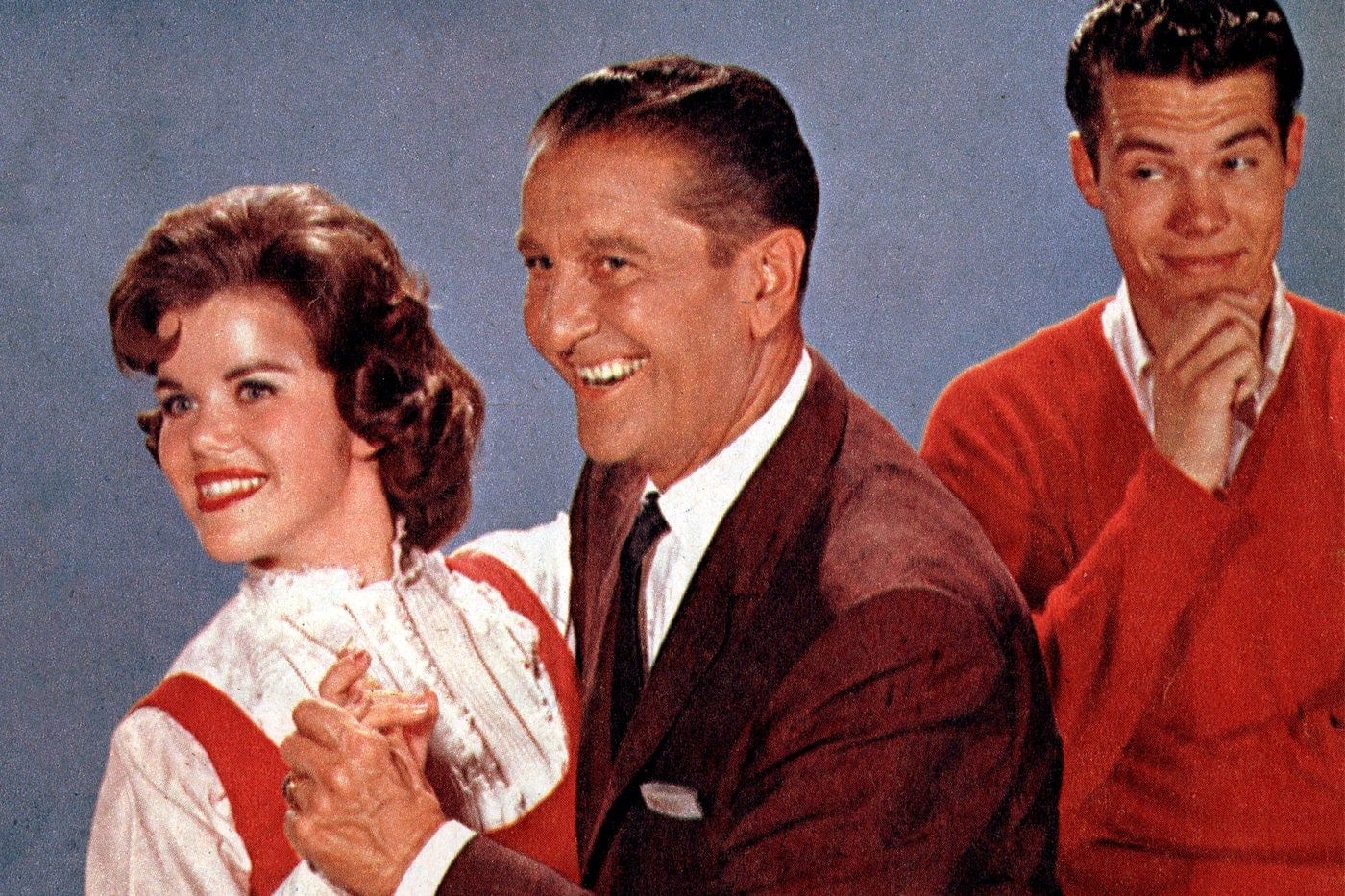
The radio exposure turned regional gigs into steady Midwestern bookings. Then, in 1938, a fan letter read on-air during a Pittsburgh performance gave his music its permanent name. A listener had written that hearing Welk’s band was like sipping champagne. The phrase stuck, and the “Champagne Music” brand was born.
By the 1940s, Welk and his orchestra had settled into a standing residency at the Trianon Ballroom in Chicago before he eventually relocated to Los Angeles. In 1951 the band landed an engagement at the Aragon Ballroom on the Ocean Park pier, and KTLA-TV broadcast that night. The flood of calls to the station was so overwhelming that KTLA extended Welk’s contract for four years.
The Lawrence Welk Show debuted nationally on ABC in 1955 — sponsored by Chrysler and billed as the Dodge Dancing Party — and the ratings held strong enough that by 1956, the show was airing twice a week. At its peak, a 1957 profile in Life magazine reported that Welk was being seen or heard by between 40 and 50 million people a week — roughly one quarter of the entire U.S. population — and commanding concert guarantees of $100,000 a week, more than three times what the top big bands of the 1930s had ever earned.
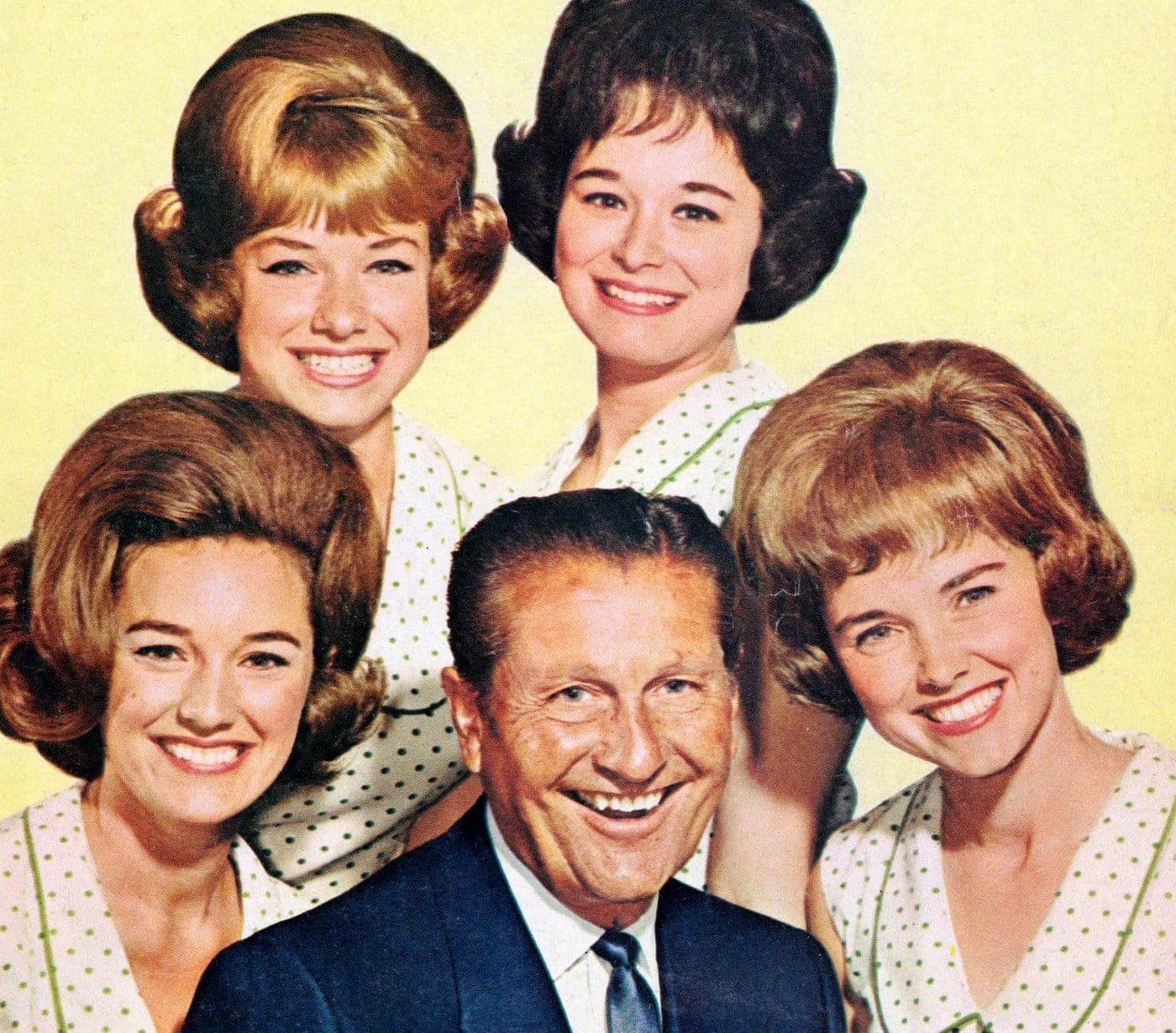
The show had a formula and Welk kept it. The program’s standing policy was to play only well-known music from previous years, so audiences heard nothing unfamiliar. Polkas, Tin Pan Alley standards, ballroom numbers — all delivered clean and smooth, with the bubble machine running.
He maintained a roster of regulars, including a designated “Champagne Lady” vocalist and, for a stretch, the Lennon Sisters. He was a demanding boss about it, too. Clarinetist Pete Fountain left the show after Welk objected to his attempt to play a jazz version of “Silver Bells” during the 1958 Christmas special.
Fountain later summed it up simply: “Champagne and bourbon don’t mix.” Welk himself put his philosophy plainly in a 1957 interview: “I bend over backward to give people what they want. Nothing is wrong if the folks like it. Sure, I like better music than what I play, but if I played what I like, we’d still be eating hamburgers instead of steak.”
VIDEO | The Lawrence Welk Show PBS opening

When the counterculture of the late 1960s scrambled TV audiences, The Lawrence Welk Show largely survived — and even grew its viewership, though increasingly among older viewers. ABC cancelled the show in 1971 after 17 years on the network, citing advertiser concerns about audience demographics — the thinking being that younger, urban viewers had more buying power, and Welk’s crowd skewed too old. Welk’s response was to go directly to local stations.
In what was then considered a bold move, he began producing episodes for first-run syndication, and by the fall of 1971 he was back on the air across 250 stations — including many of the same ABC affiliates that had just dropped him. He kept producing new episodes until 1982, when he retired at 79. He also accumulated royalty rights to some 20,000 songs, including the entire body of work by composer Jerome Kern. From 1987, the show appeared on PBS, where rerun episodes continue to air today. Welk died in Santa Monica in May 1992 at 89.
VIDEO | The Lawrence Welk Show 1980 opening

The photos and archival material collected on this page pull from across his career — including a richly detailed 1957 Life feature that captured him at the height of his network run, a 1960 American Home piece on a California Christmas with the Welk family, and a 1969 Southern California tourism feature. All together they offer a close-up look at a man who had figured out exactly what a huge swath of America wanted to hear on a Saturday night.


Some champagne for the folks (1957)
“I make no claim to being a great musician,” says Lawrence Welk. “Even as an accordion player, I just don’t rate.”
Great or not, Welk at 54 is the most popular musician in U.S. history. In 32 years of band leading, he has progressed from four-piece square-dance combos with names like “Lawrence Welk’s Hotsy-Totsy Boys” and “Lawrence Welk’s Honolulu Fruit Gum Orchestra” to his “Champagne Music-makers” who are heard on TV twice weekly and in jukeboxes from coast to coast.
He sells more records (over $9 million gross sales since 1955), is seen and heard by more people (between 40 and 50 million a week, or about one fourth the total U.S. population), and commands higher concert guarantees ($100,000 a week, compared with a top of $30,000 earned by the big bands of the 1930s) than any maestro before him.

This year, Welk will gross somewhere between $3.5 and $4 million, of which he will pay out $2.5 million to his staff of 55, which includes 27 bandsmen, seven arrangers and assorted managers, TV specialists, eight secretaries and two public relations experts.
More startling than these fiscal superlatives is the enigma of Welk himself. Until he was 21 he was a farmhand on his immigrant father’s 400-acre place in Strasburg, North Dakota. He is neither glamorous nor especially charming. He speaks haltingly, with a German accent. He has no swimming pool and few worries.
He has never in his life smoked a cigarette, drunk a drop of liquor or used profanity. A devout Catholic, he has been happily married for 27 years to a former nurse. They have three non-problem children.
Whence comes his success in a business where glamor, charm and a good neurosis are almost prime necessities?
Welk’s TV fans say, “He makes us feel comfortable; we feel we know him so well; he’s just like we are; he’s right in our living room.” Welk’s detractors say his show is “ideal to read by, cook by or play cards by. You don’t have to watch it.”
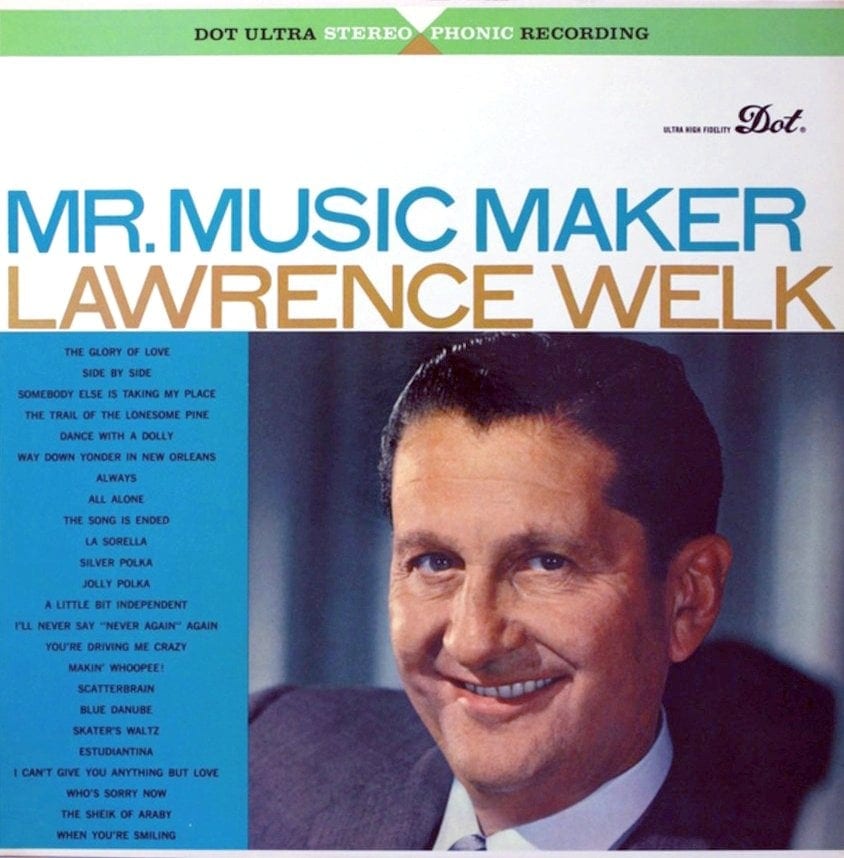
Welk himself has a more philosophical explanation: “I bend over backward to give people what they want. Nothing is wrong if the folks like it. Sure. I like better music than what I play, but if I played what I like, we’d still be eating hamburgers instead of steak.”
Welk has an exact description of his “champagne music.” “It is very light, produced not with big, open brass — the ‘big band sound’ — but by using cup mutes on the brass, lots of clarinets, flutes, piccolo. It stems out of my heart. I want a rhythmic band but not so loud you can’t stand it. After all, being that I have to stand up in front all the time, I want it to be pleasant for me.”


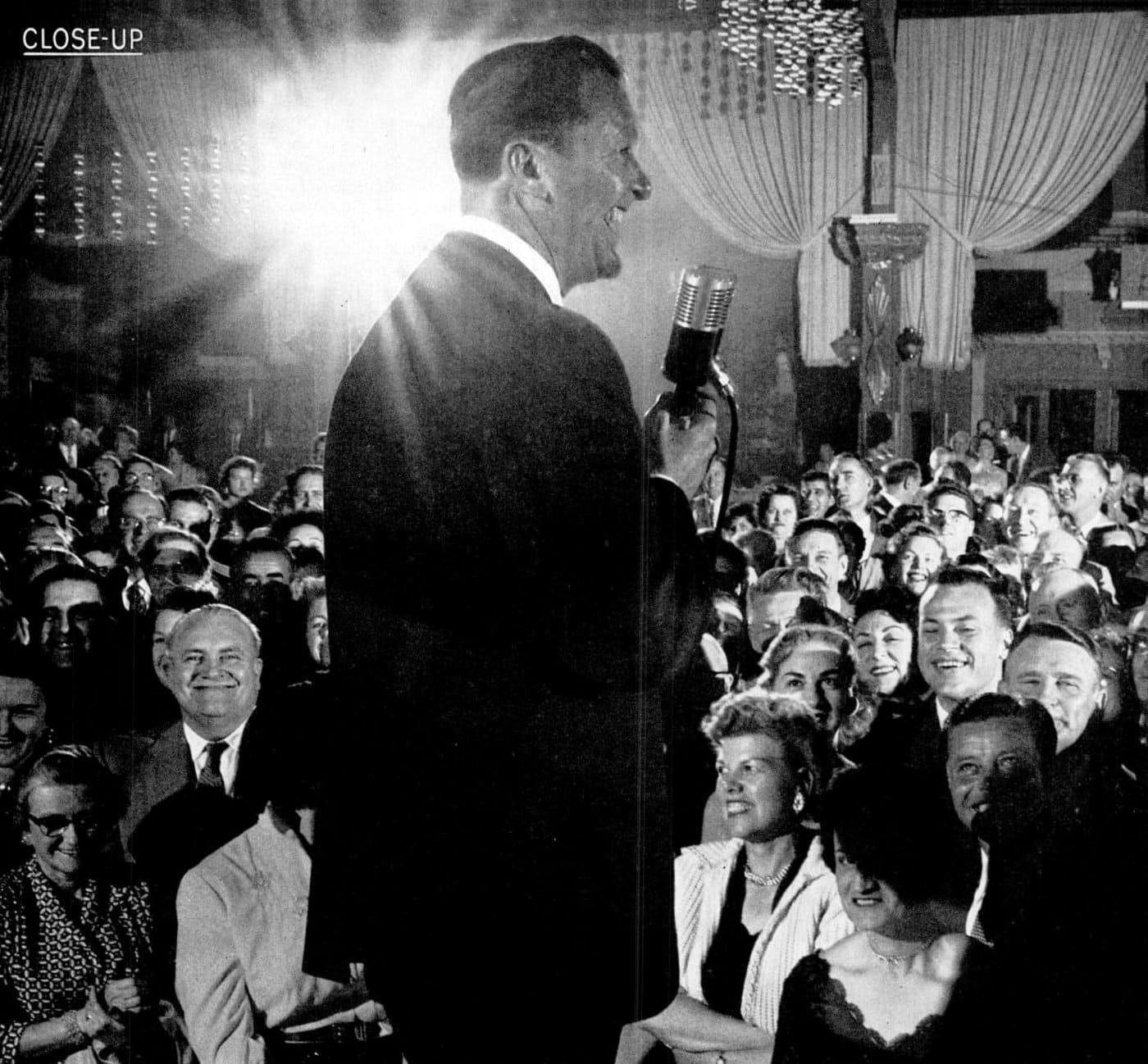
WELK smiles at fans who pack Aragon Ballroom near Santa Monica to hear him.
When I stand up here I’m having fun with the folks. I really am. I’m always so grateful to the people for coming to see me. When people get all dressed up like this and drive a long way and maybe get a baby-sitter, I want to be sure they have fun. Nest day they’ll say they had a ball with Welk at the Aragon.”
WELK sits behind an assortment of the $40,000 worth of things he gives away annually to fans at his public appearances.
“The cheapest item is the most popular — pictures of me. I don’t understand it. Cost 12 cents. I order 100,000 at a time. Gave away one million during the years I worked in Yankton, S. Dak. I’ve always tried to give people a souvenir. Main thing I’ve learned is not to start giving too early in the evening.”

SEEKING quiet during ballroom rehearsal, Welk joins popular Lennon Sisters and their father for a run-through in the ladies’ room.
“I’ve seen the inside of more washrooms than anyone in America, I think. All my life I’ve had one ambition — that someday I’ll do well enough that I don’t have to dress in the washroom. I finally made it here at the Aragon, but elsewhere somebody still has to stand outside and hand me my pants.”

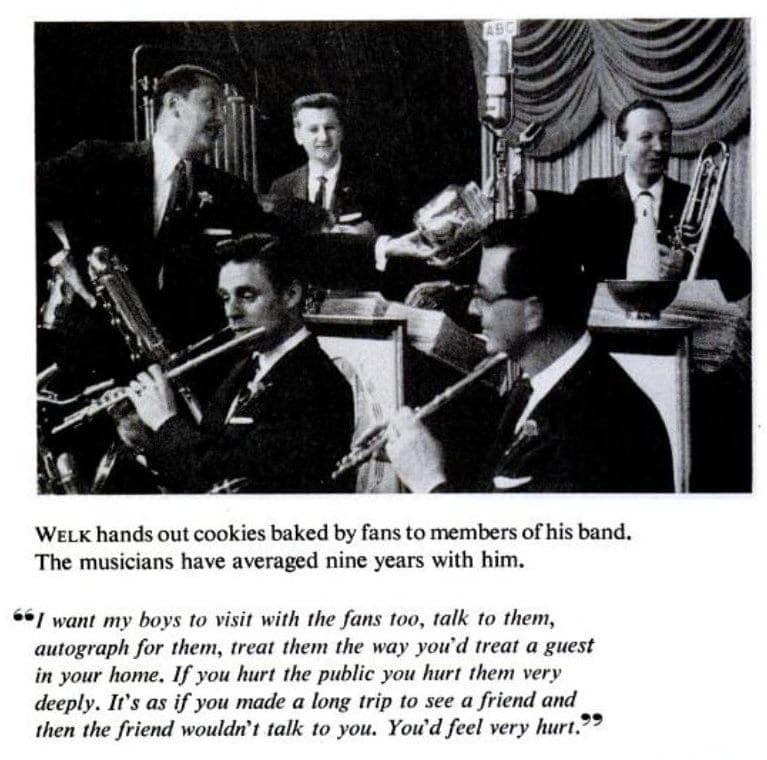
WELK hands out cookies baked by fans to members of his band. The musicians have averaged nine years with him.
“I want my boys to visit with the fans too, talk to them, autograph for them, treat them the way you’d treat a guest in your home. If you hurt the public you hurt them very deeply. It’s as if you made a long trip to see a friend and then the friend wouldn’t talk to you. You’d feel very hurt.”
WELK and accordion appear in one of his two weekly TV shows. His Saturday night ABC show is rated seventh in the U.S.
“People take potshots at me for being corny. I don’t know what corny music is. We play a little of what some folks call corn, but we play everything, from Dixieland to semiclassics. When you play to 45 million people in one week, you can’t afford to feed them only one thing.”

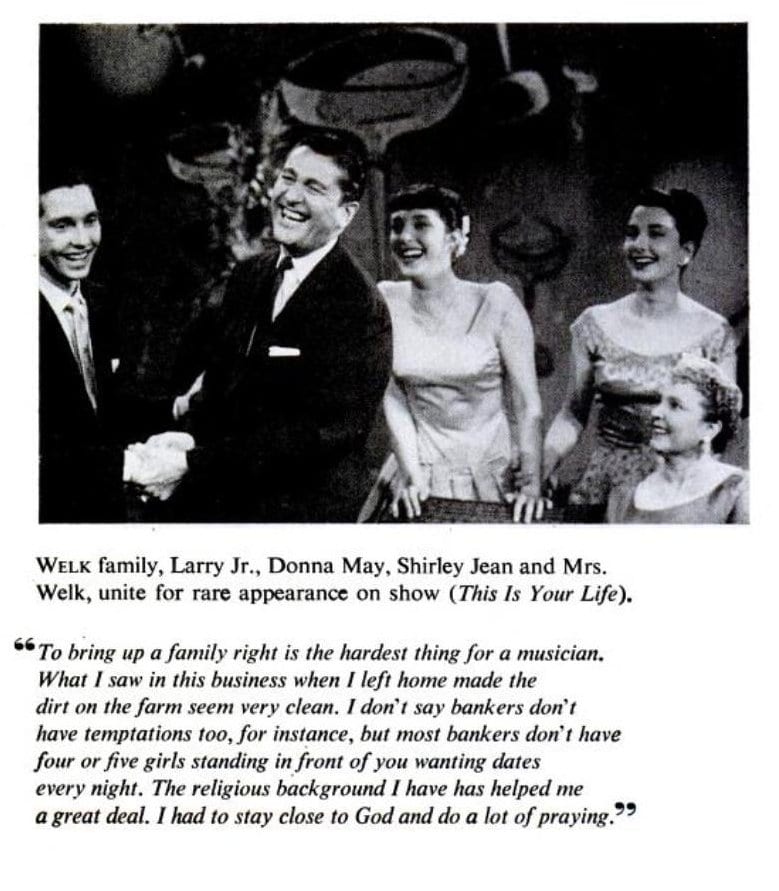
WELK family, Larry Jr., Donna May, Shirley Jean and Mrs. Welk, unite for rare appearance on show (This Is Your Life).
To bring up a family right is the hardest thing for a musician. What I saw in this business when I left home made the dirt on the farm seem very clean. I don’t say bankers don’t have temptations too, for instance, but most bankers don’t have four or five girls standing in front of you wanting dates every night. The religious background I have has helped me a great deal. I had to stay close to God and do a lot of praying.”
VIDEO | The Lawrence Welk Show full episode January, 21 1956

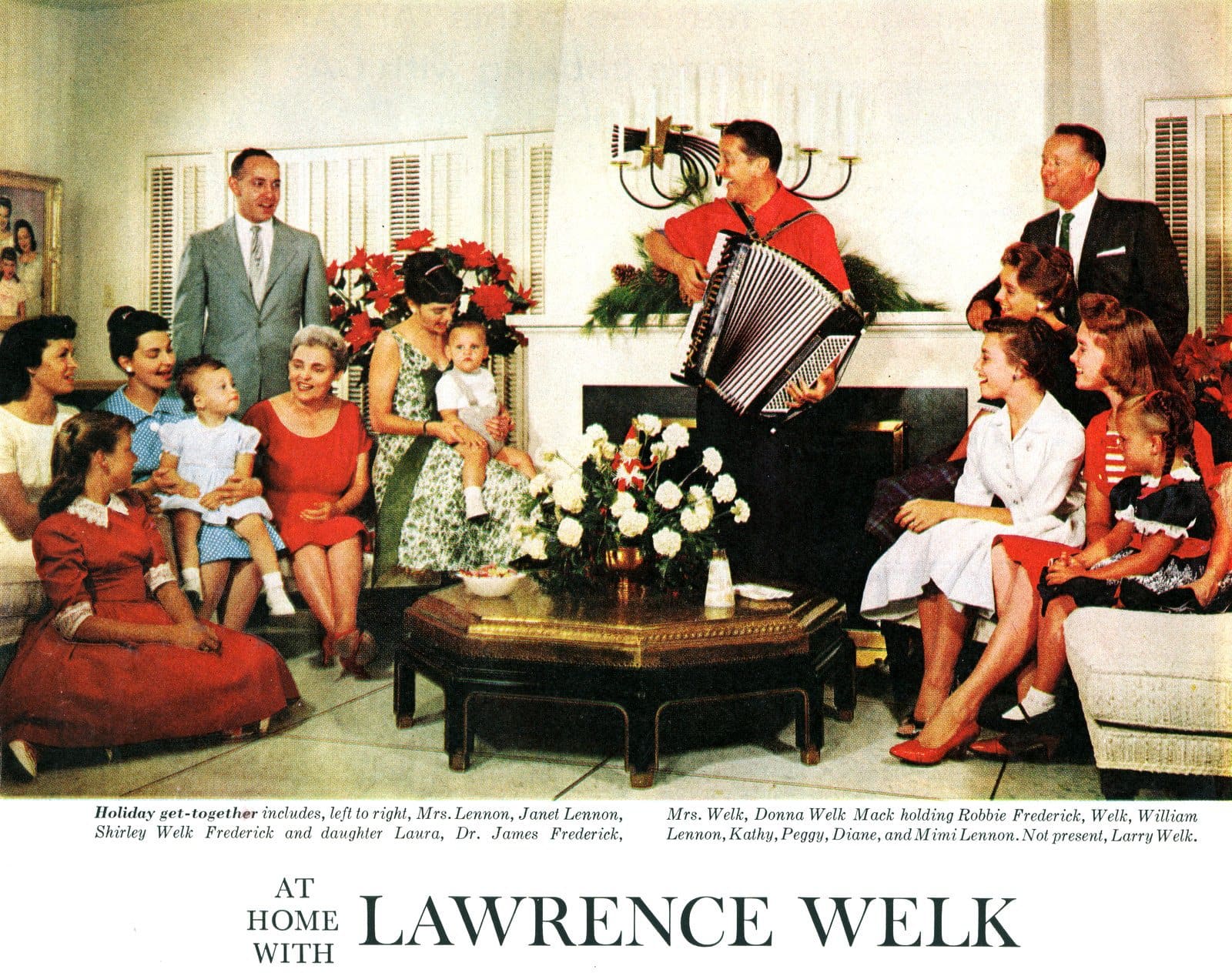
Christmas at home with Lawrence Welk (1960)
by Jim Liston – American Home magazine, December 1960
Lawrence Welk sat at the organ in his paneled study and let his fingers wander over the keys.
“It’s a nice way to relax,” he said. He drifted into “White Christmas.”
“‘White Christmas.’ That’s something you had plenty of in North Dakota. What are your Christmases like in California?”
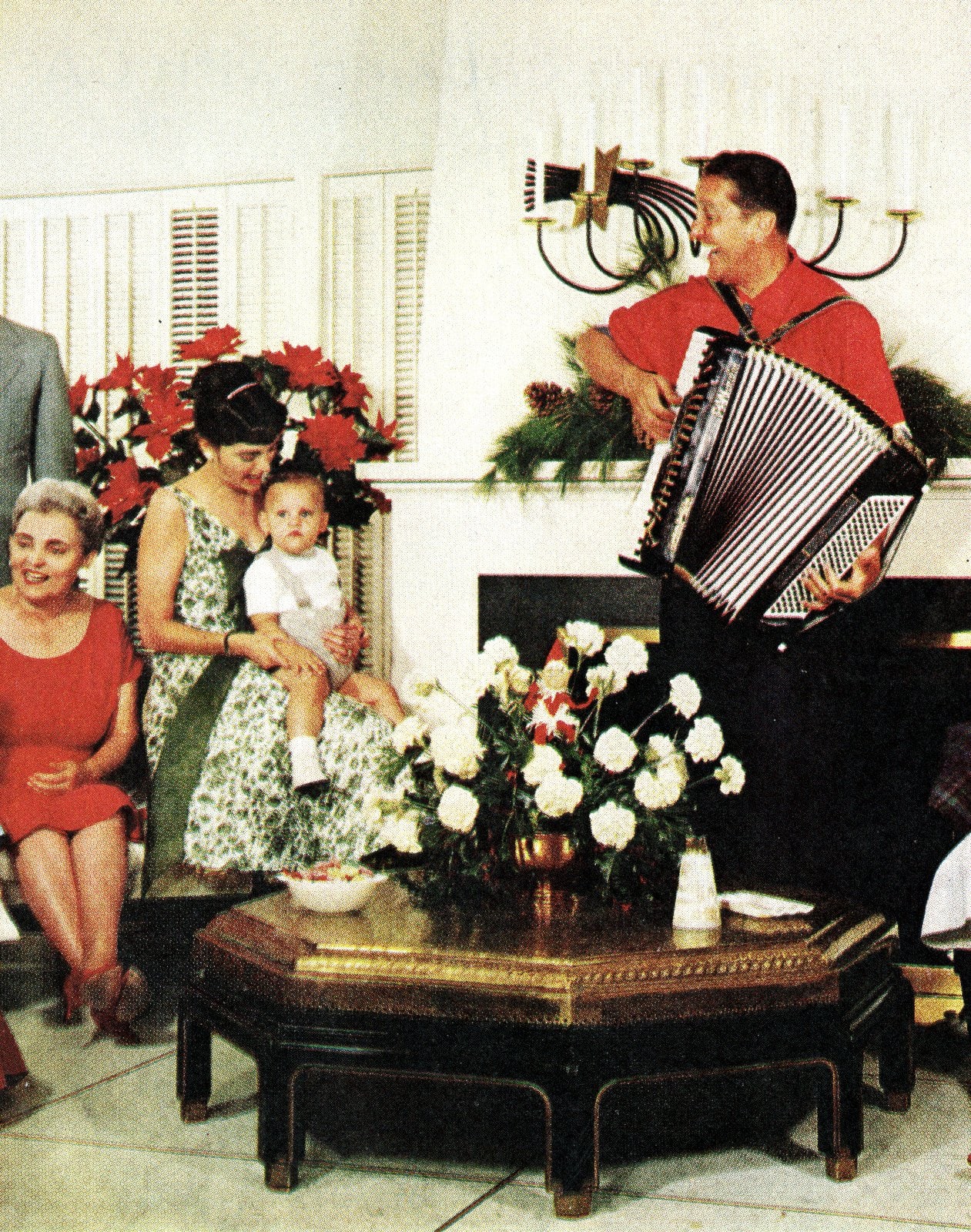 “A lot warmer!” he laughed, switching off the organ. “One of the nice things about my life here is that I have more time with my family.
“Nearly every Christmas in the old days, the band would have an engagement away from home and I couldn’t be with the family. Now we’re all together. We start the day by going to church and then we have Jerry Burke, our organist, over for dinner because he’s a bachelor and doesn’t have any relatives out here.
“And if there are any new band members who aren’t married and are away from home, we ask them to join us because Christmas is a family celebration. My daughter Shirley and her husband bring their children, and the Lennon family drops in. We really have a lively time of it, singing, dancing, and talking.”
“What was Christmas like in North Dakota?”
“Well, it can get pretty cold there — 30 and 40 below. We never had to worry about a white Christmas — snow drifted above the windows. We heated the house with coal and wood stoves, but we were snug and warm.
“The real celebration of Christmas was at church. We often had to shovel a path from the house to the barn to get the horses hitched. It was three miles to Strasburg, so we’d heat rocks on the stove and put them in the sleigh to keep our feet warm. It wasn’t easy getting through the drifts and sometimes it snowed so hard we could hardly see. But we went every Sunday — my folks never thought weather was an excuse for missing Mass.
“There were all kinds of cakes and cookies at Christmas. There were get-togethers with other families in the neighborhood. My father would play his accordion and everybody danced and sang. I guess that’s why I love music; I really like to see people having a good time.”

Lawrence Welk in Southern California – tourism from 1969

VIDEO | The Lawrence Welk Show closing credits