He graduated from L.C. Humes High School in 1953 and walked into Sun Studio that same summer, ostensibly to cut a personal record as a gift for his mother. Producer Sam Phillips heard something in the 18-year-old’s voice — a white kid who’d grown up absorbing Black gospel and blues from Memphis radio and local church services — and within a year, Elvis was recording for Sun Records.

The 1954 session that produced “That’s All Right” is as good a starting point as any for rock ‘n’ roll itself. Phillips had been famously searching for a white artist who could channel the feel of Black music for a mainstream audience, and Elvis, without quite meaning to, fit the description. By 1955, Colonel Tom Parker had taken over as his manager, and RCA Records had bought out his Sun contract for $35,000 — then a record sum for the industry.

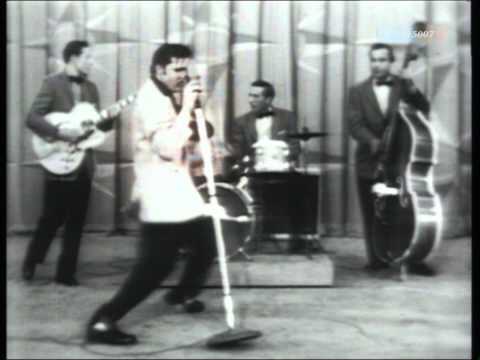
What followed in 1956 was a controlled explosion. “Heartbreak Hotel” hit number one in January. Television appearances on The Ed Sullivan Show drew some of the largest audiences in the medium’s history — Sullivan’s producers famously instructed cameramen to film Elvis only from the waist up during his third appearance, responding to public pressure over his stage movements. Six million records sold by mid-year. A Life magazine profile that August noted the hysteria at his concerts and the alarm among civic leaders, with one Florida judge threatening legal action if Elvis repeated his onstage gyrations. He was 21 years old.
The movies came next, and with them a significant pivot. Between 1956 and 1969, Elvis made 31 films — most of them light musical vehicles like Blue Hawaii and Viva Las Vegas — which kept him commercially visible but largely sidelined him from the creative evolution happening in popular music during the 1960s. While the Beatles and Bob Dylan were reshaping the industry, Elvis was working through studio-produced soundtracks.
VIDEO | Elvis performs “That’s All Right” during his ’68 Comeback Special

His 1968 NBC television special, known simply as the ’68 Comeback Special, marked a genuine return: stripped-down, live performance that reminded audiences what he could do when the formula fell away. The following year, he launched a Las Vegas residency at the International Hotel that ran until his death and became its own cultural institution — 636 sold-out shows over seven years.
 His personal life rarely stayed out of the headlines. Elvis met Priscilla Beaulieu in 1959 while stationed in West Germany during his Army service — she was 14, he was 24 — and after a years-long courtship conducted largely at Graceland, they married in Las Vegas in 1967. Their daughter, Lisa Marie Presley, was born in 1968. The marriage ended in divorce in 1973, though Priscilla remained closely tied to his life and later to the management of his estate after his death.
Elvis was known for a series of relationships throughout his adult life, and Graceland — where his parents and grandmother also lived — functioned as much as a family compound as a private home. He was, by most accounts, intensely devoted to his mother Gladys, whose death in 1958 hit him hard and visibly. That bond, and the working-class loyalty that came with it, stayed with him regardless of how large his fame grew.
By the mid-1970s, his health was deteriorating. Elvis Presley died on August 16, 1977, at his Graceland estate in Memphis at age 42. The cause was cardiac arrhythmia, complicated by years of prescription medication dependency. He was mourned on a scale the country had rarely seen for a private citizen.
His estate and legacy have only grown since — Graceland draws more than 600,000 visitors a year and ranks among the most-visited private homes in the United States, behind only the White House. Decades on, the Elvis Presley biography reads less like a single life story and more like a document of mid-century America itself: the class mobility, the racial complexity of early rock ‘n’ roll, the machinery of fame and the cost it can carry.
We’ve gathered vintage photos and an original 1956 Life magazine feature that catches Elvis at the very start of his commercial peak — before the Hollywood years, before Vegas, when the controversy was fresh and the phenomenon was still surprising everyone, including him.
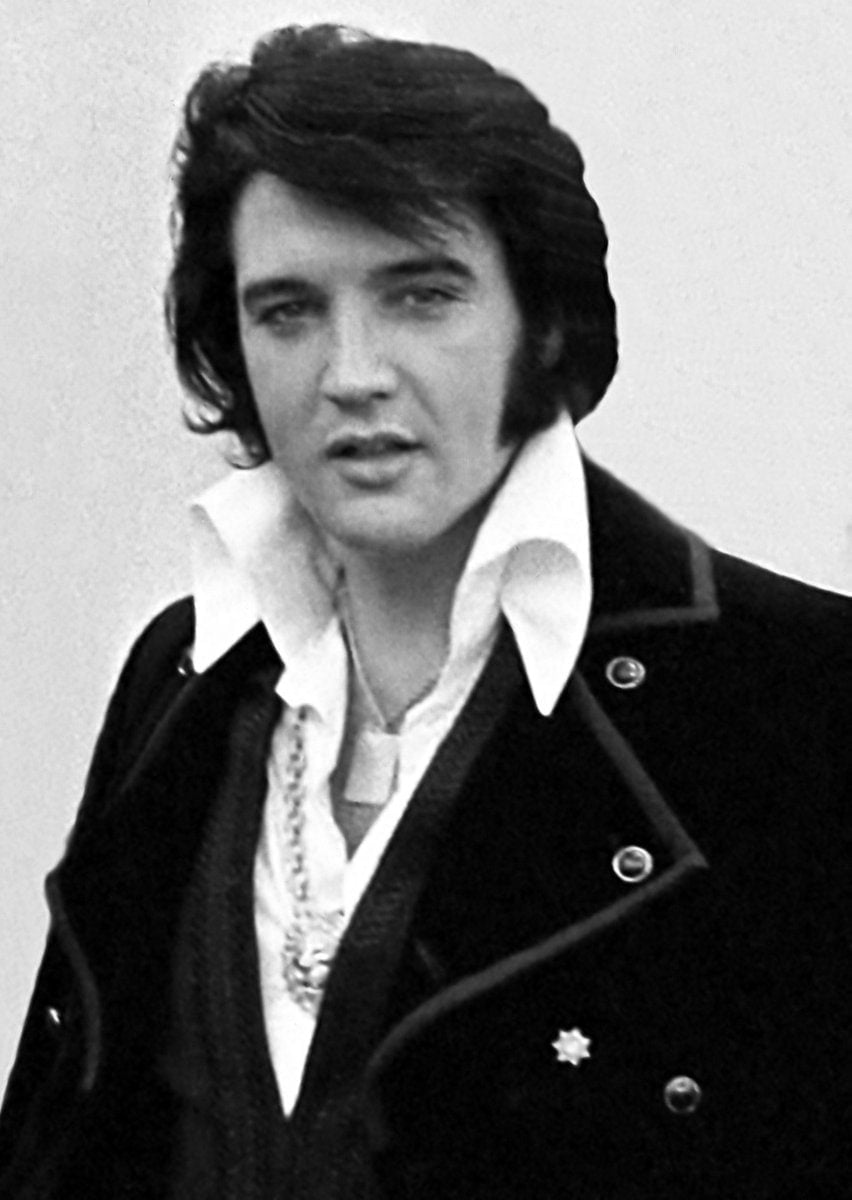
Elvis Presley’s impact piles up fans, fads — and fears
Up to a point, the country can withstand the impact of Elvis Presley as a familiar and acceptable phenomenon. Wherever the lean, 21-year-old Tennessean goes to howl out his combination of hillbilly and rock ‘n’ roll, he is beset by teenage girls yelling for him. They dote on his sideburns and pegged pants, cherish cups of water dipped from his swimming pool, covet strands of his hair, boycott disk jockeys who dislike his records (they have sold some six million copies).
All this the country has seen before — with Ray, Sinatra and all the way back to Rudy Vallee. But with Elvis Presley, the daffiness has been deeply disturbing to civic leaders, clergymen, some parents.
He does not just bounce to accent his heavy beat. He uses a bump and grind routine usually seen only in burlesque. His young audiences, unexposed to such goings-on, do not just shout their approval. They get set off by shock waves of hysteria, going into frenzies of screeching and wailing, winding up in tears.
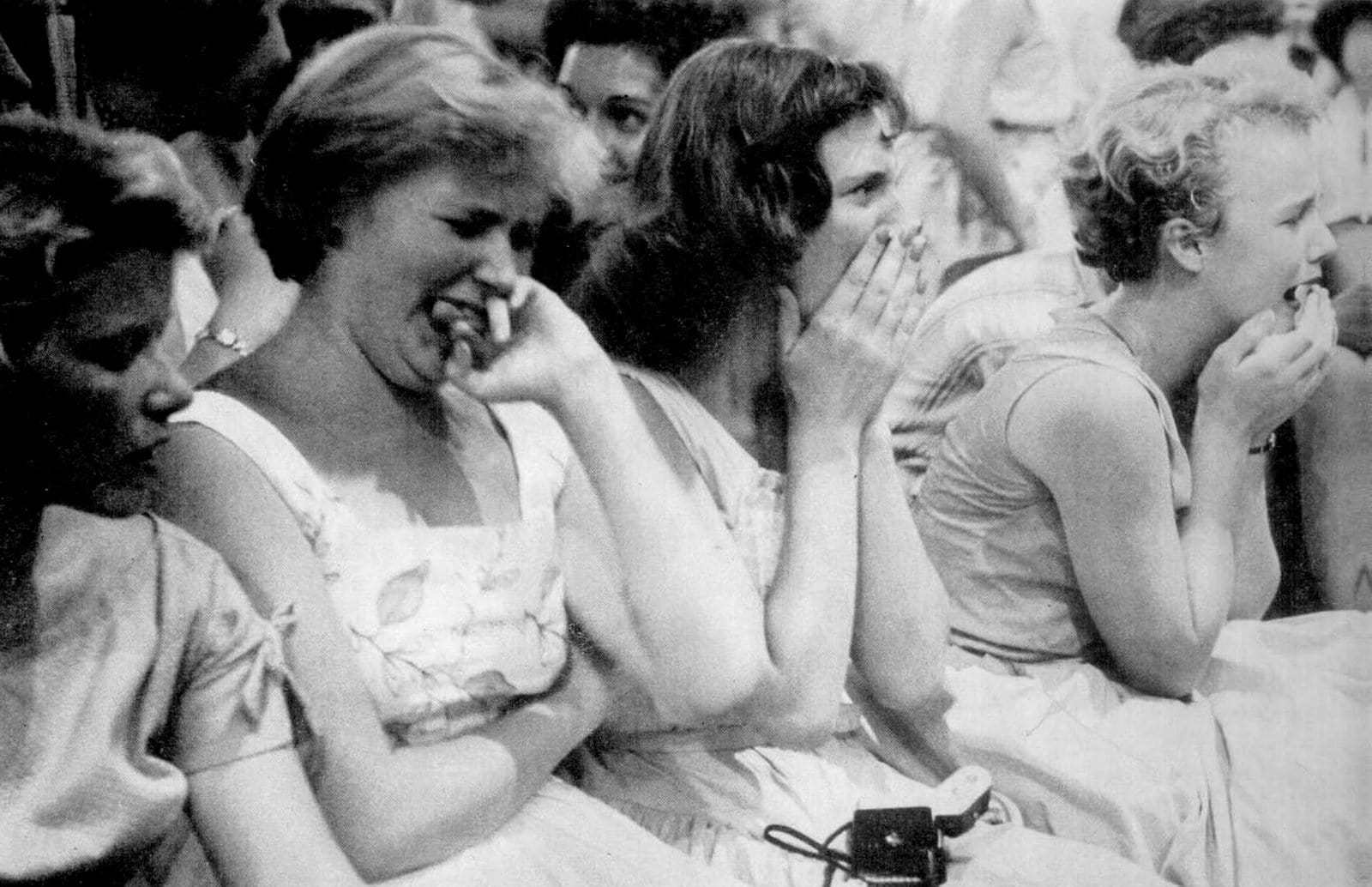
In Miami, one newspaper columnist called Presley’s performance “obscene.” In Jacksonville, he was threatened with jail. His impact had brought Presley a welcome taste of wealth and fame. But now it was also bringing him some unwelcome attention.
When Elvis Presley played in Jacksonville, Fla. last summer, his easily-aroused fans ripped nearly all his clothes off. Memories of this visit and of Presley’s growing notoriety stirred up civic leaders, and when the singer headed back to Jacksonville this month to play a two-night stand, the city was ready for him. Juvenile Court Judge Marion Cooding had warrants prepared, charging Presley with impairing the morals of minors. The judge declared he would sign and serve them if Presley repeated the torso-tossing spectacle of his earlier visits.
“I don’t do no dirty body movements,” protested Presley. But he toned down his act noticeably, and the judge took no further action.
Neither this nor clergymen’s denunciation of Presley dampened teenage enthusiasm. and his six performances all sold out. Elvis left town richer in pocket and with the prayers of devout citizens following him.

The breaking up
When he starts a show, Elvis takes a few swipes at his guitar, then lurches into one of his scorchers like, “I Want You, I Need You” (“Ah Wa-ha-hunt Yew-who, Ah Nee-hee-heed You-who”) or his first hit, “Heartbreak Hotel.” The girls out front go into their screams and seizures. From then on, most of them do not hear what Elvis sings as he flings about, bringing his susceptible audience to the breaking point.
“He isn’t afraid to express himself,” was one 15-year-old’s defense of his free style. “When he does that on TV, I get down on the floor and scream.”
>> Also see: Young Elvis: Elvis Presley as a child & teenager
The rewards of this fearless expression are almost unbelievable for the young man who gave up his truck driving job two years ago to become a full-time singer. Since the first of the year, he has fallen just short of grossing half a million dollars — $100,000 for over 125 public appearances, $350,000 in record royalties, $20,000 from TV, and $50,000 more due in the fall for three Ed Sullivan appearances.

Video of Elvis Presley performing “Hound Dog” in 1956