A D-Day diary from a 508th paratrooper captain — the broader story of June 6, 1944, with a grandfather’s firsthand account of his first hours in Normandy.

A D-Day diary from a 508th paratrooper captain — the broader story of June 6, 1944, with a grandfather’s firsthand account of his first hours in Normandy.

The flight of the Space Shuttle Columbia marked the first time a vehicle would be flown into space, returned — and refurbished and used again.

Lizzie Borden, a double murder, and a verdict that stunned the nation. See original 1892 news coverage and decades of follow-up on America’s most infamous case.

Phonograph history comes alive with Edison’s original ads & the story of how a talking machine changed everything about sound.

The Wright Brothers made history with a 12-second flight in 1903. See how their breakthrough launched the modern age of aviation.

President Kennedy’s assassination shocked the nation in 1963. See the original news reports, photos and reflections that followed.

Arizona’s push for statehood took decades — and came with wild stories, big ambitions, and a lot of bees. Here’s how it finally became the 48th state.
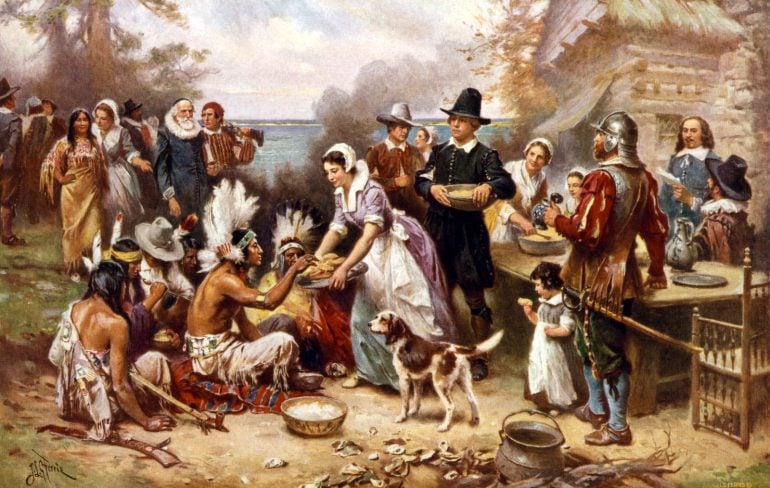
Thanksgiving, now held each year on the fourth Thursday in November, has long been a controversial holiday, Here, look back at Thanksgiving history as it played out over more than three centuries.

Explore how the sit-in movement began, spread, and reshaped the civil rights struggle—plus a look back with the students who started it in Greensboro.

Amelia Earhart’s daring 1937 world flight ended in mystery. Explore her life, her last journey and the historic search that followed.

The American flag has changed shape many times since 1777. See how it evolved, and what each version said about the country that flew it.

Learn how Mother’s Day began with Anna Jarvis’ heartfelt tribute to her mother — and how it grew into a national tradition celebrated across America.

In 1906, a short film called ‘A Trip Down Market Street’ ended up being a valuable record of old San Francisco just before the huge earthquake and fire destroyed much of the city.

Television history goes back farther than most people think. Here’s how early inventors built the first TV sets–and why it took a team to pull it off.

Dishwasher history starts with Josephine Cochrane, who invented the first automatic model in the 1880s. Her creation changed kitchens forever.

Labor Day is unlike many other patriotic holidays, as it glorifies no armed conflicts or battles of man’s prowess over man. Here’s a look back at the history of Labor Day.

When the newspapers first reported on the 1929 stock market crash, nobody knew what was coming. See these Great Depression newspaper headlines for how it began.

Many well-known serial killers don’t quite compare to the exploits of Herman Webster Mudgett, alias Dr H H Holmes, perhaps one of the most fiendish mass murderers in American history. See diagrams of his infamous murder house, and images of his victims.

Gain insights into the struggles and aspirations of the signers of the Declaration of Independence.

Drafted in secret during the summer of 1787, the Constitution of the United States established the government of the United States. Here, the original US Constitution text.

Join us as we explore the fascinating history of George Washington’s life – a true testament to the power of determination, leadership, and an unwavering belief in the potential of a young nation.

From suffragettes to scientists, activists, artists & leaders who paved the way for future generations, these women in history have played a key role in shaping our world.

Look back at the biggest news in the universe on July 20, 1969 – the day we first landed on the lunar surface, walked on the moon, then went for a drive.

Did a lie and nine blank cartridges win independence for America? The war ended at Yorktown. It was there, on October 19, 1781, that Cornwallis surrendered to Washington. Find out more of the story here!

Look back at these D-Day pictures and remember that a German nation with super-race delusions once actually planned to conquer the world.

Charlotte Collyer lived through the tragic disaster the world remembers more than 100 years later. Here, read about what happened in this dramatic and compelling first-person account from a Titanic survivor.

Here’s a look back at Abraham Lincoln’s funeral and the entire funeral procession, where millions of people came out to see the President’s hearse pass by on the way from Washington DC to Chicago.

Below are several chapters from a book that was issued the same year as the Titanic disaster, and was called simply Titanic. While many aspects

Although penicillin was discovered in 1928 by Alexander Fleming, real research and production started in earnest in mid-1941, thanks to World War II.

When the infamous zeppelin airship Hindenburg caught fire and crashed as it was landing in New Jersey back in 1937, the spectacular disaster was caught on film and audio. Here’s how it went down.

To this day, the Triangle Shirtwaist Factory fire in New York on March 25, 1911, remains the deadliest industrial disaster in the city’s history,

On July 16, 1969, Apollo 11 took off for the moon – a historic mission for Americans, and for people all around the globe. See vintage newspaper headlines from that day here!

In June 1919, a peace treaty with Germany was signed in France, and formally brought an end to the Great War, which we now call World War I.

From the middle of the destruction after the 1906 San Francisco earthquake, these detailed accounts of the damage were published in the city’s newspaper the very next morning.

The important events described here were the beginning of the end of the Civil War, though the official declaration was signed on May 10, 1865.

Ad Astra… to the stars! John Glenn was the first American to orbit the earth, and he did it on the Mercury spacecraft named Friendship 7, on February 20, 1962. Here’s how it went.

This is a detailed account of what would come to be known as The Battle of the Wilderness, which was the first battle of Grant’s

By looking back at these old Civil War recruitment posters & broadsides, you can see what was being offered to men as an incentive to sign up to fight in the Civil War — and what exactly the leaders were looking for in troops back in the 1860s.

The Civil War wasn’t going well for the Union in the early weeks of December 1861 – and it was going still worse for William Tecumseh Sherman. Find out why here.

The Civil War’s bloodiest day: Lee turned back at Antietam (1962) A look back on the centennial, by Merton T. Akers — The Lawrence Gazette

Many of today’s Halloween costumes and the tales of pirate treasure we all know can be traced back to the life and times of the very real person, Captain Kidd. But where is his treasure?

There have been tales of what happened at Wounded Knee Creek in South Dakota in 1890. Here, see original vintage news reports of the battle, plus a historical review of the events from 1976.;

See what it looked like during President Lincoln’s historic Gettysburg Address speech, plus eyewitness accounts, analysis, full text & and a handwritten copy of the speech.

Abraham Lincoln: Republican candidate for President of the United States – 1860 Description from the US Library of Congress: “A print for a large campaign

Back in 1871, The Great Chicago Fire killed an estimated 200 to 300 people, destroyed more than three square miles of the city, and left 100,000 people homeless.

While books and articles on America’s slave trade can offer important historical insight, seeing ads for slave auctions casually placed in newspapers of the era really brings the brutality home.

Take a look back at how America – and the world – celebrated Victory in Europe Day, meaning World War II was nearly over.

Take a look at the original WANTED poster that was distributed far and wide to help catch President Lincoln’s killer – John Wilkes Booth, and two of his accomplices.

Here’s the true story of Abraham Lincoln’s assassination, as reported at the time of his murder at the hand of actor John Wilkes Booth.

The great loss of the Titanic: It is now practically certain that 1,492 human beings went to their death in the sinking of the giant ship on the ice banks of Newfoundland.

In the early morning hours of July 23, 1967, police in Detroit raided an unlicensed, after-hours bar in what they assumed was just another routine

President Abraham Lincoln issued the Emancipation Proclamation on January 1, 1863, as the nation approached its third year of bloody civil war.

Richard Nixon’s final presidential crisis truly began with the ruling that he could no longer withhold 64 disputed White House tapes from the Watergate prosecutors. Here is the story of the last days before Nixon’s resignation.

Find out what set in motion the deadly chain of events that led to General Custer’s troops being overwhelmed by Sitting Bull’s force of 8,000 Lakota & Cheyenne during The Battle of Little Bighorn.

I am at loss for the proper word to use to describe what television has done with Haley’s book Roots. “Enhance” will not do, nor is “heightened” sufficient. There is no word that is adequate.

Producing by far a larger amount of copper than any other country, the United States is extremely fortunate in being able to supply to a great extent the ever-increasing demand for this useful metal.

On the inside of the pedestal of the world-famous New York landmark is the Statue of Liberty poem, written by Emma Lazarus to welcome immigrants and visitors to America.

How did the great Gold Rush of 1849 get started? Find out its history, how it made people rich and poor – and helped make California what it is today.

The Boston Tea Party resulted from at least four important historical factors, and was, in fact, the catalyst for the Revolutionary war for independence.

Find out more about World War II’s important military offensive, the Battle of the Bulge, and see several pictures from the snowy scene.

The Titanic was one of the most luxurious, well-appointed cruise liners ever, with seemingly no expense spared… except when it came to passenger safety in the event of an emergency. Artists had a lot to say about safety and Titanic lifeboats.

In 1917, President Woodrow Wilson went before a joint session of Congress, and the United States formally declared war – The Great War, which became known as World War 1 – on April 6, 1917.

How did America get its name? The man from whom the continents got their names was an especially fascinating character of the late 15th century.

Electricity will cure all the ills of the world, predicts Thomas Edison, whose inventive genius is responsible for the widespread application of electricity.

At the start of the Watts Riots, rumors of police brutality during an arrest quickly spread, and a crowd began to form. It was the flashpoint for rioting and rebellion that had been simmering under the surface of Los Angeles that summer.

WAR DECLARED: See 31 consecutive front page headlines from DC from those tumultuous weeks leading to the outbreak of hostilities in WWI back in 1914.

The Allies today sent their invading forces against Adolf Hitler’s occupied Europe. The long-awaited invasion was announced by General Dwight Eisenhower with the promise that the high command would accept nothing short of victory.

Here are images showing New York City’s growth from a frontier settlement known as New Amsterdam to the metropolis of the western world –through the Colonial times, and in the early days of US independence.

Did you ever think that every first or last name must originally have meant something? It originally meant something, and was intended to be applicable to the person who first bore it.

Free electricity for everyone? Here’s a look at some predictions from Nikola Tesla from a century ago – some we have seen, others… well, not yet.

Richard Nixon’s first Watergate speech was broadcast live from the White House’s Oval Office on April 30, 1973, starting at 9:01 pm Eastern. Below, see a video of his statements, followed by a transcript of the speech.

Original Editor’s note from 1968: This article by the noted author James Baldwin… is an attempt to explain to whites the militant Negro’s reaction to ‘black power,’ as well as the Negro revolution now in progress. It is bitter, but not devoid of hope.

Amid the most dramatic scenes ever witnessed in Congress, the house early today passed the resolution which formally declared Germany as an enemy and launched the United States in the fight for the democracy of the world.

How Susan B Anthony and Elizabeth Cady Stanton recorded history (1893) The Herald (Los Angeles, California) December 17, 1893 “If you want to know how