The stickpin’s rise tracks closely with Victorian-era fashion culture, where personal accessories served as visible markers of taste and status. Worn at the throat or chest, a fine stickpin drew the eye to the wearer’s face and, by extension, to their refinement. Men’s fashion of the mid-to-late 19th century leaned heavily on neckwear — cravats, ascots and stock ties all needed securing — and the stickpin was the obvious solution that also happened to be decorative.
Women wore them too, tucked into high-necked blouses or used to pin shawls and scarves in place. By the Edwardian era, the styles had grown more elaborate, with Art Nouveau flourishes like the butterfly-and-flower designs associated with makers like René Lalique becoming especially fashionable.

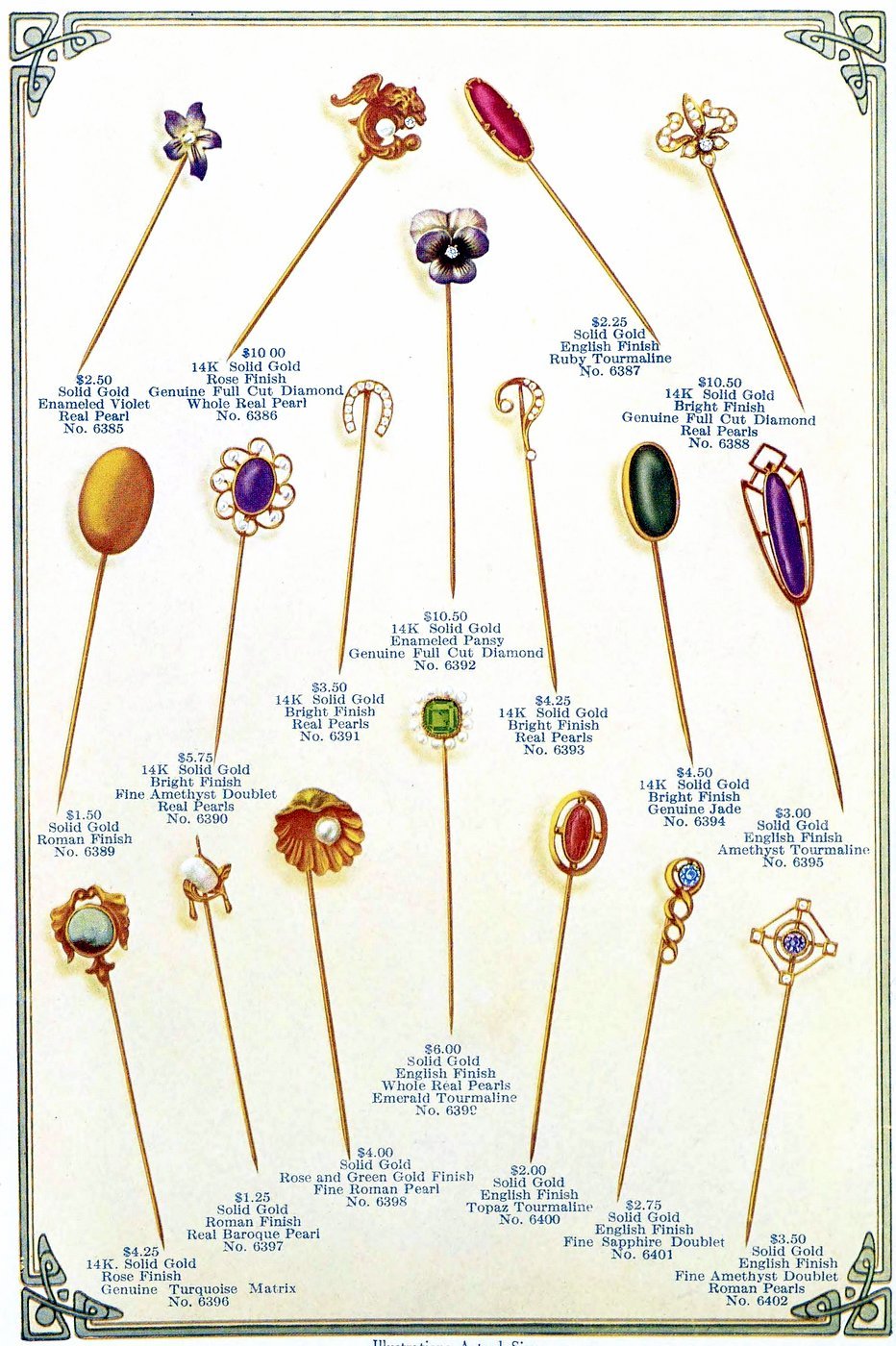
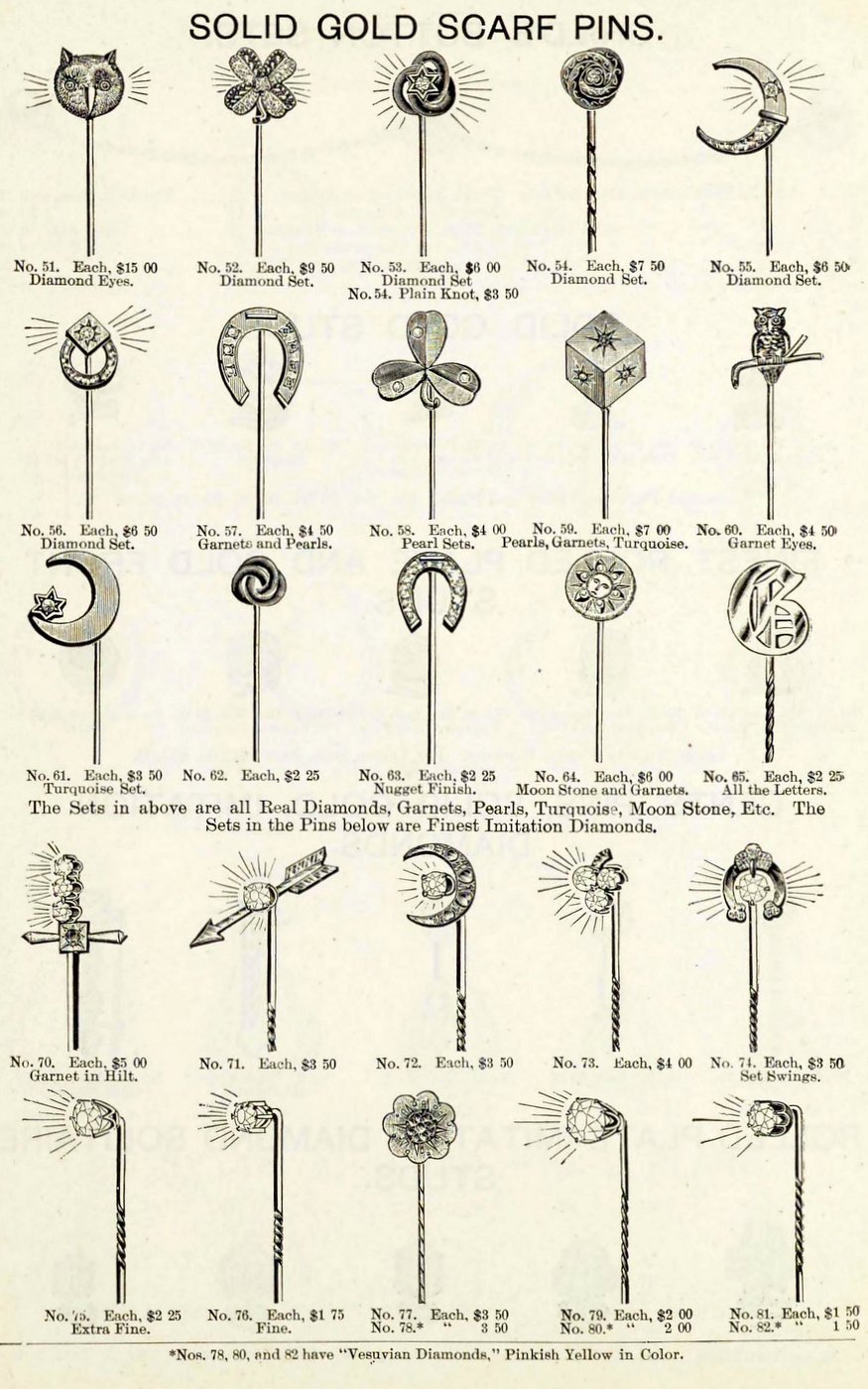
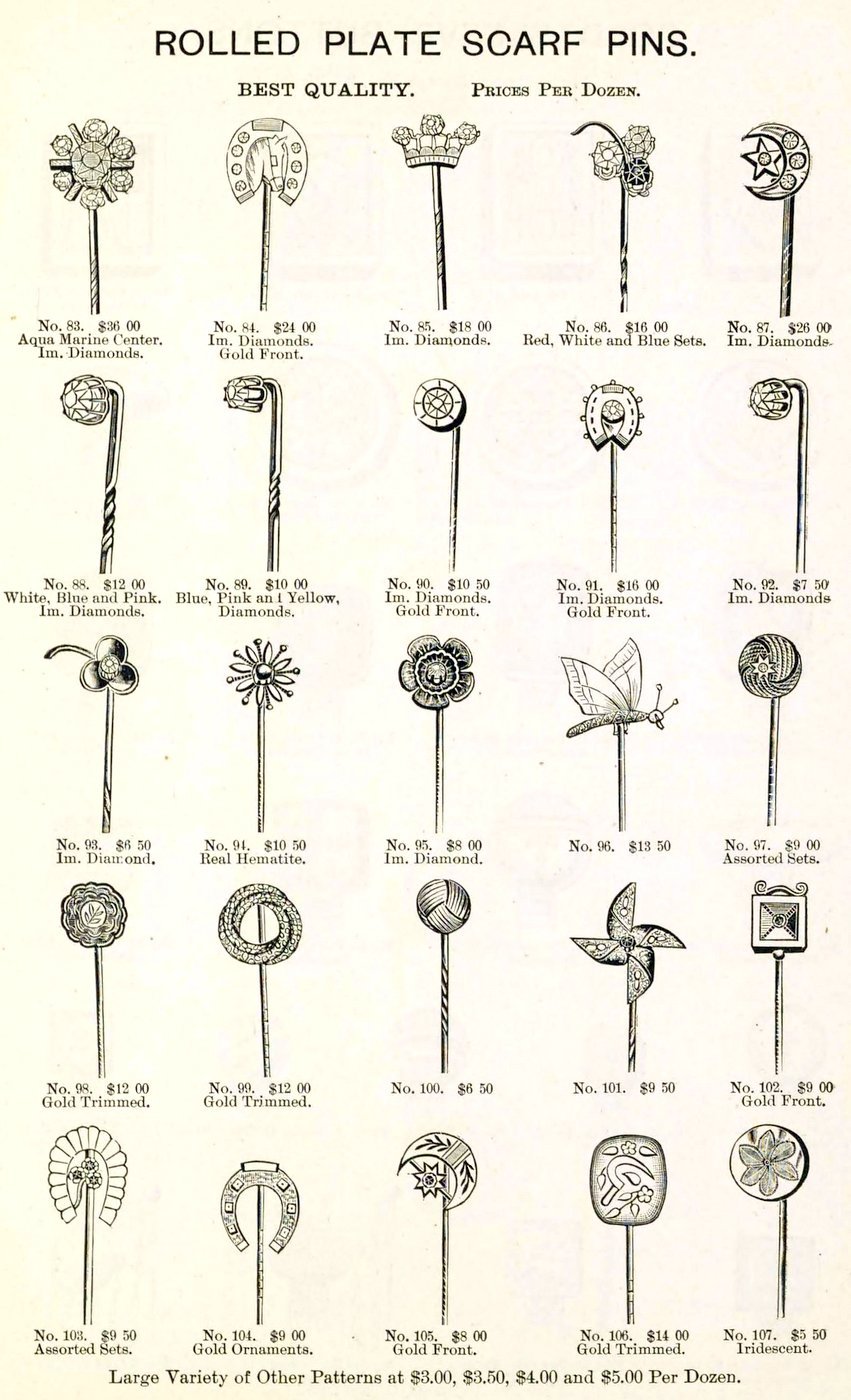
The materials ranged from modest to magnificent. Catalog pages from 1887 show rolled-plate “scarf pins” in simple geometric forms — affordable options for everyday wear. But serious collectors know the upper end of the market tells a richer story: star rubies, moss agate, seed pearls, coral cameos, amethysts ringed by sapphires, diamonds paired with garnets.
Ivory was prized too, sometimes carved with extraordinary skill. One collector, a retired engineer interviewed in 1977 by the El Paso Herald Post, described a piece in his collection — a tiny rotating ivory cube hollowed out to reveal “a native man standing before a thatched hut with a tree in the background,” all in nearly microscopic scale. A friend who had spent years in Burma told him the carving could represent the work of a man’s lifetime.
That same collector, who had spent 15 years building a group of 42 choice pieces, was careful to note that stickpins should be preserved in their original form. “Beautiful jewelry should be preserved as it is,” he said, pushing back on the practice of repurposing them into rings or charm bracelets.
Serious collectors stored them in stickpin holders — small, solid-bottomed vessels that resembled salt shakers — or in purpose-made velvet-lined cases. The holders themselves became collectibles, with hand-painted porcelain examples especially sought after.
Stickpins fell out of everyday use as fashion shifted in the 1920s and ’30s, when looser neckwear and changing silhouettes made them less practical. But they never disappeared from collections, antique shops or the occasional estate sale.
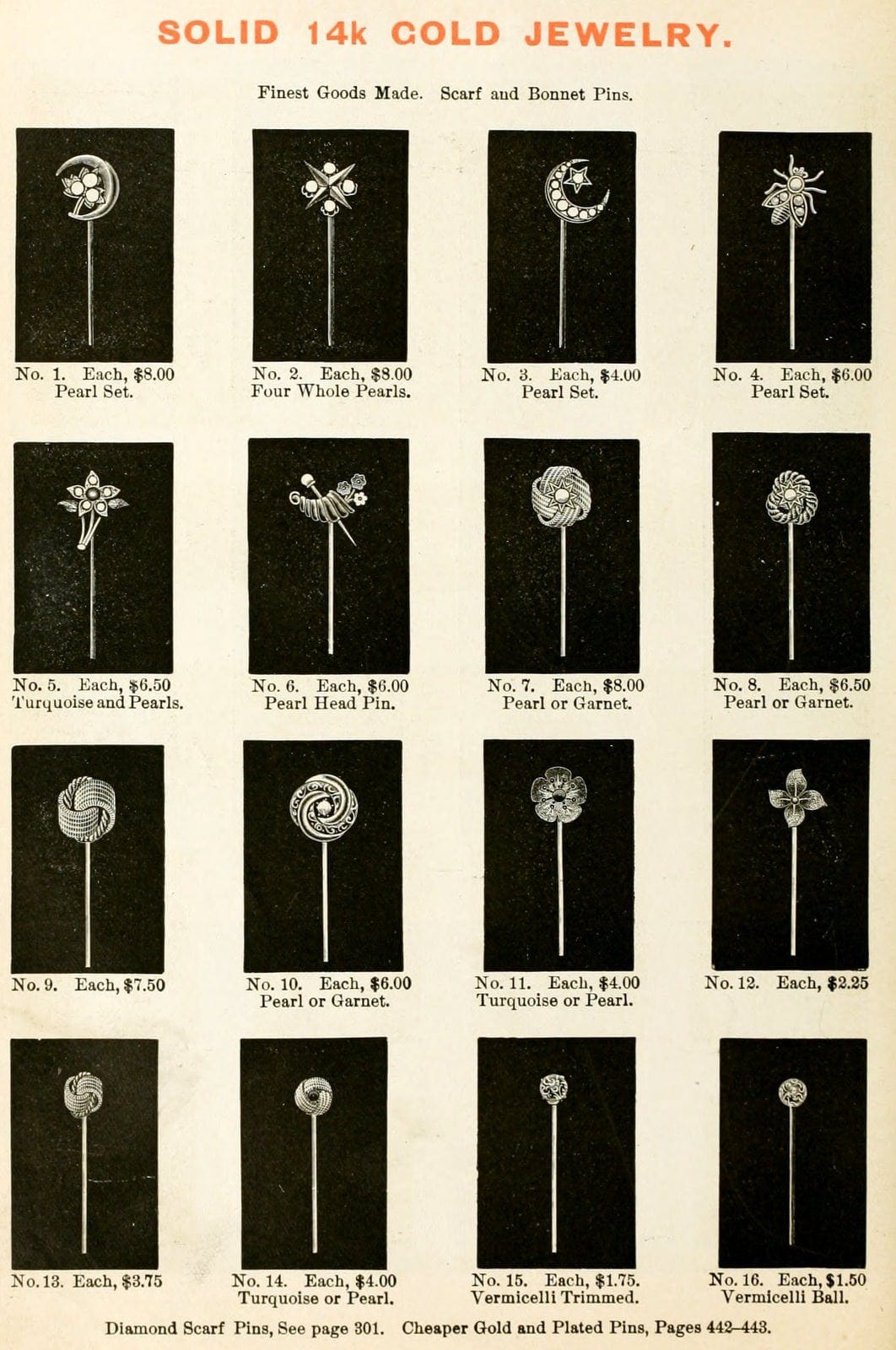
Below, we’ve gathered a selection of more than 100 antique stickpins and scarf pins here — from Victorian catalog pages dating to 1887 and 1889, to Edwardian-era gemstone pins from the Smithsonian’s Cooper Hewitt collection, to that arresting Lalique-style butterfly piece. Take a look at what people once considered the perfect finishing touch.
Collector stuck on antique stickpins (1977)
by Jean Barnes – El Paso Herald Post (El Paso, Texas) July 21, 1977
The really good old stickpins are few and far between, according to collector Karl B., a native Kansan and retired engineer.
Karl’s collection is small as numbers go, but each stickpin is a choice piece. These days, he considers himself fortunate to find more than one or two in a year’s time.
“I wasn’t that careful when I first started,” he said. “My first one was a gold nugget that my wife had a jeweler mount for me.”
That was 15 years ago, and after receiving it, he started looking for others.
“I bought almost every one I found,” he explained. “Now I’ve weeded out the collection, and used those I didn’t want to keep as trading material. Now I have 42, but every one is special.”
He took one stickpin from a soft suede case and showed it to me. It was a small cube of ivory with a carved design on the front of it. The cube was set between pins so that it could rotate from side to side.
In one side of the cube, you could see that it had been hollowed out, leaving a scene of a native man standing before a thatched hut with a tree in the background.
It was all done in nearly microscopic proportions. Seen through a magnifying glass, the carving is amazingly detailed. Karl said that several years ago, he showed it to a mining engineer friend who had spent many years in Burma and was knowledgeable about Oriental art.
“He told me that this little piece of ivory could easily represent the work of a man’s lifetime. Imagine spending years doing just that one little piece of magnificent, delicate work,” he said. Karl purchased the pin from a local dealer who had no information about it.
Other stickpins in his collection represent a wide variety of precious and semi-precious stones. One is a slender gold bar set with tiny seed pearls. Another is a cameo carved from coral. There is an amethyst surrounded by sapphires, diamonds set with garnets, a pearl framed with a square of onyx, a long narrow oval of moss agate, a star ruby, and stickpins of jade turquoise and amber.
Karl keeps most of his collection in stickpin holders. These look like small salt shakers except that the bottom of the holder is solid. He explained that holders are rare and that when you do find one, the price is likely to be high. He has two in hand-painted porcelain and one in silver.
His most simple stickpin is engraved with the initial B and is kept in a small velvet box shaped like a fiddle case. “I found that box in a junk shop and got it for a quarter,” Karl explained.
Karl likes to wear his stickpins, but since his retirement, he doesn’t have as many opportunities as he did when he went to his office every day.
“I guess I’m a purist. I’ve seen collectors use them for finger rings and charm bracelets, and it upsets me. Beautiful jewelry should be preserved as it is.”
MORE: Peek inside some vintage jewelry boxes, including some with spinning ballerinas & wind-up music
Antique Victorian rolled plate scarf pins (1887)
MORE: Big rings: The super-sized vintage costume jewelry trend from the ’50s & ’60s
Lalique style butterfly stick pin antique jewelry
A close-up photo of a vintage stickpin finial with a pretty butterfly and flower design

Antique stickpin jewelry from 1889: Scarf & bonnet pins
SEE MORE! Antique jewelry: Rings, necklaces, bracelets & more