

Summer of Love & the Haight-Ashbury district: The intersection of peace, music & revolution

What happened there in the summer of 1967 was short-lived, complicated and impossible to fully separate from the mythology that grew up around it almost immediately. But it was also real, and the neighborhood’s story starts well before the flowers arrived.
The Haight-Ashbury district is named for the intersection of two streets — Haight, after an early San Francisco banker, and Ashbury, after a city supervisor from the 1860s. Before the Haight Street cable car line was completed in 1883, the area was mostly sand dunes and isolated farms. The cable line made it a practical place to live, and by the early 20th century it was a solidly middle-class neighborhood of Queen Anne homes clustered along the western edge of Golden Gate Park.

The Depression hit it hard, World War II carved its large houses into apartments and boarding rooms, and by the 1950s the middle class had largely moved on. What was left were cheap rents and a lot of space. That combination, more than any ideological gravity, is what drew artists, writers and bohemians into the neighborhood in the early 1960s. They shared the Beat Generation’s suspicion of corporate conformity but preferred the sunlit parks to the coffeehouses of North Beach. Their neighbors called them, with some derision, junior hipsters — hippies, for short.
VIDEO | Human Be-In full program (1967)
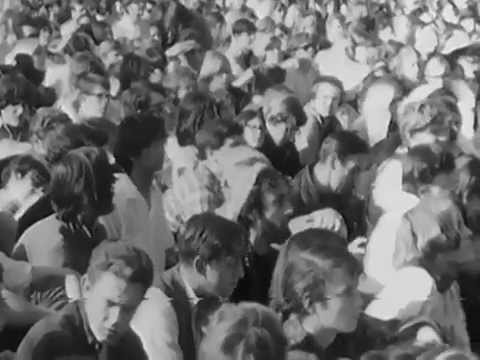
The neighborhood’s countercultural scene was already established when, on January 14, 1967, roughly 30,000 people gathered in Golden Gate Park for the Human Be-In — an event organized by artist Michael Bowen and promoted in the Haight’s own underground paper, the San Francisco Oracle. Timothy Leary addressed the crowd and delivered his phrase “turn on, tune in, drop out” for the first time in public. The Grateful Dead, Jefferson Airplane and Big Brother and the Holding Company played.

The national press showed up, and what had been a local scene was suddenly a national story. Sensing the wave that was coming, some Haight residents formed a loose organization called the Council for the Summer of Love, hoping to manage the influx. Their concern was well-founded. By spring, teenagers were already streaming in on spring break. By summer, somewhere between 75,000 and 100,000 people had flooded into those 25 blocks.

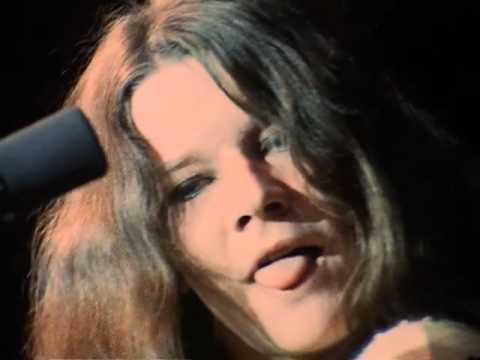
The summer produced real things. The Haight Ashbury Free Clinic opened on June 7, 1967, providing medical care to a population the city had no interest in helping. The Diggers — a group loosely named after a 17th-century English utopian movement — ran a Free Store and fed hundreds of people daily. The Monterey Pop Festival in June introduced Janis Joplin, Jimi Hendrix and Otis Redding to a national audience.
VIDEO | Janis Joplin / Big Brother & the Holding Company
John Phillips of the Mamas & the Papas wrote “San Francisco (Be Sure to Wear Flowers in Your Hair)” specifically to draw people to the city, and it reached number four on the Billboard Hot 100 that July. It worked better than anyone anticipated. By August, when George Harrison walked through the neighborhood strumming a guitar, he described the scene afterward in terms that were considerably less romantic than the press coverage — the neighborhood was overcrowded, overwhelmed and visibly deteriorating.

The collapse was fast. The Haight simply could not absorb what the media had summoned. Overcrowding, homelessness and crime replaced the earlier sense of communal possibility. On October 6, 1967 — just months after the summer began — a group of longtime Haight residents staged a mock funeral called “The Death of the Hippie,” marching a coffin through the neighborhood filled with beads and other symbols of the movement.

The funeral notice they circulated read, in part: “Hippie, devoted son of Mass Media.” It was a direct indictment of the press coverage that had turned a neighborhood scene into a spectacle. Many of the people who had given the Haight its character left — some for rural communes in New Mexico, the Sierra Nevada and coastal California, others back to wherever they’d come from. By 1968, the neighborhood was struggling badly. The Free Clinic stayed open and remains open to this day, but the utopian experiment was over.

- Used Book in Good Condition

What the Summer of Love left behind was more durable than the summer itself. The music it amplified — psychedelic rock, folk-rock, the San Francisco Sound — shaped the next decade of American popular music. The antiwar energy concentrated in the Haight fed into the broader protest movements of 1968 and beyond. Communal living, alternative medicine and a general skepticism toward institutions all have traceable lines back to that moment.
VIDEO | “Summer Of Love: The Psychedelic Revolution Of 1967”
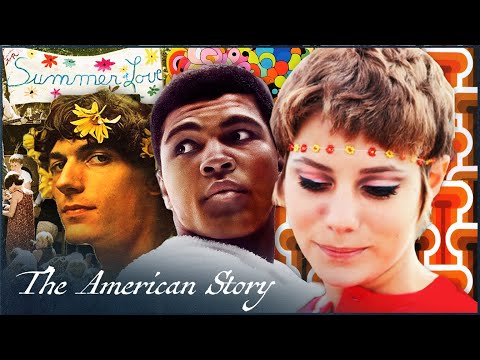
The neighborhood eventually stabilized, gentrified and became a tourist destination; the clock at Haight and Ashbury streets is permanently frozen at 4:20, a wry wink at the era. The photos and vintage news coverage collected here catch the Haight at its most charged moment — the free concerts in Golden Gate Park, the street scenes, the faces of people who believed, at least for a season, that something genuinely new was possible.
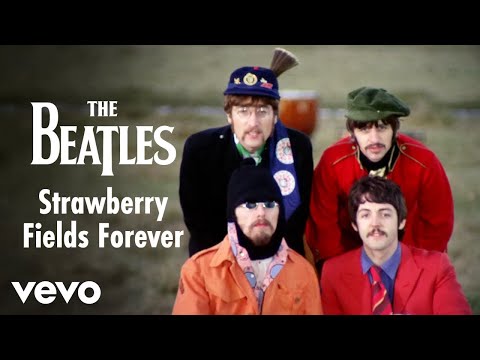
VIDEO | “San Francisco” by Scott McKenzie

ALSO SEE: 10 of the best psychedelic rock songs that defined the 1960s
Article from 1967: A rollicking rock concert in Golden Gate Park
From The San Francisco Examiner (California) June 23, 1967
A soap bubble soared up out of the packed music concourse and floated into the Golden Gate Park Band Shell.
Pushed on by the good vibrations of the Steve Miller Blues Band, it drifted around the shell from one side to the other, then disappeared in the gleaming blue sky.
It was one of many that bobbed over the crowd of 6,000, most of them teenagers, who attended the first free summer Rock Concert sponsored by The Examiner yesterday.
Most of the 5,000 seats had been filled with youngsters when the five Sons of Champlin hit the first beat at 1 p.m., but as the crowd began to grow, it became evident that the audience was more than teenagers.

Camera-carrying tourists who had been driving by parked and joined the throng. People walked out of the museums on either side of the concourse and sat down in the sun.
Small picnics were laid out on the bordering lawns. There were hippies, but they were a surprisingly small percentage of the group. There were teeny-boppers — junior hippies — and a scattering of micro-teeny boppers, little girls in tiny skirts who didn’t know the steps and danced anyway while their smiling mothers watched.
Even Recreation Director Ed McDevitt, a relatively staid civil servant, was observed slyly tapping a toe. “It’s a fine afternoon,” he smiled. “The weather’s lovely, the kids are happy, and they have something to do. I wish we could have a pleasant crowd like this here every day.”
Biggest cheer of the day came when jazz critic Phil Elwood, who mc’d the concert, told the crowd the Examiner was contemplating further free concerts. Dancers who had been stomping up a cloud of dust with bare feet and moccasins in front of the shell cheered when he said that next time there’d be more room for them.
The Examiner, the Recreation and Park Department, and the San Francisco Youth Association cooperated in presenting the concert. While it was in progress, the Recreation and Park Commission approved a resolution calling for similar concerts on a weekly basis.
Article from 1967: San Francisco typifies hippie movement in America
By Robert Strand – Kenosha News (Kenosha, Wisconsin) June 19, 1967
On a chilly night three months ago, a slender girl stood for the first time on San Francisco’s Haight Street and smiled. Strangers smiled back, and that is why she came. In her Midwestern city, people don’t.
Sandra, a blue-eyed brunette, knew where to go. She had noted the address in an underground newspaper. Although $100 was tucked in her pocket, she preferred to doze off on the floor of an apartment crammed with three dozen others.
From there, it was an easy transition to a third-story railroad flat where the bathroom door was never closed. The flat was home for seven boys, four girls and a baby who lived communally, sharing all things. It was a haven for pot (marijuana) smoking, acid dropping (LSD), and record playing (folk rock) where books were seldom read and angry voices almost never heard.

Gal’s wisdom
Here Sandra thought she was discovering a wisdom not found at the large university where she won admirable grades for two years and wore a coveted sorority pin — how to live in exciting peace and warm love.
Sandra’s contribution to the commune was occasional cooking, proceeds from the sale of bead necklaces she made, and small checks that came in anxious letters from her mother.
But she knew mother wasn’t too terribly upset. The mother, she said, would forget the day after each letter because “that’s how she copes.”
One day, crawling on all fours, Sandra pretended to be an elephant, mimicking the mammal’s awkwardness and grace. Everybody laughed. With that, Sandra changed her identity, and became known to all as Dancing Elephant.
ALSO SEE: If you love San Francisco, don’t miss this ’50s video blast from the past
Not so strange
The name was not strange in the Haight-Ashbury, headquarters for the hippie movement whose tentacles are shooting from pad to pad across the nation.
Nor would Dancing Elephant be out of place in hippie communities developing in Boston, New York, Philadelphia, Detroit, Cleveland, Chicago, Boulder, Colorado; Austin, Texas; Los Angeles and Seattle, to name a few.
And Dancing Elephant is no longer a shock to some respected thinkers who seriously suggest the hippies’ rapid growth may be sweeping enough to become one of the 20th century’s more important events.

Others, like a San Francisco Examiner columnist, Dick Nolan, says, “the hip world is the slob world… Society’s sad sacks, traipsing around in Halloween costumes, reciting slogans as meaningless as their barren lives,” he writes. “They are pitiful.”
DON’T MISS: How the Manson murders shocked the nation when Sharon Tate & 6 others were killed in 1969
Long reach
Whatever they are, the hippies’ influence is reaching not just into the suburban ranch house with a swimming pool of the Dancing Elephant’s father, a busy and successful pediatrician. To his neighbors’ houses, their message is being spread by psychedelic advertising, psychedelic posters reproduced in mass magazines and psychedelic sports shirts and psychedelic jewelry.
More importantly, the psychedelic rock music speaks in language, unfathomable to thoughts perfectly understood by the nation’s youth.

The Haight-Ashbury district is a 50-block area of post-Victorian flats inhabited by a variety of races and economic classes. Mainly, its rents are low, and that is what has been luring young people into the district for several years.
As the youths went hippie, “Get out of Vietnam” signs appeared in the windows. The spacious buildings proved easily adaptable to the hippies’ communes. And the district’s great advantage turned out to be its border on the 1,014 acres of San Francisco’s delightful Golden Gate Park. Since its acquisition, in 1868, the park policy has always been, ”don’t keep off the grass.”
Here the hippies now sit blowing their flutes, dropping their acid, strumming their guitars and letting their children run. The city should have gotten its first warning that something bizarre was happening in 1966 when 10,000 people passed in and out of Longshoremen’s Hall for a trips festival organized by novelist Ken Kesey.

Psychedelic trips
The event’s name referred to psychedelic trips. The entertainment was do-it-yourself. Everything went on at once. Electronic bands shouted, fantastic and sensual light patterns jumped up and down the walls, weirdly costumed spectators danced and groups clustered around stroboscopic lights whose effects were supposed to turn one on.
By the time Sandra arrived, the Haight-Ashbury was seething with excitement. A human be-in in the park Jan. 14 had attracted 15,000 people.
“Wow, if we can do that, we can turn on the world,” the hippies exulted.
Later in the spring, the be-ins occurred every Saturday and Sunday afternoon. Long forgotten ballrooms, the Avalon and the Fillmore, converted early in 1966 for rock bands, drew thousands each weekend night.

High on pot
Sandra, the Dancing Elephant, has been high on pot too many times to count. Four times she has taken the eight-hour long LSD trip, but she regards acid with caution. And with good reason. One of her experiments was a bad trip in which she sat shaking with panic and had to be talked down by an understanding fellow hippie.
Hippies are better physicians in such situations, she says, because they offer love instead of the coldness of an emergency hospital.
The LSD Rescue Service, a volunteer group whose telephone number is widely published, deals with another 20 or 30 a week in the immediate area of the city. The rescue service estimates 40,000 people here have taken LSD.
At San Francisco General Hospital, psychiatrists now treat about five bad trippers daily. About one out of five is kept overnight, and about one out of a dozen is committed for extended psychiatric care.
The hippies are warned by psychiatrists that the long tere consequences of taking LSD there’s evidence to suggest it may have physical, psychic and genetic damage which is permanent. But for the hippies, recently being called flower children, the danger is far outweighed by the spiritual insights claimed for LSD.
A good trip is said to awaken the senses to their environment. The walls, the floor, the ceiling and and the furniture all are supposed to vibrate in harmony.
“I saw God,” is the flower children’s refrain, and their frequent discovery is, “all is one.”
Despising conventional institutions, the hippies have organized a complete set of their own. Each is formless, and denies any strong personal leadership, for in the hippie creed — if there is one — the individual must remain a small part in the collective.

New community
The Haight-Ashbury’s “new community” includes a theater group to give free plays in the park, a job co-op, a housing agency, a group renovating an abandoned theater, several newspapers, at least 25 businesses, and a happening house, which plans lectures and discussion groups.
ALSO SEE: San Francisco in the 1970s: See photos of vintage downtown SF
All these activities have turned Haight Street, once a second-rate neighborhood business artery, into the place tourists want to see first, even before topless night clubs or Fisherman’s Wharf.
Auto traffic often is at a standstill. Long-haired youths sit in circles on the sidewalks. On every block hippies stand in the street waving The Oracle, their foremost newspaper. The last issue sold 100,000 copies.
Overlooking it all, a theater marquee is emblazoned with the single word, “LOVE.” But in the older stores, the merchants are full of hate and anger. Their customers can’t park, are accosted by panhandlers and must step over reclining bodies to enter the stores.

Loud music
In afternoons, amplified electronic music from the park smashes through walls of apartments of the elderly blocks away. Letters arrive daily at the hippie job co-op advising the flower children to jump off the Golden Gate Bridge. A bullet recently banged through the co-op’s front door.
Health authorities report venereal diseases in the district has multiplied six times in three years. Narcotics arrests, numbering 148 in 1965, now are running at the rate of 1,000 a year.
Police Chief Thomas Cahill has called the hippies “no asset to the community” and Mayor John F. Shelley and the board of supervisors have declared them ”unwelcome.”
A trouble here is just who are “they?” Nobody appears to have defined the term, hippie, with precision and clarity. It is difficult to define a phenomenon that keeps changing, a movement which includes many kinds of people. There are hippies capitalists, priests, social workers, artisans, do-absolutely-nothings and some who work 40-hour weeks.
ALSO SEE: The Lovin’ Spoonful made us believe in magic with their catchy tunes & upbeat vibes (1960s)
Thrill seekers
And there are what Police Capt. Daniel W. Kiely calls “pseudo hippies,” the thrill seekers who don a costume and “some looking for some of that free love.”
The flower children themselves define themselves variously “seekers” of spiritual wisdom, as being “self aware” and as those responsive to ”the vibrations of love.”
Something hippies are not is beatnik. And the notion they are filthy is based more on hair lengths than fact, although bare feet do get grimy. Besides advocating use of drugs, San Francisco’s “new community” has some common philosophical concepts.
Its members regard world leaders as probably insane and their capacity for solving any of the obvious problems of society as hopeless. But at present, they find protest of the establishment as futile, and choose “to live our protest” by creating a new way of life rather than by staging demonstrations.
Half human
They believe their parents’ devotion to the acquiring of material things has made them unhappy and half-human, and that in our affluent society, there should be plenty for everybody.
They argue automation is making labor less and less necessary, and that their generation must individually learn to derive joy from leisure time. They conceive of love as sharing, and offer love as the supreme value.
What the hippies believe is worth study if for no other reason than that they may be signaling the unspoken thoughts and dreams of the young all over the nation.
In the view of Dr. John Milner, a University of Southern California professor, hippies reflect ”a general reaction against the establishment which cannot be dismissed as it might have been by previous generations as an adolescent fling or the sowing of wild oats.”
ALSO SEE: Remember vintage reel-to-reel tape recorders?
End badly
Among the hippies themselves, a few think their trip will end in “concentration camps.” These pessimists foresee their own forceful repression because of their attack on all of the nation’s institutions. And they predict that resistance to the Vietnam War may take the form of widespread sabotage requiring thousands of arrests.
But most hippies are bubbling with hope. There’s talk of moving into the vast open spaces of Nevada and quickly outnumbering the state’s 183,863 registered voters.
Presumably, the hippies would abolish the casinos, set up free drug dispensaries, ban alcoholic beverages, establish marijuana farms and substitute group marriages for the quickie marriage and divorce business.
The dominant hippie personalities are confident that be-ins this summer in many cities will start vibrations leading to formation of thousands of new hippie groups.

Just “a fad”
The San Francisco Examiner has regarded the hippies editorially as ”a fad’ which will pass just as the city’s beatniks did. The beatniks attracted tourists in the 1950s to their North Beach haven. The tourists inspired gift shops and honky tonks which in turn brought high rents. The beatniks then moved.
Along Haight Street the process has begun, and big money is quietly acquiring storefronts where “love burgers” and psychedelic knick knacks can be hawked. A bar has introduced the topless.
As thrill seekers, exploiters, junior Hell’s Angels, and toughs masquerading as flower children invade the changing scene, the number of violent incidents is rising sharply.
Some of the most “beautiful” people have already split, mostly for rural colonies close to nature, in Mexico, the Sierra, New Mexico, and on the California coast.
Sandra, by the way, left with Electric Octopus, a camera enthusiast who has been her constant male companion of late. They needed money, and the young man was taking a job with a movie crew. She said she wanted to stay with Electric Octopus “maybe forever.”
DON’T MISS: Woodstock: What people said the famous music festival was REALLY like (1969)







One Response
The 1960s counterculture never went away so much as it was normalized and absorbed into the mainstream. So much of what seemed “freaky” and radical back then are just seen as different lifestyle choices today (sadly, the Manson murders were also a preview of things to come). That photo of George Harrison playing guitar with a bunch of kids looks as if it could have been taken yesterday… yet photos of the Beatles taken a couple of years earlier look genuinely old. What made the “hippies” stand out was what came before, and what they were rebelling against — a monoculture that was far more conformist and conservative than nearly anything we see now.