The story started as a book. Peter Benchley’s novel Jaws came out in 1974, and Benchley settled on the title at the last minute after considering working names like “Leviathan Rising” and “Silent Fall.” He later admitted he wasn’t entirely sure what the title meant, but he liked that it was short.
Producers Richard D. Zanuck and David Brown brought the project to Universal and hired Spielberg, a young director whose résumé included the TV movie Duel and the feature The Sugarland Express. Spielberg insisted on filming in the open ocean instead of a studio tank, so the production set up on Martha’s Vineyard in Massachusetts, which stood in for the fictional resort town of Amity Island.

The ocean had other plans. Special effects artist Bob Mattey, who had built the giant squid for Disney’s 20,000 Leagues Under the Sea, oversaw construction of three full-size sharks, and the crew nicknamed them “Bruce” after Spielberg’s lawyer, Bruce Ramer.
The sharks had been tested in fresh water, and the salt water of the Atlantic corroded their wiring and hydraulics (one sank straight to the bottom on its first trip in). A shoot planned for 55 days stretched to 159, and the budget climbed to roughly $9 million, about $54 million today, or around three times the original estimate.
With his star out of commission much of the time, Spielberg kept the shark mostly offscreen. He relied on floating yellow barrels and John Williams’ two-note theme to tell audiences it was close, and moviegoers don’t get a clear look at Bruce until more than an hour in.
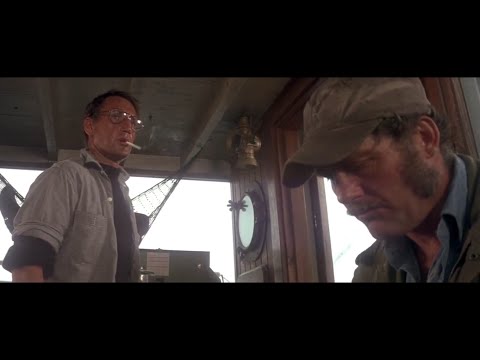
Roy Scheider played police chief Martin Brody, with Robert Shaw as the salty shark hunter Quint and Richard Dreyfuss as oceanographer Matt Hooper. Scheider ad-libbed the film’s most quoted line, “You’re gonna need a bigger boat,” which had started as a running crew joke about the cramped support barge.

Universal opened the movie on more than 400 screens at once, a pretty unusual move at a time when most films rolled out city by city over several weeks. Jaws covered its production costs within two weeks and passed The Godfather as the highest-grossing film ever, a title it held until Star Wars arrived in 1977.
At the Academy Awards, the film won Oscars for editing, sound and original score, and it was nominated for best picture. Three sequels followed with Jaws 2 (1978), Jaws 3-D (1983) and Jaws: The Revenge (1987) (though Spielberg had no part in any of them) and the Library of Congress added the original to the National Film Registry in 2001.
Benchley came to regret how his story fed public fear of sharks, and he spent much of his later life working on ocean and shark conservation until his death in 2006. A 25-foot Bruce has hung above the escalators at the Academy Museum of Motion Pictures in Los Angeles since it opened in 2021, and the museum marked the film’s 50th anniversary in 2025 with a full exhibition.
Below, you’ll find a review from the Alton Telegraph published June 21, 1975, the day after the film opened, in which critic Richard Taylor called it “a genuine horror movie.” The page also includes the original poster, a handful of stills, a 1975 Time magazine cover and the trailer.

Released in the summer of 1975, Jaws single-handedly drove more Americans away from the beaches and into the theaters than any storm or other force of nature ever possibly could have.
Though the cast featured Roy Scheider, Robert Shaw and Richard Dreyfuss, the star of the film was undoubtedly Bruce — the 25-foot-long mechanical shark — and of course, the now-iconic theme music by composer John Williams.
While filming ran long and went horribly over budget, it didn’t matter in the end — Jaws would rake in over $400 million at the box office, becoming the highest-grossing film of all time… until a little movie called Star Wars came along two years later. – AJW
Don’t miss a HD version of the Jaws movie trailer at the end of this page.
‘Jaws’ will scare the hell out of you
Movie review by Richard Taylor
There are moments in Jaws that will literally lift you out of your seat with suspense and shock.
Jaws is that rarest of films — a genuine horror movie. This is the real thing. There are no phony creatures in rubber suits, no tall, dark men with long sharp teeth, nobody changing into a wolf when the moon is full and bright.
Jaws deals with the horror of man confronting a real monster, a great white shark, and the terrifying results.
Yes, I know the shark is just a mechanical model, but in this film, it doesn’t make a bit of difference. In the first place, you don’t see the shark until more than two-thirds of the film is over, and once you do see him, you’ll believe. You’ll believe!

Based on a bestselling novel
For those of you who may have been living on a desert island for the past several years, Jaws is based on Peter Benchley’s perfectly awful best seller of the same name.
Had the film followed the book to the letter it would have been a disaster, but luckily for us, Benchley, along with director Steven Spielberg, trimmed off most of the trash in the novel and left us with a straightforward adventure story that slowly evolves into a nightmare.
Gone is the tacky and rather unbelievable romance that slowed the book down to a crawl, and gone too are the overblown philosophical statements and landlocked plotting that kept things from really getting going until the last couple of chapters.
What we are left with is the story of a small resort town whose economy is kept alive by the summer tourist trade. To the horror and concern of the townfolk, a shark begins to stalk the beaches, attacking several bathers.
ALSO SEE: Man-eating shark attacks on the New Jersey shore made headlines nationwide back in 1916
After the first attack, the city fathers persuade the town’s police chief (Roy Scheider) that this single incident isn’t sufficient to close the beaches. He reluctantly agrees with the predictable disastrous results.
The showdown is not long in coming when an old shark hunter named Quint (Robert Shaw) is hired to destroy the marauder. He and the Police Chief, with the help of Hooper, a young ichthyologist who tries to persuade them that they’re in for more of a fight than they think, set out in Quint’s rather shabby old boat for the final confrontation.

Jaws is superbly-crafted
Jaws is a superbly-crafted film. The photography is excellent, the special effects flawless and the direction, by 27-year-old Steven Spielberg, is assured and often brilliant. Spielberg directed last year’s excellent, but little seen, Sugarland Express, and was also at the helm of one of the best TV movies ever made, Duel.
His work in Jaws is faultless as he builds the suspense to the ultimate pitch, and then slams you into your seat with climax after climax. The acting is equally exciting. Scheider’s Police Chief is a real and human character. He is heroic, yet believable.
One scene at the dinner table with his small son manages to be very moving, a difficult feat in this action-crammed film. Robert Shaw overacts just the right amount to make his Quint the larger than life character he needs to be.

Richard Dreyfuss steals the film as the engaging Hooper, the catalyst that keeps Shaw and Scheider reacting. Dreyfuss played Curt in American Graffiti, and recently scored with the critics in The Apprenticeship of Duddy Kravitz. His work here is his best ever.
The star of the cast is “Bruce” the shark. He’s a 25-foot hydraulically-run, metal and plastic Great White shark, built by a former Walt Disney effects man.
“Bruce” looks very real on the screen, and Spielberg is careful not to show us too much of him at one time. He is often just a terrible shadow waiting beneath the waves.
MORE: Raiders of the Lost Ark movie with Harrison Ford as Indiana Jones was an instant classic (1981)
Jaws will have you clawing the arms of your seat (or your date) in delicious suspense and sighing with relief at the conclusion of each bit of terror that is presented.
The film builds slowly to an almost unbearable finish, starting with the first attack on a young woman swimming at night, moving on to a terrible attack on a crowded beach, and finishing with the final assault from Quint’s boat.
The terror is made even more real by the fact that sharks are real and they do attack people. This isn’t some made-up creature that might provoke more snickers than screams — this is the genuine article.
Watching the film, you know that if you met up with this baby out in the water you wouldn’t have a chance.
The shark is really the ultimate movie monster. Frankenstein and Dracula will have to take a back seat to “Bruce.”
Jaws is no rip-off. It’s a quality film, far better than the book, that will scare the hell out of you, not by gore or cheap tricks, but by good tight direction, beautifully staged scenes, fine acting, and a just plain terrifying story.
A trip to the ocean for a little swimming will not be on your agenda after you see Jaws.
You’ll probably stay away from lakes and swimming pools for a while, too.
Jaws movie trailer (video)
“You’re gonna need a bigger boat.”