

The kids swore, lost badly and acted roughly the way real kids act. Audiences showed up in large numbers. Critics mostly loved it. And the film earned $42.3 million at the domestic box office against a $9 million budget, making it one of the bigger surprises of the year.
The screenplay came from Bill Lancaster, son of actor Burt Lancaster, who drew on his own childhood experience playing Little League with a leg affected by polio. His agent — who had actually coached against Lancaster’s team during that period — eventually sold the script to Paramount Pictures for $105,000.

The studio hired director Michael Ritchie, who was already known for sharp, irony-edged looks at American competitive culture from films like The Candidate and Downhill Racer. Little League, it turned out, was perfect territory for him. The Bears themselves existed because a fictional city councilman had won a lawsuit against the league for excluding certain kids — a setup that let the film comment on suburban adult behavior without ever turning preachy about it.
Walter Matthau took the role of Buttermaker after Steve McQueen and Warren Beatty both passed. He was essentially the anti-coach — rarely seen without a beer in hand, not particularly invested in winning, and far more interesting to watch than any idealized mentor figure would have been.
Tatum O’Neal played Amanda Whurlitzer, the 12-year-old pitcher with a sharp arm and sharper attitude. O’Neal had won an Oscar three years earlier for Paper Moon and was paid $350,000 plus eight percent of net profits for this one. Her father, actor Ryan O’Neal, had reportedly refused to let her take lead roles until age 16 — a rule that got set aside here.

Also notable was Jackie Earle Haley as Kelly Leak, the juvenile delinquent who turns out to be the Bears’ best player and who gave the film much of its edge.
Reviews at the time were largely positive, though not without reservations. Variety called it “the funniest adult-child comedy film since Paper Moon.” The Los Angeles Times declared it the best American screen comedy of the year.
A review in the Berkeley Gazette, included in the original press coverage of the film, praised it for portraying kids as real people rather than sentimentalized versions of them — and noted, pointedly, that the film let a girl join the team without a whisper of protest from anyone, which struck the reviewer as unrealistic given that most girls who made Little League teams in 1976 did so by court order, and often faced real resistance once there. It was a reasonable criticism, though the film’s larger instincts — that children’s sports had become a vehicle for adult anxieties — largely held up.
Bill Lancaster won the Writers Guild Award for Best Comedy Written Directly for the Screen in 1977, and the script received an Oscar nomination as well.
The franchise didn’t stop with one film. Two sequels followed in quick succession — The Bad News Bears in Breaking Training in 1977 and The Bad News Bears Go to Japan in 1978 — neither of which matched the original’s reception.
A CBS television series ran for a single season in 1979-80, and a remake landed in 2005 with Billy Bob Thornton stepping into the Buttermaker role. None of those captured what made the first film work, which was essentially Ritchie’s refusal to let anyone — coaches, parents or the kids themselves — off the hook for caring too much about winning a children’s baseball game.
The ending of the original is notably unsentimental: the Bears lose the championship to the Yankees and respond by dumping beer on each other anyway. It’s the right ending for a film that spent two hours arguing against the idea that winning is the point.
Below, you’ll find original reviews, images and other archival material from the 1976 film, giving a sense of how The Bad News Bears landed when it was new.

- Amazon Prime Video (Video on Demand)
Movie review: The Bad News Bears portrays kids as real people
By Dan Bickley – The Berkeley Gazette (Berkeley, California) April 7, 1976
Michael Ritchie’s “Bad News Bears,” starring Walter Matthau and Tatum O’Neal, may well be the first intelligent “family film” in many years. Opening this week around the Bay Area, the film casts Matthau as a drunken ex-pitcher who is called on to wield a bedraggled group of kids into a winning little-league baseball team.
Most films dealing with the interactions of children and adults are either mindless attempts to talk down to the kids (the Disney formula) or insipid attempts to mesmerize adults with sentimentality (such as “Lies My Father Told Me”).
“Bad News Bears” does neither. It portrays kids as real people, youthful members of a larger society. The adults are recognizable too: suburban middle-class Americans perfectly complacent in their competitive values.
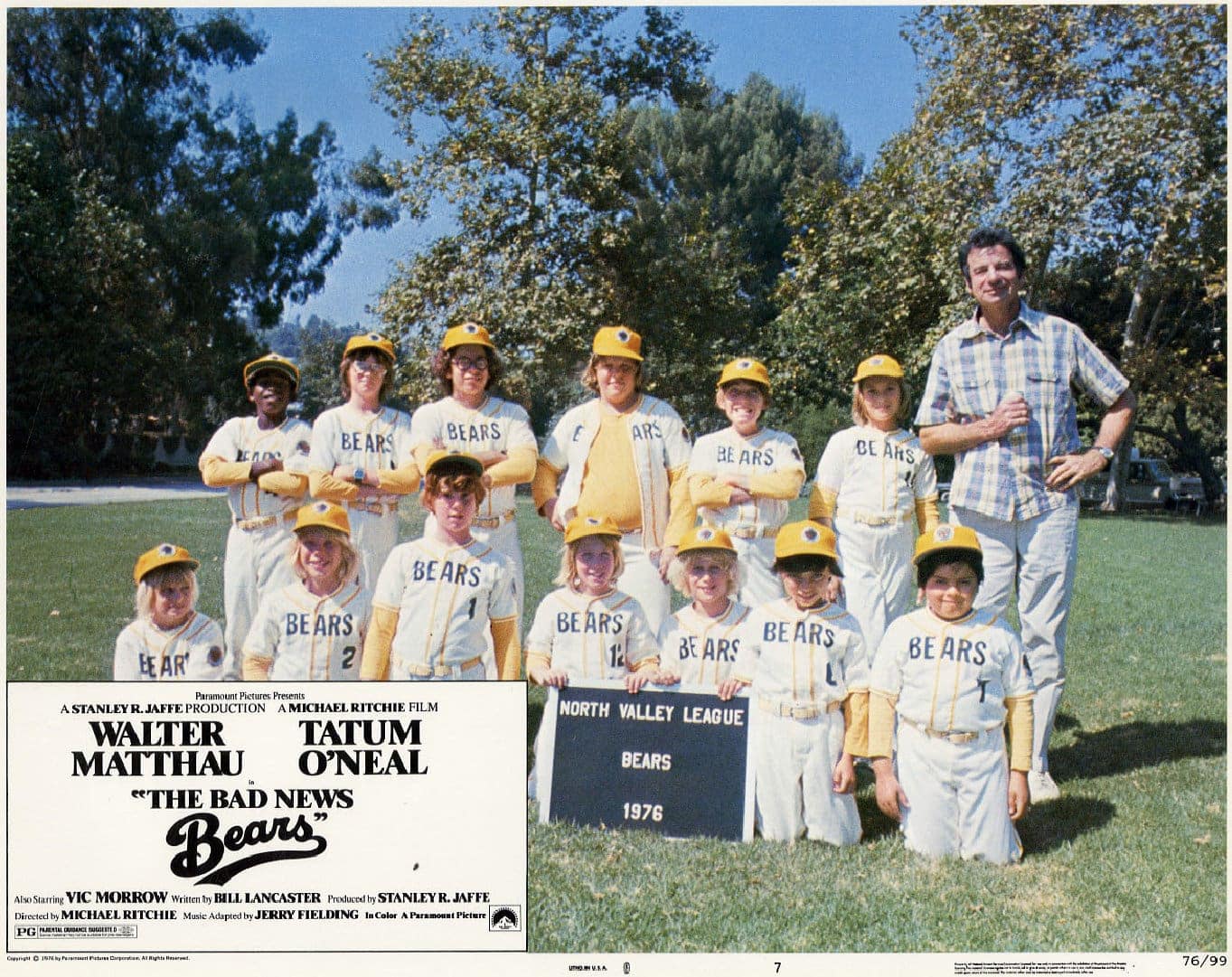
Director Ritchie is justly recognized as a pointedly ironic observer of the suburban American lifestyle, especially the syndrome of winning in its various manifestations. His sharp wit is apparent throughout this film, as well.
Nevertheless, “Bad News Bears” is not primarily an expose of the ways in which parents pervert competitive sports for their children. Such an objective would have far too facile.
Rather, Ritchie has tackled the more complex subject of a relationship between adults and children in a world that is changing rapidly for both. “Bad News Bears” is a warm, funny, and entertaining look at the relationship between Matthau, as coach, and the members of his team, especially O’Neal, a young girl faced with the complications of adolescence, nearness to puberty and the lack of a father figure.
Called upon to forge a winning team out of an inept group of misfits, Matthau spends most of his time drinking beer until the Bears’ first game, called off in the top half of the first inning because the Bears can’t get anybody on the other team out.
The kids are utterly dejected, but Matthau has his competitive ire raised, decides to pull himself together, and manages to encourage the dispirited youngsters. As part of his plan, he enlists O’Neal, whose fantastic spitball transforms the team. The local juvenile delinquent (played by Jackie Earle Haley) is brought in next. Suddenly the Bears, now the Bad News Bears, find themselves as challengers for the championship.
Ritchie has done a fine job organizing his material. The film is simultaneously funny, touching, and ironic; the performances from all the young actors are extraordinary; and even the baseball scenes appear realistic and, when necessary, suspenseful.
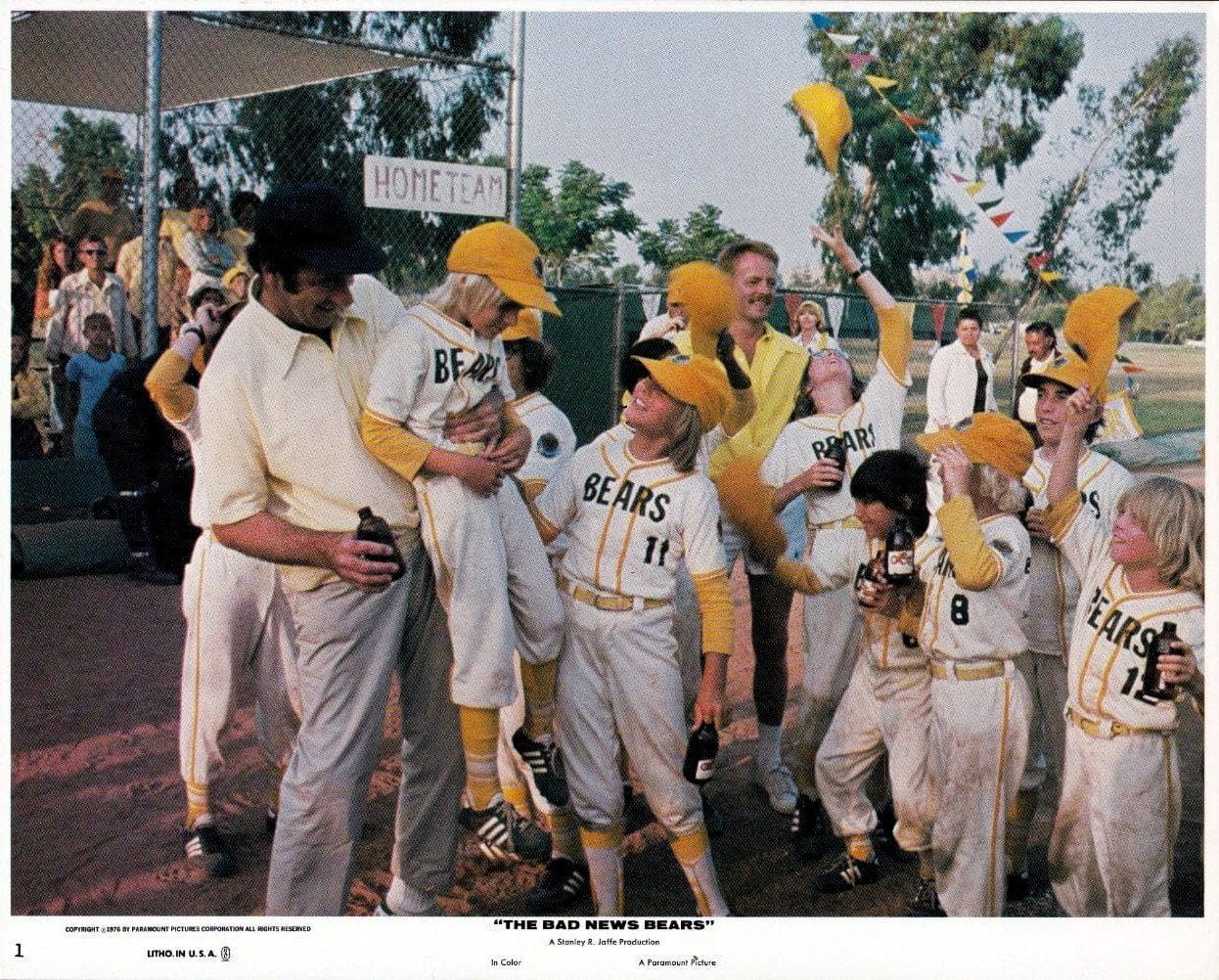
There are some problems though. Ritchie has a tendency to isolate certain themes for ironic inspection while at the same time rendering the rest of the world rather antiseptic. Here, for example, he emphasizes the adults’ competitive folly but ignores the problems of discrimination that plague enterprises like the Little League.
Although much honor is drawn from the interracial nature of the Bears, none of the real problems of this situation are explored. More importantly, the addition of a female pitcher to the Bears raises not even the slightest protest from any quarter. This is strange at a time when most girls make teams by court order, and once on, often face severe harassment from their male opponents.
Such reservations notwithstanding, “Bad News Bears” is at once an enjoyable and intelligent film, with an optimistic though unsentimental ending. Hopefully, it is only the first of a number of films, entertaining enough to be viewed by all ages, that treat young adolescents and adults as thinking beings. It’s the kind of film that thoughtful parents may enjoy viewing with their children, and afterward having an interesting discussion about. Need anything more be said?
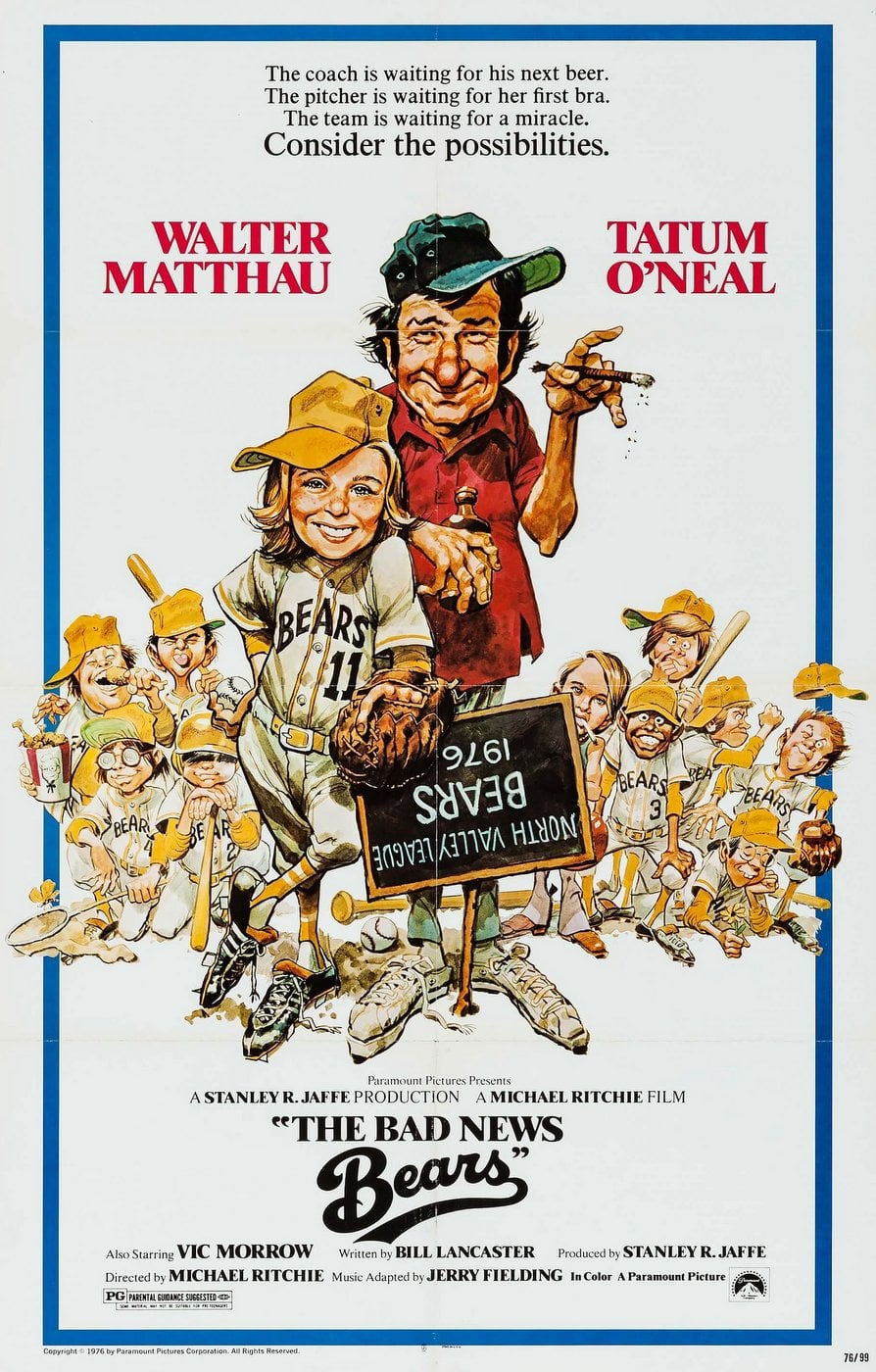
Bad News Bears vintage movie trailer
Warning: Language that you would never see in a kids’ movie preview today
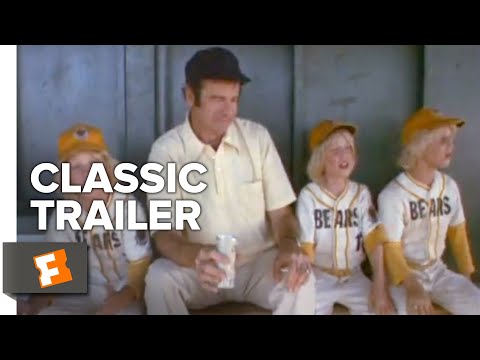
Movie review: The Bad News Bears a surprisingly painless adventure
By Vincent Canby – The Morning News (Wilmington, Delaware) April 8, 1976
If Neil Simon ever wrote a kiddie comedy, it might very well sound like Michael Ritchie’s “The Bad News Bears,” a wise-cracking, occasionally funny, often foul-mouthed movie about one season in the life of a California sandlot ball club called the Bears.
The Bears, whose ages appear to range from 9 to 13, are more hard luck than bad news until their coach, Morris Buttermaker (Walter Matthau), an over-the-hill ballplayer who now cleans swimming pools, has the good sense to sign aboard Amanda Whurlitzer (Tatum O’Neal), a pitcher with a magic arm.

The predictability of the subsequent rise and rise of the Bears — sparked by their glamorous 12-year-old pitcher — within their mini-league is not particularly detrimental to the movie’s entertainment value. “The Bad News Bears” relies much more on Matthau’s rich interpretation of the beer-guzzling coach and on an audience that finds something pricelessly funny about kids who can trade one-liners with the best of them.
I really don’t. Yet “The Bad News Bears” has a number of other virtues that make it a surprisingly painless adventure.
Among these are the screenplay by Bill Lancaster, Burt’s son, who has the talent and discipline to tell the story of “The Bad News Bears” almost completely in terms of what happens on the baseball diamond or in the dugout.
Ritchie, whose work (“Smile,” “The Candidate,” “Downhill Racer”) is bound to prompt a lot of boring theses about his vision of what competition means in the American system, keeps the sentimentality in check most of the time, and obtains first-rate performances from his miniature cast all of the time.
The star, of course, is Miss O’Neal, in her first film since “Paper Moon.” At 12, she has a peculiarly unsettling screen presence, looking, as she does, like a pretty child, but possessing the reserve of someone who’s been through the wars. She’s eerie.
So is Jackie Earle Haley (last seen as the dreadful child actor who was stomped to death in “The Day of the Locust”), impersonating a juvenile delinquent who smokes, drinks and fools around with girls. Like Miss O’Neal, he’s small, but there’s something about him that makes you suspect he may actually be an aged Munchkin, exiled from Oz for crimes that must remain unspeakable.








One Response
Commies gotta commie even back then the inklings of intersectionality were creeping into the writings of publications. After all it is Berkeley. Would you expect anything less?