

Young Gloria Steinem had unconventional ideas about female beauty and aging
The interview ran that December in the Syracuse Herald-Journal, timed to her lecture circuit work with the Federal Women’s Program, and it caught her mid-career as the founder of Ms. magazine and one of the most recognized faces of the women’s movement. She pushed back hard on the idea that a woman’s value shrinks as her looks fade, arguing that society only ever measured women by whether men found them attractive.
By the mid-1970s Steinem had already spent more than a decade building the reputation that made reporters seek her out. She broke through in 1963 with “A Bunny’s Tale,” an undercover exposé for Show magazine documenting the working conditions at Hugh Hefner’s Playboy Club in New York, where she spent eleven days as a costumed waitress under a fake name.
VIDEO | Gloria Steinem on A Bunny’s Tale exposé

The piece drew attention but also typecast her for years as a glamour girl rather than a serious journalist, a frustration she referenced often in later interviews. She kept working through it, joining New York magazine as a founding editor in 1968 and writing a political column called “The City Politic.”
Her involvement in feminist organizing deepened around the same time. Steinem attended a meeting of the radical group Redstockings in 1969, and by July 1971 she had helped found the National Women’s Political Caucus alongside Betty Friedan, Bella Abzug and Shirley Chisholm.
That same year she started developing what would become Ms. magazine, a national publication built entirely around feminist reporting at a time when, as she put it, there was nothing controlled by women for women to read. A preview edition appeared inside New York magazine in December 1971, and the first standalone issue hit newsstands on July 1, 1972, with Wonder Woman striding across the cover.
Ms. became the platform from which Steinem argued for the rest of the decade, including in that 1976 interview about aging. She rejected the idea that being single or living alone made a woman incomplete, calling the shift toward accepting those choices one of the more useful contributions of the women’s movement.

She also pointed out the double standard baked into television and public life, noting that a man like Walter Cronkite could appear on air with visible age while women in the same industry could not. The magazine ran through 1987 as a monthly before switching to nonprofit and later ad-free ownership structures, changing hands several times over the following decades while continuing to publish.
Steinem stayed active well past the age she’d worried about self-destructing at. She co-founded the Ms. Foundation for Women in 1973, helped launch Take Our Daughters to Work Day, and kept writing books including Revolution from Within and her 2015 memoir My Life on the Road.
President Obama awarded her the Presidential Medal of Freedom in 2013. Steinem died on September 2, 2026, at her home in New York City at age 92, according to a statement from her foundation, closing out a career that spanned more than six decades of American feminist journalism.
VIDEO | The Life of Gloria Steinem

When you think about the 1970s, you might think of disco, bell-bottoms, or even lava lamps. But for many, this groovy decade is synonymous with the rise of a fearless feminist icon who not only fought for women’s rights but also embraced aging with grace and wisdom.
Meet Gloria Steinem, a journalist and social activist who made waves in the Women’s Liberation Movement and never shied away from challenging society’s expectations. Young Gloria Steinem had some very unconventional views on aging back in the 1970s that, unfortunately, never quite caught on with our culture.
Let’s step back to 1976 — the pinnacle of Steinem’s groundbreaking career — and not only revisit her empowering views on aging as a liberating experience for women, but also, maybe this time, internalize and act on them. /BRB


Young Gloria Steinem discusses aging (1976)
By Ghita Levine, Special to the Syracuse Herald-Journal (New York) December 3, 1976
“I do not want to self-destruct when I am 60 years old,” says Gloria Steinem, feminist, activist, founder and editor of MS magazine. And from the way she looks, there’s little likelihood that will be her fate.
Although others point to her as “beautiful Gloria,” she substitutes “conventional-looking” for attractive and pretty. For Ms Steinem is one of the leaders of women’s movement, which wants to create a society that is not dependent on looks.
“It’s a you-can’t-win-syndrome,” Ms. Steinem said after a recent lecture to a Federal Women’s Program group. “If you’re young and attractive and do well, then people say you got there through men. If you’re not young and not pretty and you do well, then they say you got there because you couldn’t get a man.”
VIDEO | Gloria Steinem explains why you should become a feminist
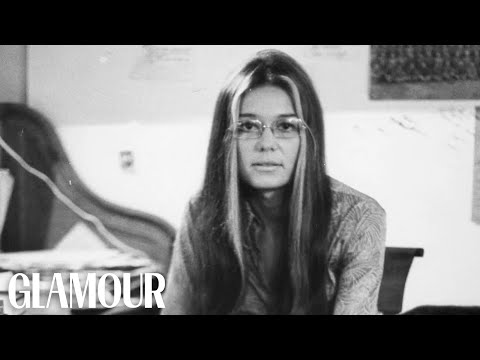
Dead end road
Either way, a woman is measured in terms of how she scores, or does not score, in the eyes of men. And that is a dead-end road when you know, with age, comes a change away from youthful good looks.
Older women especially feel a keen loss of physical attraction and a consequent loss of self-image and self-concept. For if you measure yourself in terms of how you appeal to men, then when you lose that appeal (real or imagined) you value yourself less a person, too.
“We all suffer from the same problem, which is being identified by our looks instead of our hearts and our heads,” Ms Steinem maintains, so she is working for a society in which being an older woman, or being an “atypical person” is “okay and good.”
“It’s okay these days to be widowed, divorced, single or living alone. One of the main emphases of the women’s movement has been to point out the alternatives to conventional marriage and show there is more than one way of living a productive life. Many older women report that they feel odd because they must live alone.”
Yet nowadays many women opt not to marry, like Gloria Steinem, who at age 42, chooses to live alone. “Perhaps the women’s movement has been most helpful in de-mystifying the idea of aloneness, and saying aloneness is a positive thing,” Ms Steinem points out.

Loneliness
Even married people can be alone because, as she puts it, one’s condition of loneliness doesn’t depend on whether you have a spouse or children, but how you feel about yourself, how you relate to people around you.
When you don’t like yourself very much, or when you feel unconfident with yourself, you’re more likely to doom relationships with other people, she says.
Gloria Steinem is the first to admit that the women’s movement should be doing more for the older woman. But what is it doing, she says, is contributing to the understanding that women are valuable people, regardless of age.
“We are trying to do something about this world in which it is all right if Walter Cronkite is on television with wrinkles, but show me the woman who can get away with that.
“Just at the time when we’re at the height of our experience, we’re dismissed because we’re no longer decorative.”

Then and now: Activist/journalist Gloria Steinem in 2016, aging on her own terms








One Response
For once I am not sorry to see an “icon” reach the end of her life. Feminism is nothing but lies built upon lies, lies young women today are suffering from terribly. Those who realized in the nick of time that they’ve been lied to, like myself, almost missed everything this life had to offer vis-a-vis a husband and children. Steinem’s lies about women, what women should and shouldn’t want, and what their lives should and shouldn’t be will not be missed.