

The man behind it was Angus G. Wynne Jr., a Dallas-area real estate developer who controlled a large industrial tract midway between Dallas and Fort Worth, near the banks of Johnson Creek. In the late 1950s, Wynne visited Disneyland and came home with a different plan for his land.
Rather than an industrial complex, he’d build a theme park — one organized around Texas history, with each section of the grounds representing one of the six nations whose flags had flown over the state: Spain, France, Mexico, the Republic of Texas, the Confederate States of America and the United States. He originally planned to call it “Texas Under Six Flags” until someone in his inner circle — his wife, by several accounts — pointed out that Texas wasn’t under anything. The name flipped, and it stuck.
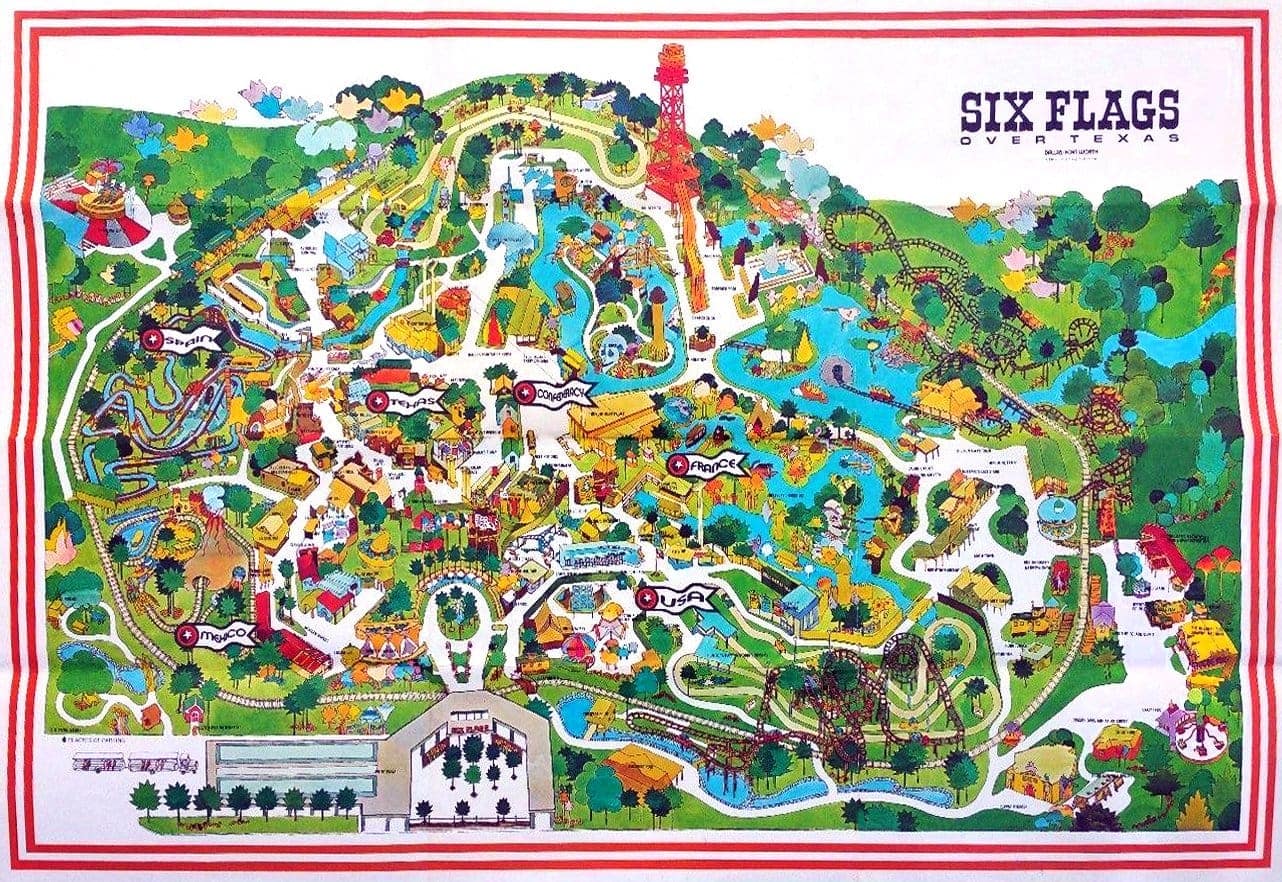
Construction began in August 1960, and the park’s final price tag came to $10 million — real money for a gamble that many local business leaders thought was too risky. Six Flags Over Texas opened on August 5, 1961, drawing 8,374 visitors on opening day. Wynne had originally conceived it as a short-term revenue source to fund other development projects.
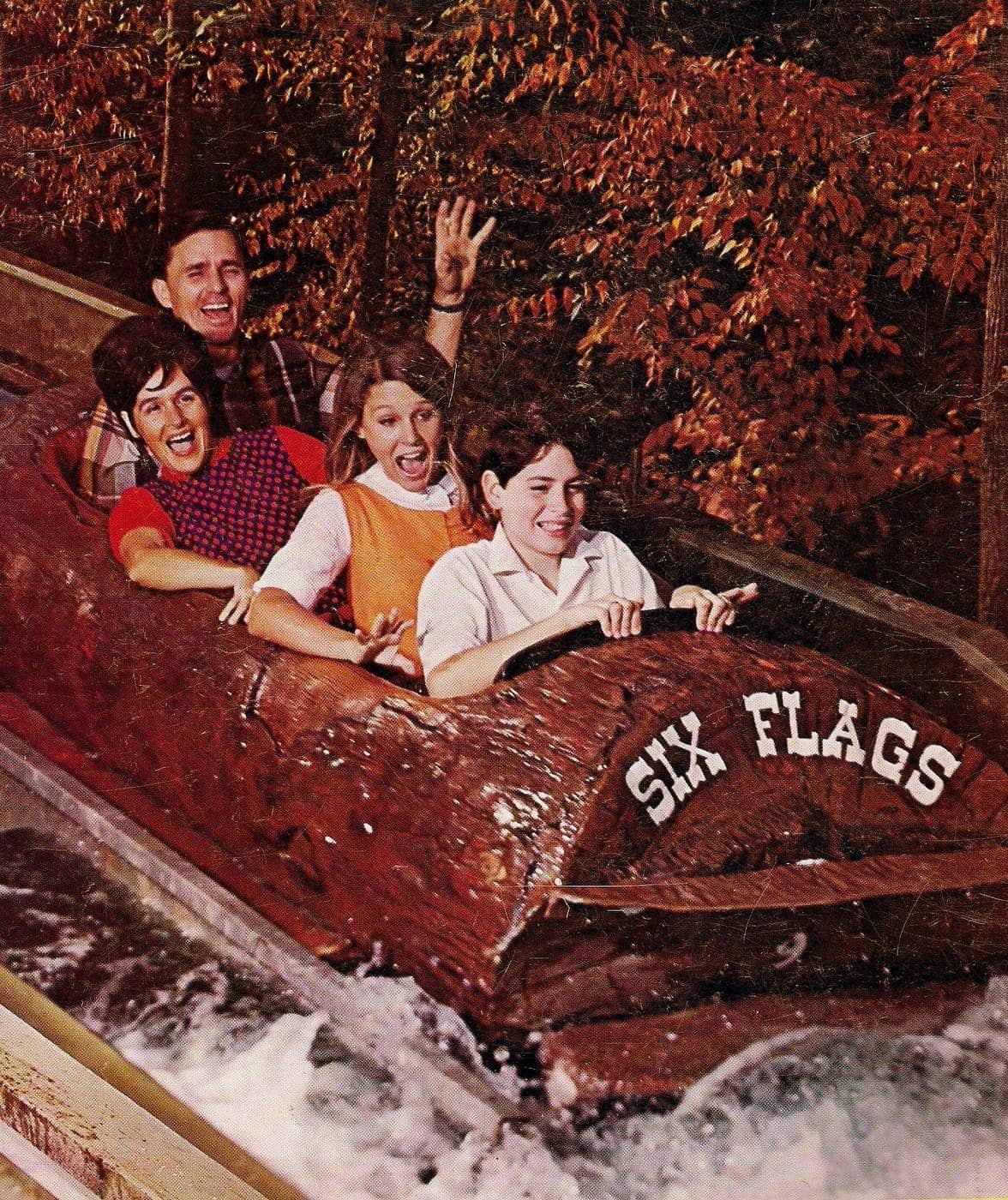
Nobody, including Wynne himself, expected what happened: the park immediately outpaced projections, and it became clear it wasn’t going anywhere. One of its early innovations was the “Pay One Price” model — a single admission that covered all rides — which was unusual for the era. Even Disneyland still used a pay-as-you-go system at the time. Six Flags Over Texas also debuted the world’s first log flume ride, El Aserradero, in 1963, and later introduced the first 360-degree looping roller coaster in the country.
The concept proved scalable. Six Flags Over Georgia, outside Atlanta, followed in 1967, and Six Flags Over Mid-America near St. Louis opened in 1971. By then, Wynne had already sold the business — he divested in 1969, and the company passed through a series of corporate hands over the following decades. Penn Central Railroad took over management, then came a leveraged buyout, then Time Warner gained control in 1993 and brought with it licensing deals for Looney Tunes and DC Comics characters — Bugs Bunny, Batman, Superman — which became fixtures across the parks.
The 1984 acquisition of Marriott’s Great America had already secured the Warner Bros. character rights, giving Six Flags a brand identity that set it apart from competitors. Through the 1970s and ’80s, the chain expanded aggressively by acquiring existing parks — AstroWorld in Houston, Great Adventure in New Jersey, Magic Mountain in California — building out a genuinely national network.
The growth eventually caught up with the company. Acquiring 15 parks between 1997 and 2001 under Premier Parks amassed over $2 billion in debt, and attendance dropped sharply after September 11, 2001. Six Flags filed for Chapter 11 bankruptcy protection in 2009, emerging the following year under a restructured corporate identity. A decade of relative stability followed, though the COVID-19 pandemic hit the industry hard and set the stage for the next major shift.
In November 2023, longtime competitors Cedar Fair and Six Flags announced a merger valued at $8 billion, creating a combined portfolio of 27 amusement parks, 15 water parks and 9 resort properties — the largest regional amusement park operator in North America, trading under the ticker FUN.
The photos and archival materials collected here go back to the park that started all of it — Six Flags Over Texas in its early decades, when the Log Flume was new, the Oil Derrick tower was the tallest thing around, and two million visitors a year were making the drive to Arlington. The vintage ads and brochures capture how the park sold itself in the 1960s and ’70s: clean, wholesome, endlessly repeatable fun, all for one price.
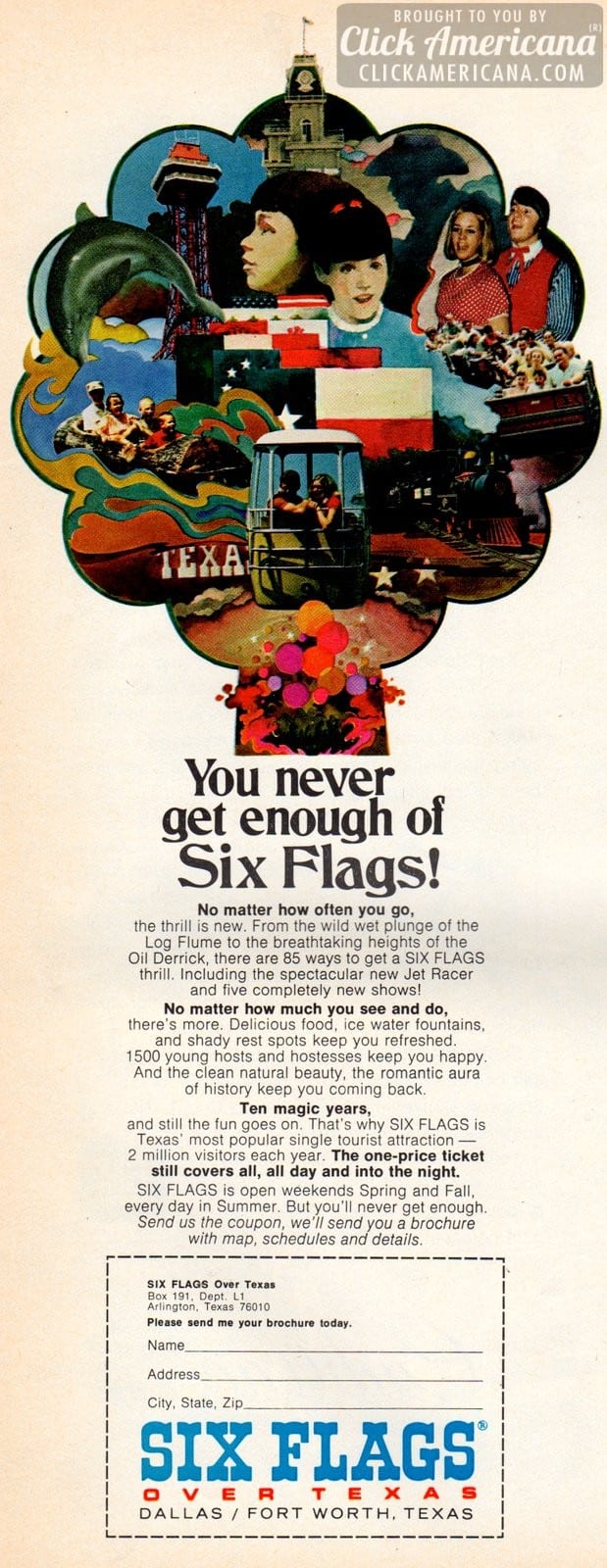
You never get enough of Six Flags!
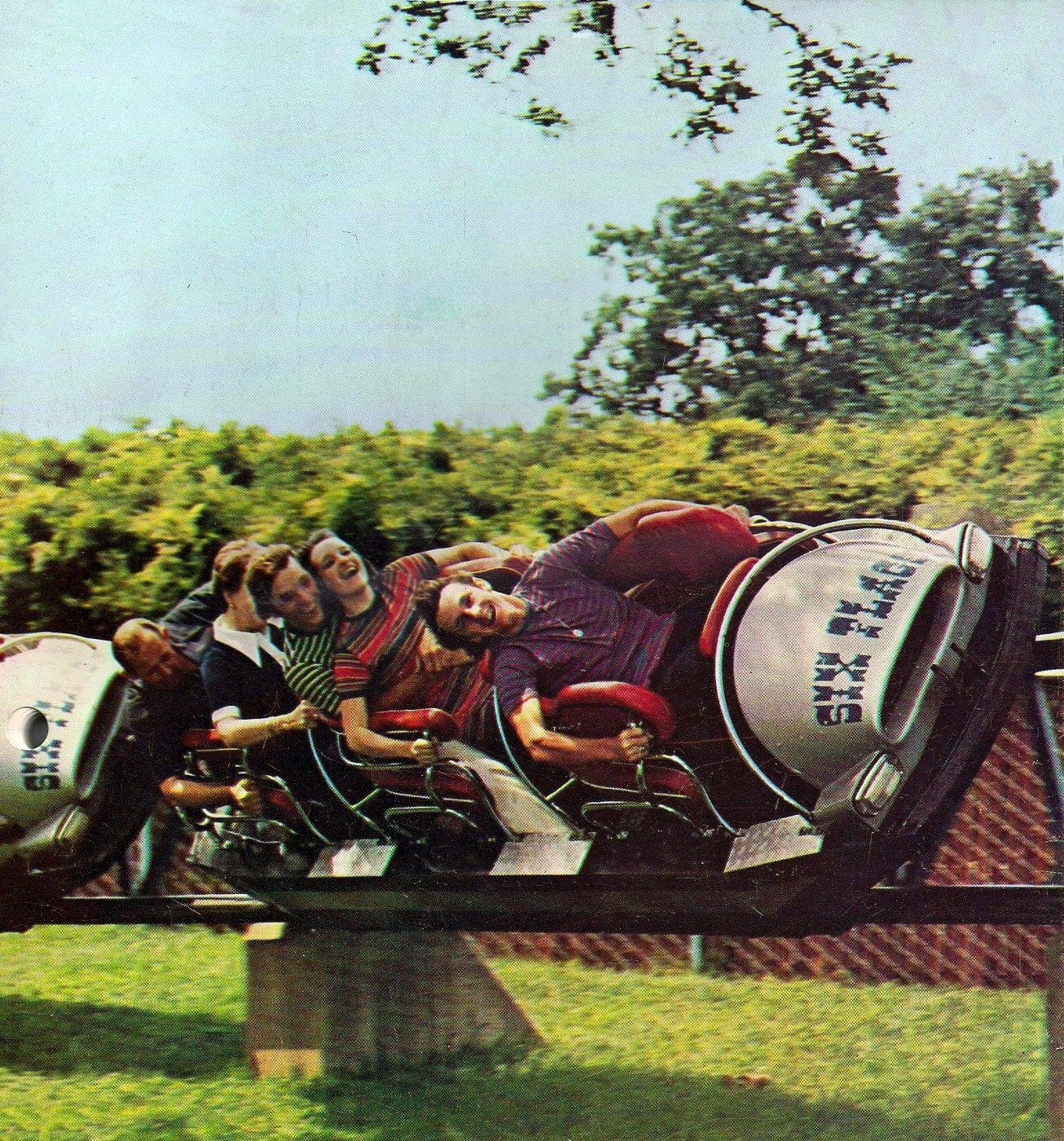
No matter how often you go, the thrill is new. From the wild wet plunge of the Log Flume to the breathtaking heights of the Oil Derrick, there are 85 ways to get a Six Flags thrill. Including the spectacular new Jet Racer and five completely new shows!
No matter how much you see and do, there’s more. Delicious food, ice water fountains, and shady rest spots keep you refreshed. 1500 young hosts and hostesses keep you happy. And the clean natural beauty, the romantic aura of history keep you coming back.
Ten magic years, and still the fun goes on. That’s why Six Flags is Texas most popular single tourist attraction — 2 million visitors each year. The one-price ticket still covers all, all day and into the night.
Six Flags is open weekends Spring and Fall, every day in Summer. But you’ll never get enough. Send us the coupon, we’ll send you a brochure with map, schedules and details.
Six Flags over Texas – Dallas/Fort Worth
The story of Six Flags Over Texas (1971)
From the Big Basin Herald (Muldrow, Oklahoma) March 25, 1971
Cattle once roamed the banks of Johnson Creek, the lazy stream which meandered near the fence line of the legendary Waggoner DDD Ranch.
Today a multi-million-dollar family fun center — Six Flags Over Texas — brings some two million people a year to that strip of pastureland.
The natural beauty of bygone days has not only been preserved, but enhanced by a costly investment in landscaping. The lavish landscape sets the scene for enjoyment of one of the nation’s best-known theme parks.
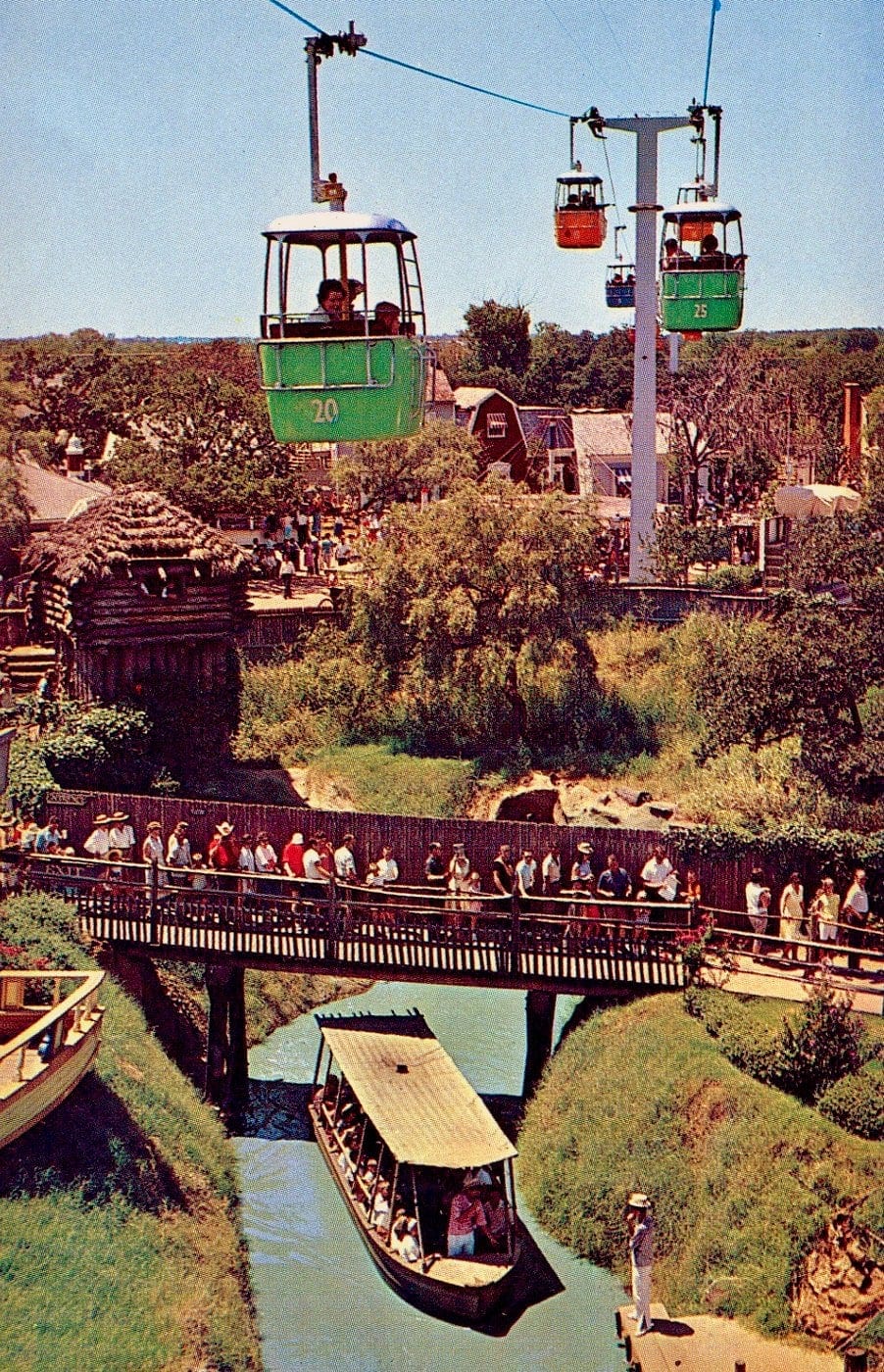
Six Flags’ founders saw the DDD Ranch as an area ripe for recreational development. Its lo-cation, exactly midway be-tween the bustling cities of Dal-las and Fort Worth, made it a “natural” for such a project.
In the Fall of 1960, Six Flags Over Texas began taking shape. The new park was based on three principles. It would have a unique and wholesome atmosphere. It would be kept immaculately clean at all times. And, it would be staffed primarily by bright, young college students.
The Park’s name was derived from Texas’ history. Six Flags have flown over the Lone Star state. It has been claimed as the territory of Spain, France, Mexico, the Republic of Texas, the Confederacy and the United States.
At first, the name was to have been Texas Under Six Flags. But, as one of the parks planners put it, “You know how we all feel about Texas, and Texas ain’t going to be under nothing.” Thus it became Six Flags Over Texas.
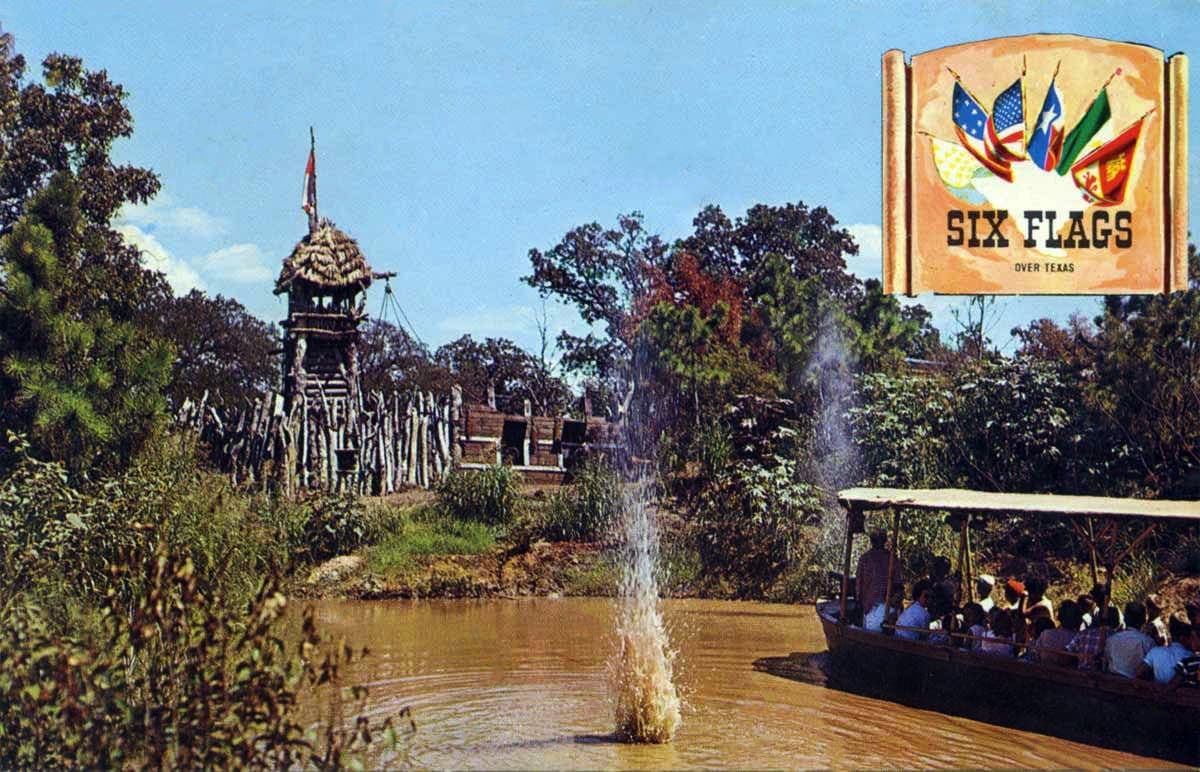
Before a spade of earth was turned, a year was spent in study, planning and research. A complete woodmill was shipped from New York. And design experts and artists began turning out sketches of the historically-accurate buildings which would give each of the six sections of the park its flavor.
Those sketches were redrawn on huge pieces of cardboard that were the exact size of the facades of the buildings. The drawings were shipped to Texas by rail, and carpenters at the woodmill began cutting lumber to conform to the sketches.
The buildings, prefabricated in the mill, were put into place as land was made ready. Beneath the surface lay a maze of wires, pipe conduit to carry the electricity for brillant lighting displays, the water for lakes and waterfalls and the sounds, which gave each section a distinctive atmosphere.
In a little less than a year, 400 construction craftsmen created a “wonderland” on the shores of Johnson Creek.
Six Flags Over Texas opened to the public on August 5, 1961. Since that time the Park has grown steadily. There are now more than 85 rides, shows and attractions at Six Flags — more than double the number in 1961.
Not only has Six Flags Over Texas grown, the idea has flourished. Six Flags Over Georgia, near Atlanta, is in its fifth season. Six Flags Over Mid-America will open in the Spring of 1971, outside St Louis.
What started as a modest, but imaginative plan for a strip of Texas pastureland has grown into one of the world’s largest and most successful recreational enterprises.








One Response
There used to be a Six Flags Inn and Resort to accommodate park visitors.