The Boston Normal School of Gymnastics launched a campaign to measure no fewer than 50,000 American women, with the goal of producing statistical charts defining the ideal female form. The project was presented as science, but it was also a reflection of the era’s deep preoccupation with female bodies as objects to be quantified, corrected and optimized (not that anything has changed much in the intervening years).
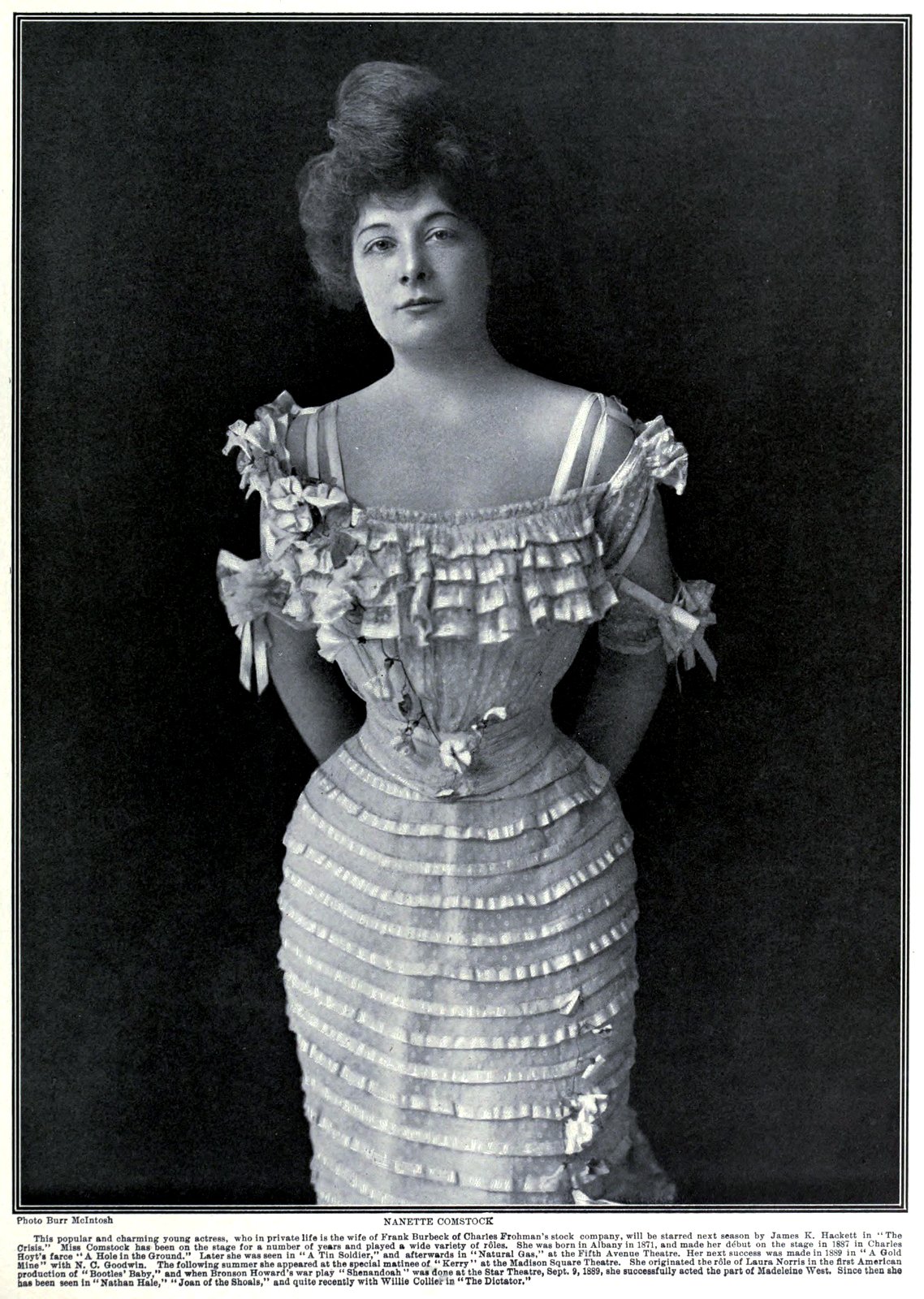
The beauty standard of the early 1900s had a face, and it belonged to the Gibson Girl. Illustrator Charles Dana Gibson had been drawing his vision of the ideal American woman since the early 1890s, first in the pages of Life magazine, and the image caught on fast. She was tall, with a small cinched waist, a full bust, rounded shoulders and elaborate upswept hair.
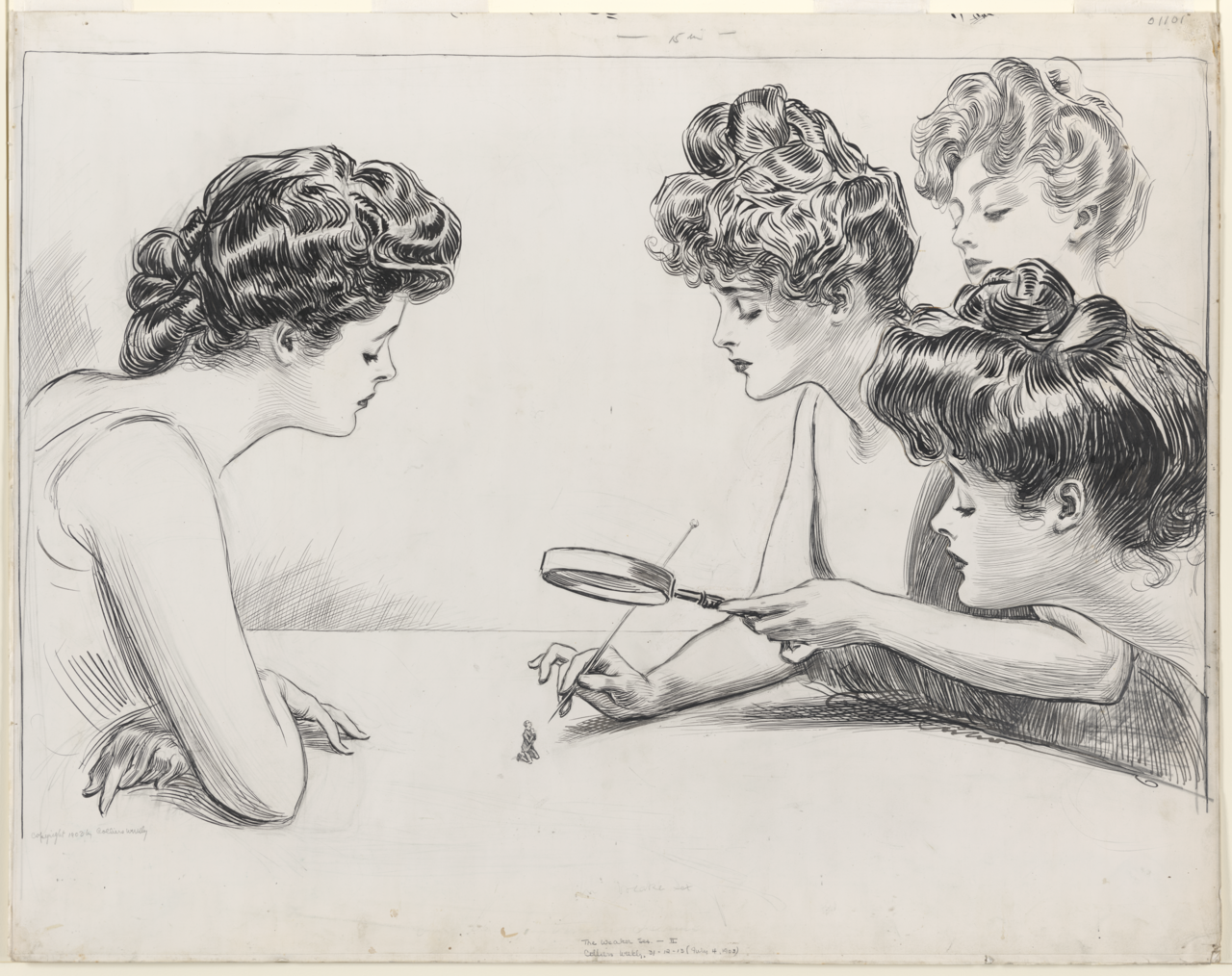
Gibson drew his narrow-waisted ideal in black and white, portraying her as a multi-faceted type, always at ease and fashionable — and for roughly two decades, that illustration defined what American women were supposed to look like. The look required engineering. The corsets of the time pushed the bosom up and forward while shifting the hips back, producing a dramatic S-curve silhouette that would have been impossible to achieve without significant structural assistance.


The Boston School’s 1905 study wasn’t the first attempt to pin down the ideal female body with numbers. About fifteen years earlier, Harvard’s Dr. Dudley Allen Sargent had assembled composite photographs of nearly 1,000 American women for a similar purpose — and reached the unsurprising conclusion that essentially none of them met his standard.
Sargent told the New York Times that among the many thousands he had measured at the gymnasium, not one had fulfilled every requirement. He continued that search into the 1900s. After examining roughly 10,000 women, Sargent eventually declared Australian swimmer and performer Annette Kellerman “the closest to physical perfection” — a designation Kellerman wryly noted applied only “from the neck down.”

The corset that produced the Gibson Girl silhouette was itself undergoing revision around this time. By 1900, the brutal hourglass corset of the late Victorian era had given way to a new “S-bend” design, advertised as healthier than its predecessor, though it actually forced women into an awkward forward tilt — hips pushed back, chest thrust forward.
The general public had begun demanding change, partly because tight-lacing had been linked by medical opinion to tuberculosis, constipation and skeletal deformities. The new corset was considered a compromise, and it remained a fixture until roughly 1910, when the silhouette began elongating again and waistlines crept higher.

The standard shifted considerably in the years after 1905. Between roughly 1908 and 1914, the “Venus ideal” of full curves began giving way to a “Diana ideal” — slimmer, more athletic in outline. The 1920s accelerated that shift sharply. Flappers favored a boyish, flattened silhouette, corsets were largely abandoned, and the soft voluptuousness of the Gibson Girl era looked abruptly old-fashioned.
Women embraced looser silhouettes that coincided, somewhat grimly, with a rise in reported disordered eating. The “perfect woman” project — the idea that some authoritative body could define the ideal by measuring enough of them — faded out, even as the underlying pressure on women to conform to a single physical standard did not.

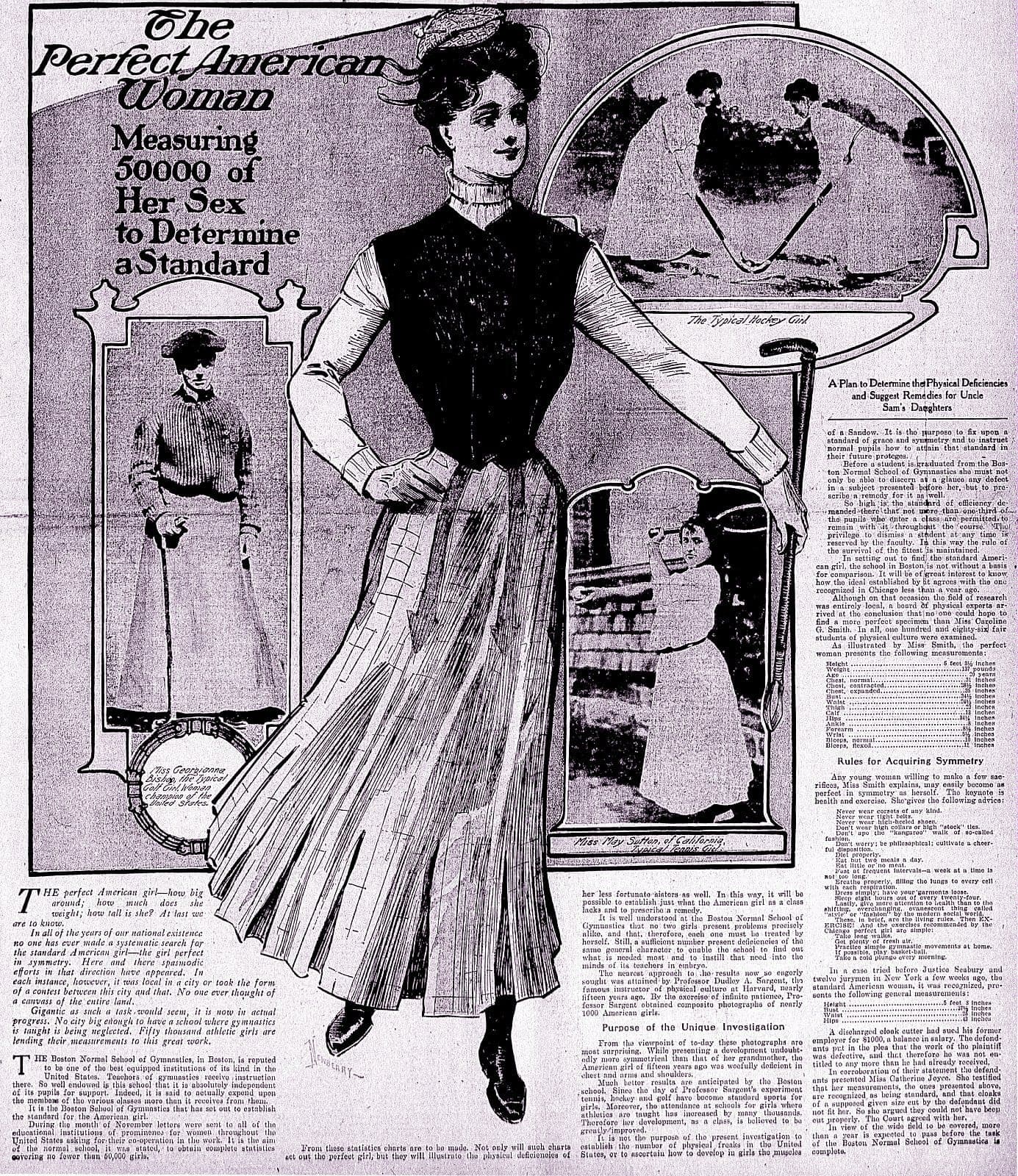
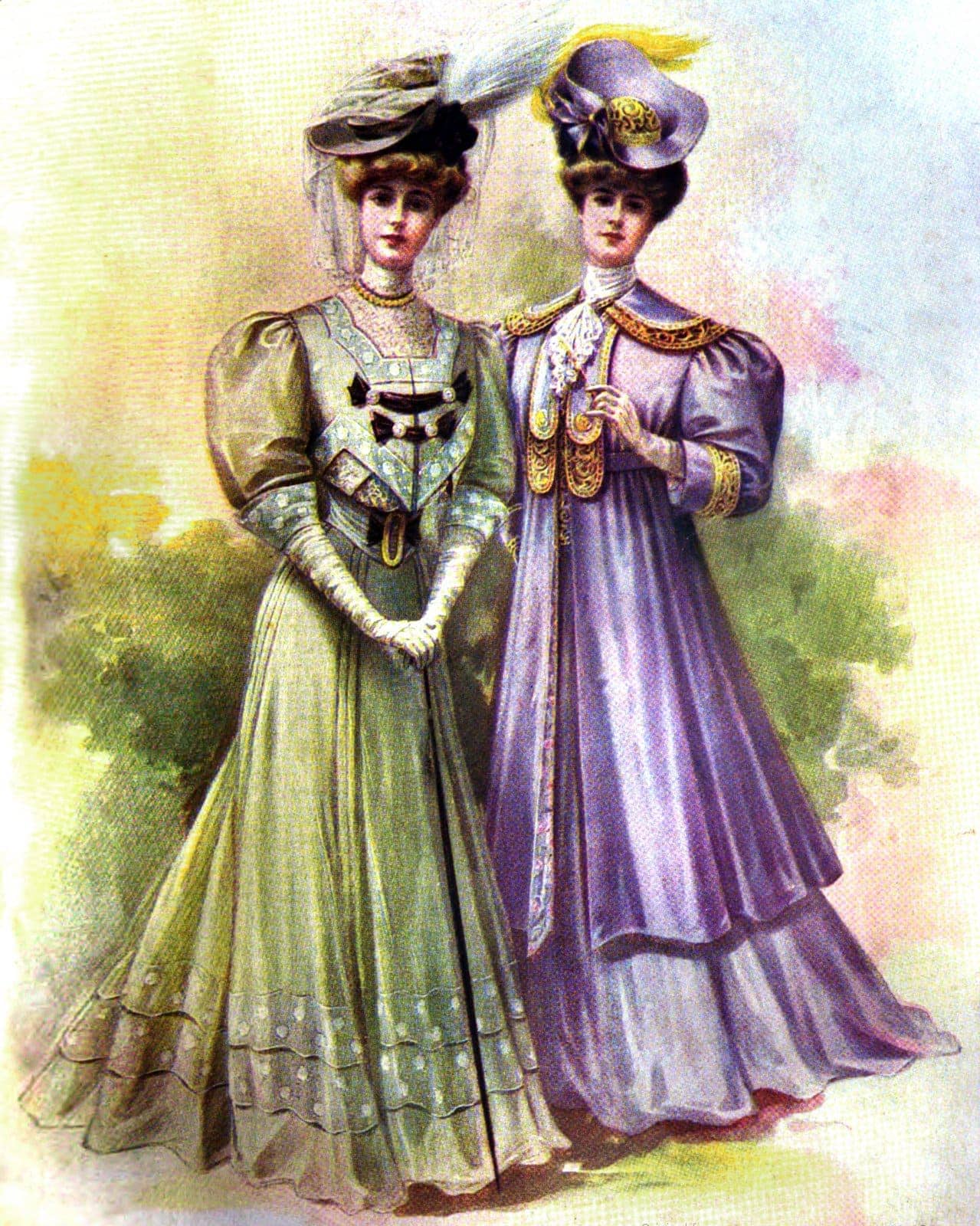
The vintage photographs and original 1905 newspaper article collected on this page capture that moment before the shift — women in elaborate shirtwaists and upswept hair, the Gibson Girl look at its height. The article itself reads as a period document about the impulse to quantify beauty as much as it does about beauty itself.
The perfect American woman
Measuring 50,000 of her sex to determine a standard
The perfect American girl — how big around; how much does she weigh; how tall is she? At last we are to know.
It is the Boston School of Gymnastics that has set out to establish the standard for the American girl.
During the month of November, letters were sent to all of the educational institutions of prominences for women throughout the United States asking for their co-operation in the work. It is the aim of the normal school, it was stated, to obtain complete statistics covering no fewer than 50,000 girls.
From these statistics, charts are to be made. Not only will such charts set out the perfect girl, but they will illustrate the physical deficiencies of her less fortunate sisters as well. In this way, it will be possible to establish just what the American girl as a class lacks and to prescribe a remedy.
It is well understood at the Boston Normal School of Gymnastics that no two girls present problems precisely alike, and that, therefore, each one must be treated by herself. Still, a sufficient number present deficiencies of the same general character to enable the school to find out what is needed most and to instill that need into the minds of its teachers in embryo.
The nearest approach to the results now so eagerly sought was attained by Professor Dudley A Sargent, the famous instructor of physical culture at Harvard, nearly fifteen years ago. By the exercise of infinite patience, Professor Sargent obtained composite photographs of nearly 1,000 American girls.
Purpose of the unique investigation
From the viewpoint of today, these photographs are most surprising. While presenting a development undoubtedly more symmetrical than that of her grandmother, the American girl of fifteen years ago was woefully deficient in chest and arms and shoulders.
Much better results are anticipated by the Boston school. Since the day of Professor Sargent’s experiment tennis, hockey and golf have become standard sports for girls. Moreover, the attendance at schools for girls where athletics are taught has increased by many thousands. Therefore her development, as a class, is believed to be greatly improved.
It is not the purpose of the present investigation to establish the number of physical freaks in the United States, or to ascertain how to develop in girls the muscles of a Sandow. It is the purpose to fix upon a standard of grace and symmetry and to instruct normal pupils how to attain that standard in their future proteges.
As illustrated by Miss Smith [below], the perfect woman presents the following measurements:
Height: 5 feet 3-1/2 inches
Weight: 137 pounds
Age: 20 years
Chest, normal: 31 inches
Chest, contracted: 28 1/3 inches
Chest, expanded: 35 inches
Bust: 34 1/2 inches
Waist: 24 1/2 inches
Thigh: 22 inches
Calf: 18 inches
Hips: 34-1/4 inches
Ankle: 8 inches
Forearm: 8-1/2 inches
Wrist: 5-1/2 inches
Biceps, normal: 10 inches
Biceps, flexed: 11 inches
1905 beauty standards: Rules for acquiring symmetry
Any young woman willing to make a few sacrifices, Miss Smith explains, may easily become as perfect in symmetry as herself. The keynote is health and exercise. She gives the following advice:
- Never wear corsets of any kind.
- Never wear tight belts.
- Never wear high-heeled shoes.
- Don’t wear high collars of high “stock” ties.
- Don’t ape the “kangaroo” walk of so-called fashion.
- Don’t worry; be philosophical; cultivate a cheerful disposition.
- Diet properly.
- Eat but two meals a day.
- Eat little or no meat.
- Fast at frequent intervals — a week at a time is not too long.
- Breathe properly, filling the lungs to every cell with each respiration.
- Dress simply; have your garments loose.
- Sleep eight hours out of every twenty-four.
- Lastly, give more attention to health than to the shifting, everchanging, evanescent thing called “style” or “fashion” by the modern social world.
These, in brief, are the living rules. Then exercise! And the exercises recommended by the Chicago perfect girl are simple:
- Take long walks.
- Get plenty of fresh air.
- Practice simple gymnastic movements at home.
- If possible, play basketball.
- Take a cold plunge every morning.
Surveying the country
In all of the years of our national existence, no one has ever made a systematic search for the standard American girl — the girl perfect in symmetry. Here and there spasmodic efforts in that direction have appeared. In each instance, however, it was local in a city or took the form of a contest between this city and that. No one ever thought of a canvass of the entire land.
Gigantic as such a task would seem, it is now in actual progress. No city big enough to have a school where gymnastics is taught is being neglected. Fifty thousand athletic girls are lending their measurements to this great work.
The Boston Normal School of Gymnastics, in Boston, is reputed to be one of the best-equipped institutions of its kind in the United States. Teachers of gymnastics receive instruction there. So well endowed is this school that it is absolutely independent of its pupils for support. Indeed, it is said to actually expand upon the members of the various classes more than it receives from them.
Before a student is graduated from the Boston Normal School of Gymnastics, she must not only be able to discern at a glance any defect in a subject presented before her, but to prescribe a remedy for it as well.
So high is the standard of efficiency demanded there that not more than one-third of the pupils who enter a class are permitted to remain with it throughout the course. The privilege to dismiss a student at any time is reserved by the faculty. In this way, the rule of the survival of the fittest is maintained.
In setting out to find the standard American girl, the school in Boston is not without a basis for comparison. It will be of great interest to know how the ideal established by it agrees with the one recognized in Chicago less than a year ago.
Although on that occasion the field of research was entirely local, a board of physical experts arrived at the conclusion that no one could hope to find a more perfect specimen than Miss Caroline G Smith. In all, one hundred and eighty-six fair students of physical culture were examined.