1910s hairstyle secrets — rats, waterfalls and the birth of the bob
Instead of the towering, forward-swept pompadours of the previous decade, women were pulling their hair back into a soft knot low on the head, styled to echo Greek statuary, with a wide braid caught in shell pins and a few curls left loose at the neck.
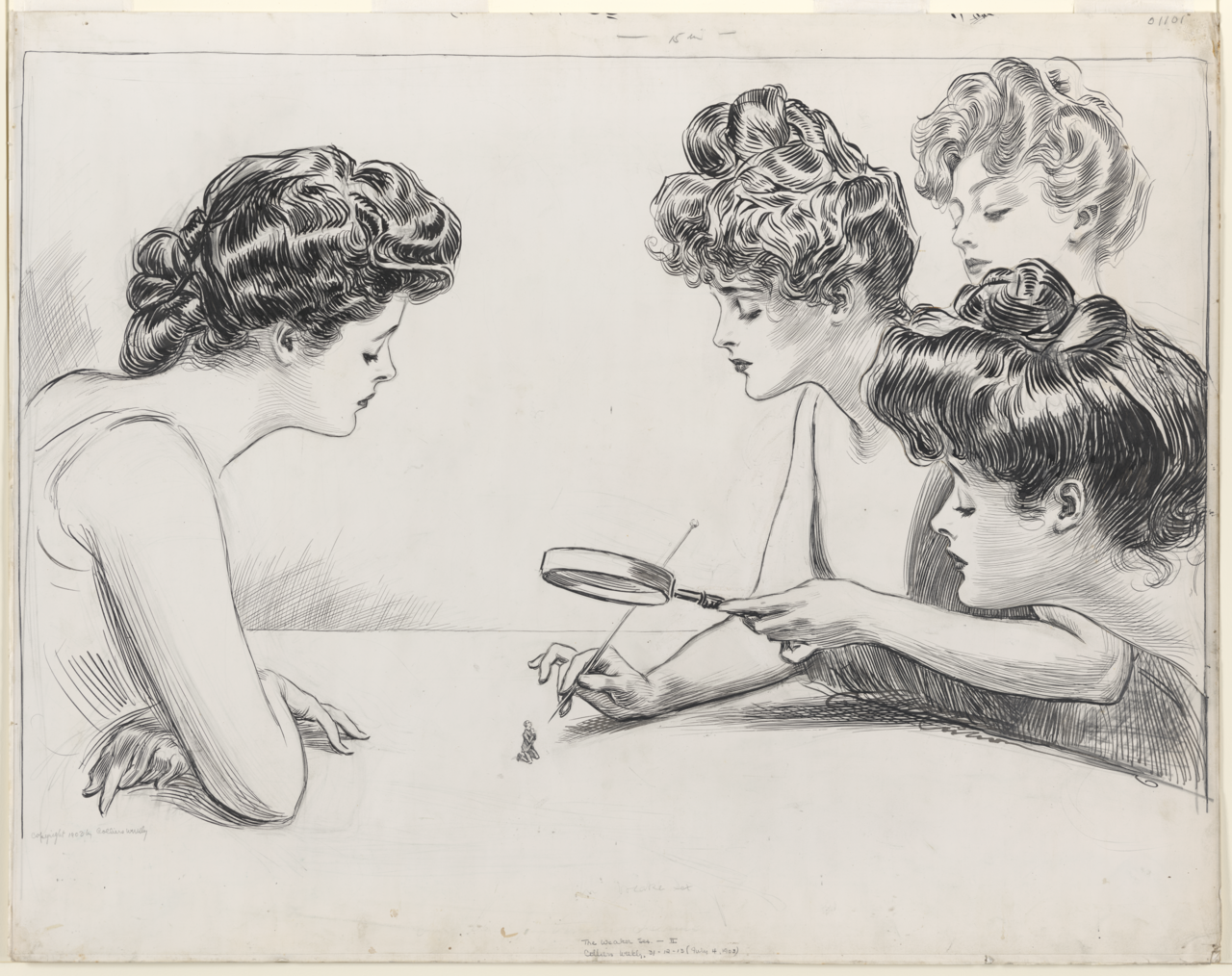
That shift followed almost twenty years of pompadour dominance. The look traced back to the Gibson Girl, the pen-and-ink ideal that illustrator Charles Dana Gibson had been drawing since the 1890s, all swept-up hair and hourglass posture.
Real women like stage actress Camille Clifford and Evelyn Nesbit brought the drawing to life, and by the late 1900s the pompadour had grown wide and flat to support the era’s enormous hats. Getting that shape usually meant padding the hair with a “rat,” a wad of hair saved from a woman’s own hairbrush over weeks or months and rolled into a form to build volume underneath the visible hair.
By 1910 the pendulum had swung toward something softer. The Grecian style favored a low knot at the back of the head, sometimes wrapped in a wide braid and pinned with shell combs, with a few curls left loose against the neck.
The Call’s piece also covered two variations building on that same idea, the Gainsborough style with its heavy crown of loose curls and a soft twisted band around the head, and a revived waterfall style that let the back hair fall in puffs from within an encircling twist.
For evening, a metal ribbon band finished with a rosette dressed up the same basic shape. Marcel waves, made with heated curling irons patented decades earlier, gave the soft, fluffy texture these styles depended on.

World War I broke the pattern for good. With men off fighting and women taking over factory and office jobs by the millions, elaborate hair that required daily attention and an army of pins became a practical liability.
Dancer Irene Castle got credit for the biggest shock to the system when she cut her hair short around 1914, a style so unexpected at the time that it made headlines on its own. Bobbing spread slowly and carried real social risk through the rest of the decade, with plenty of families treating a daughter’s short hair as scandalous rather than stylish.

By the time the war ended in 1918, the pompadour and its Grecian successor were both on the way out. The bob that Irene Castle had popularized went mainstream in the 1920s, turning what had been a daring wartime shortcut into the defining look of the flapper era.

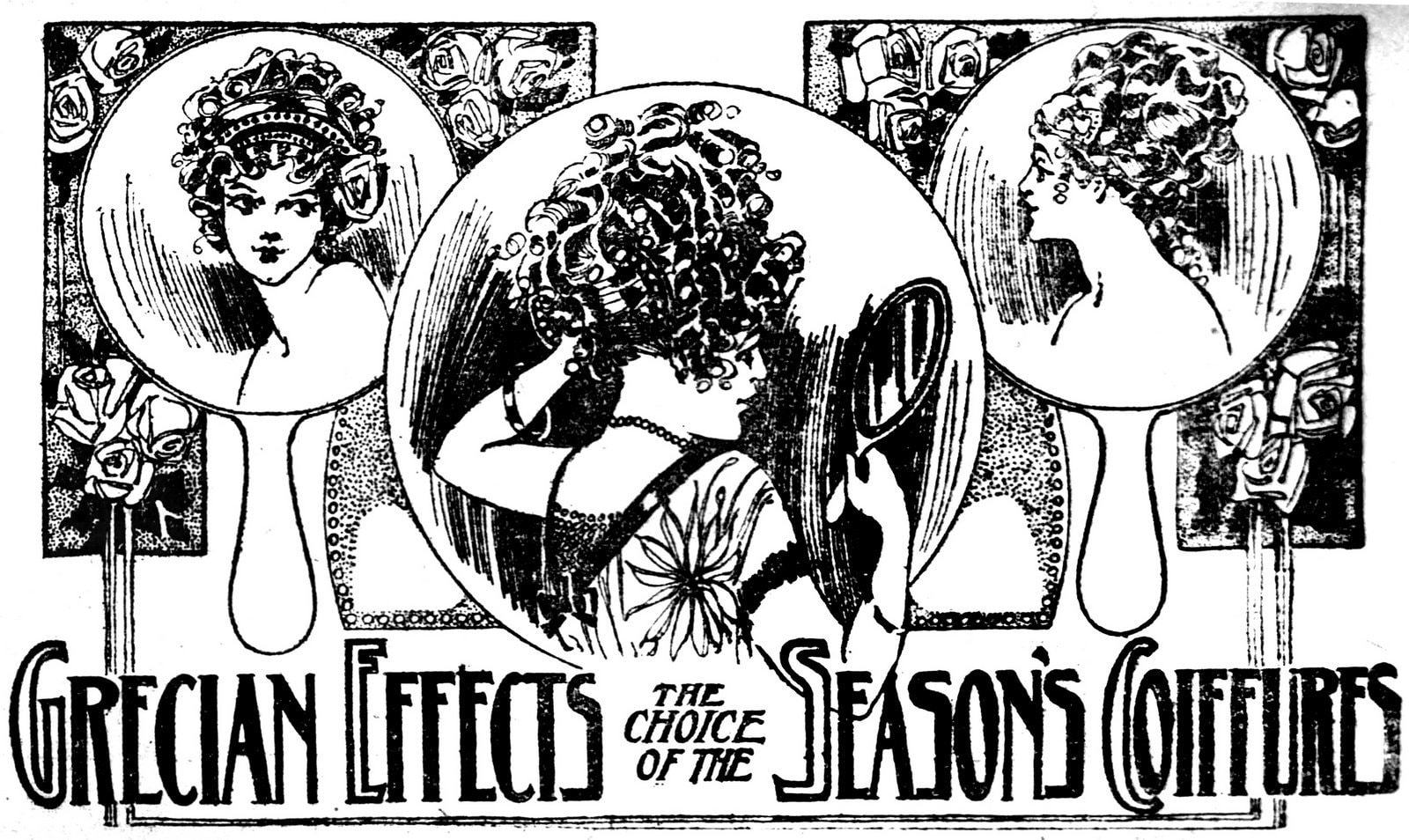
1910s hairstyles: Grecian effects the choice of the season’s coiffures
by Jane Brayton
Time was when the “little girl who had a little curl that hung in the middle of her forehead” was an object of envy to every straight-haired mother’s daughter of us. But now if the poor soul is adorned with only the curls that grew on her little topknot, we pass her by with pity and hie us to a bargain counter, where we may buy yards and yards of ringlets.
It is the day of the curl, and nature never planted enough curls on anybody’s head, except perhaps on Medusa’s, to meet the requirements of the present fashions.
The general contour of the most favored coiffures is decidedly Grecian, but with such fluffy additions as to make the classic mode becoming to almost any face.
About the face, the hair is dressed very softly and naturally, either parted or with a sort of curled bang effect about the large Greek knot at the back of the head is placed a wide braid caught here and there with the fashionable shell pins, if desired, and from beneath this three to five curls hang upon the neck. For evening, when a band of metal ribbon is brought around the head, finished perhaps with a rosette or cabochon, the effect is most attractive.

1910s hairstyles: The Gainsborough style
The Gainsborough style requires forty-‘leven curls. A soft twist of hair encircles the head, after the manner of the turban braid. The crown of the head is then filled in with a mass of loose curls, with several of them escaping from under the twist in the back to lie on the nape of the neck.
For the young face, to which the ringlets hanging in front of the ears can not import an old-maidish look, what is called the Recamier mode is very winsome. The hair is usually parted and allowed to fall in apparently careless curls over the ears. A tumble of curls is arranged at the top of the head and a narrow band of velvet or ribbon holds them in place.
One of the simpler effects is produced by covering the beehive frame — a wire, hair-covered frame, having a hole in the center of it that fits over the head like a cap — with a wide thick braid pulled out so that the sides of it completely cover the frame. About this is twisted a soft coil which may be held by big pins or threaded with gauze or satin ribbons for dressy occasions.
The old-fashioned waterfall hairstyle
The old-time waterfall style has been revived, with slight changes. The front hair is dressed becomingly, and the back hair is drawn to the crown of the head to fall in puffs and curls within the encircling twist of hair.
The pompadour has departed. The mattresses, with which we were wont to upholster our forehead, we now apply to the back of our heads, but the hair about the face must have a soft, fluffy, careless appearance. In spite of the tendency to very massive effects in present hair dressing, the trend is toward greater simplicity in arrangement, with the preference for the Greek angle or for the high dressing on the top of the head.