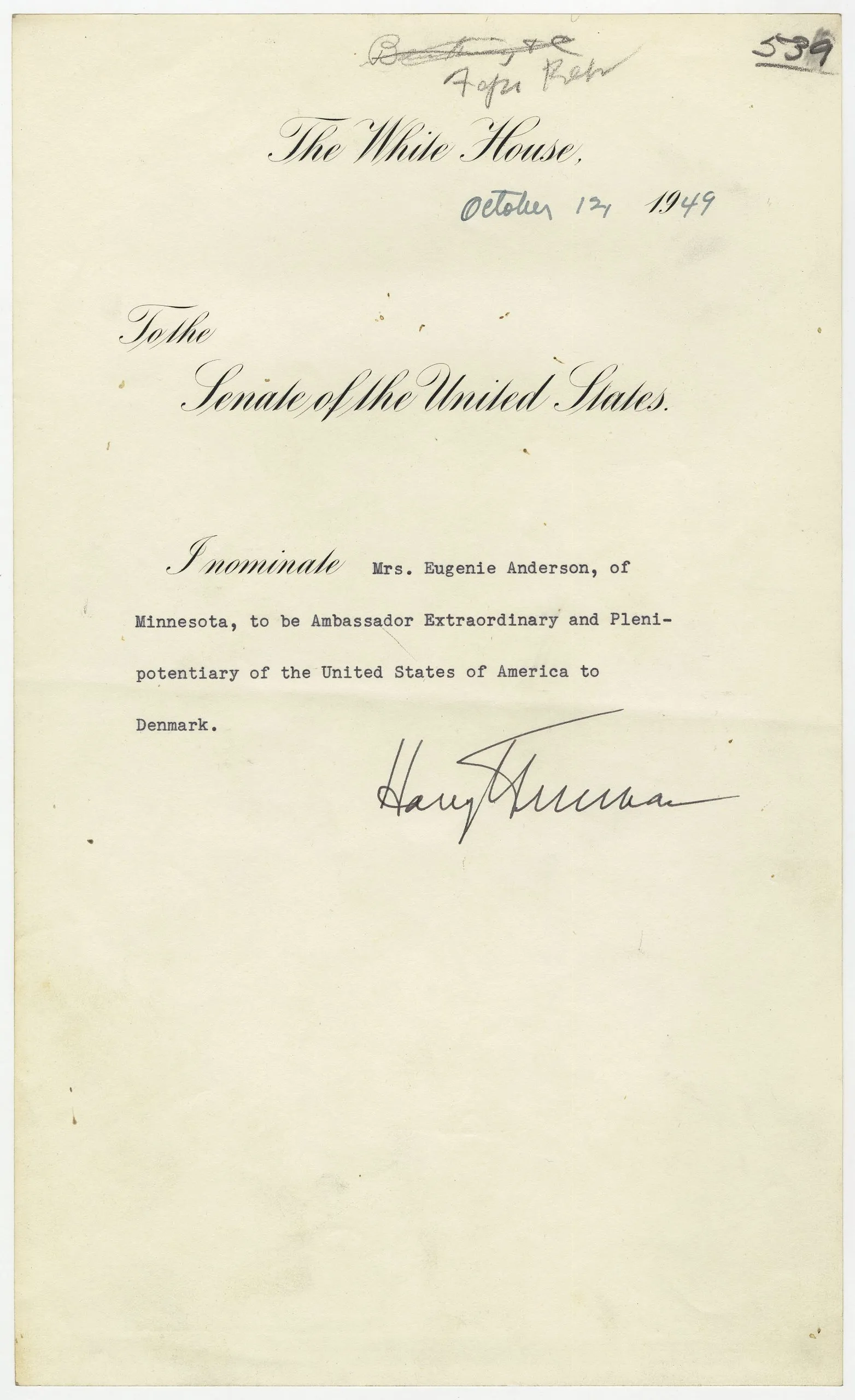
That 1949 poll landed in a specific moment. President Truman had just named Eugenie Anderson of Red Wing, Minnesota, as ambassador to Denmark, the first woman to hold that rank in US diplomacy, after earlier appointments had only reached the level of minister. Writer Vincent Sheean had also just argued in a magazine piece that a woman president would function as a powerful symbol of America’s desire for peace, coming only a few years after the Second World War.
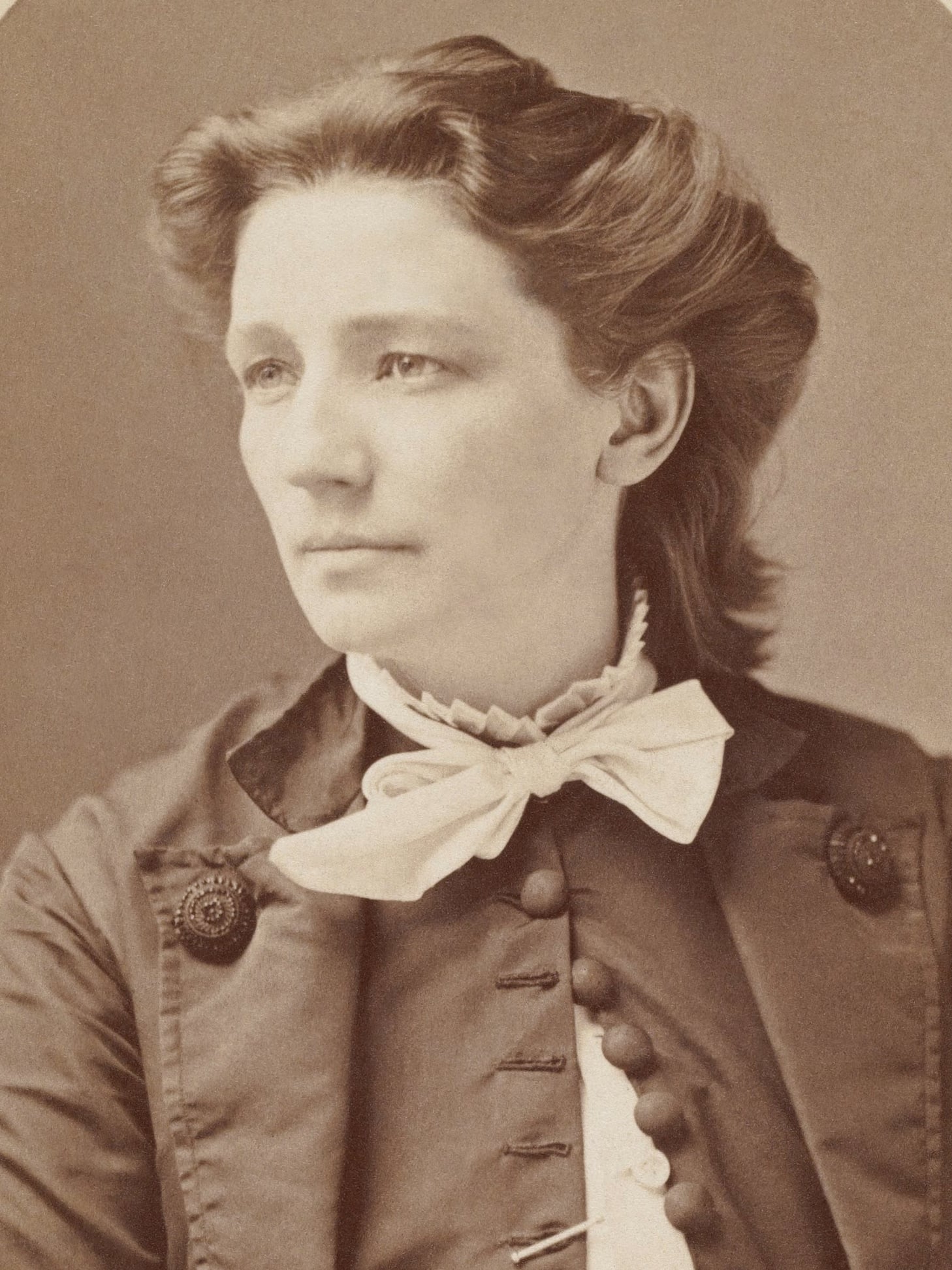
The idea of a woman running the country went back much further than 1949. Stockbroker and newspaper publisher Victoria Woodhull ran for president in 1872 on the Equal Rights Party ticket, nearly fifty years before the 19th Amendment gave women the vote at all. She named Frederick Douglass as her running mate, though he never acknowledged the nomination and campaigned for Grant instead.
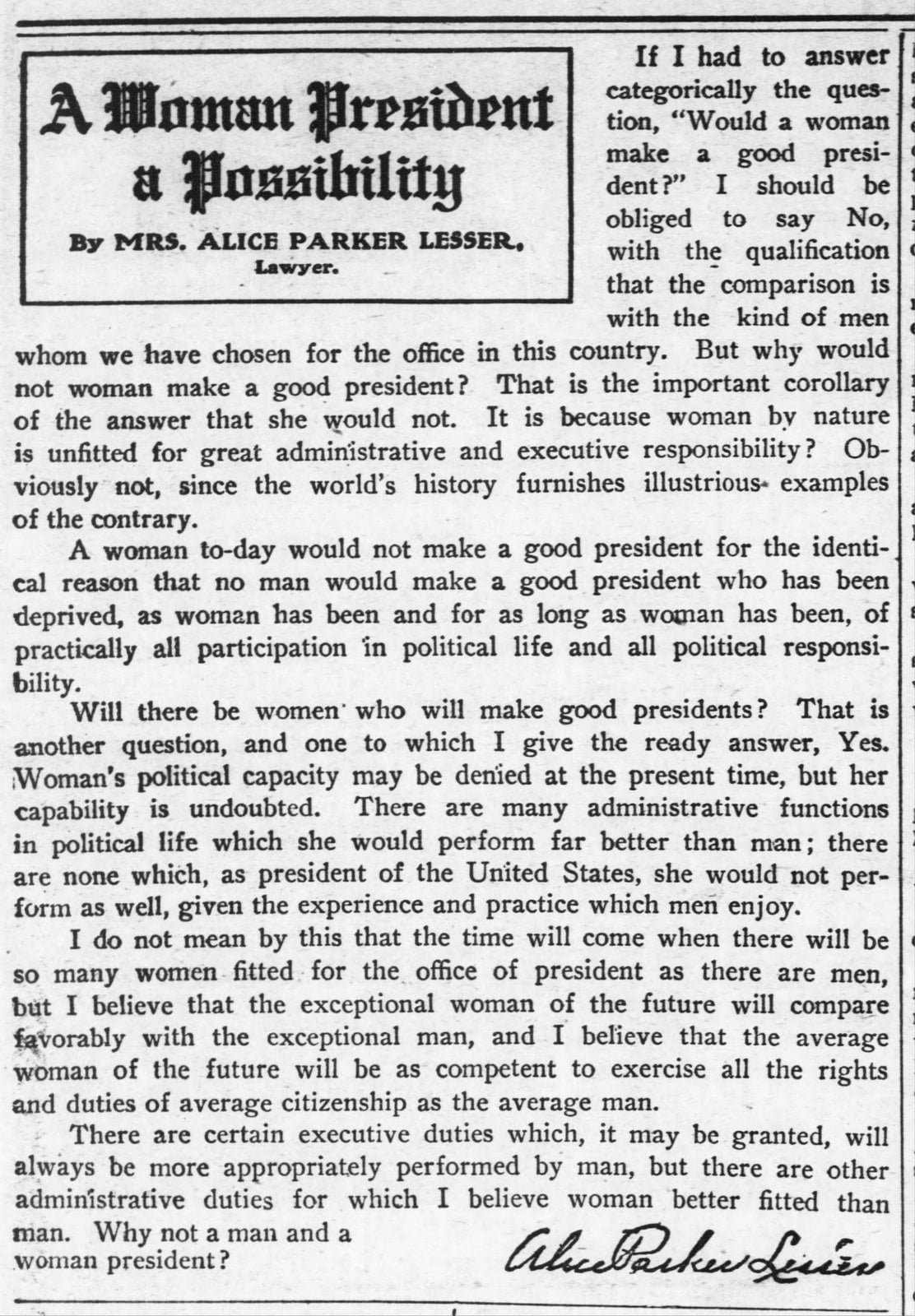
By 1906, the debate had shifted from whether a woman could run to whether she could govern well. Lawyer Alice Parker Lesser wrote that a woman would make a poor president for the same reason an inexperienced man would, having been shut out of political life for so long, and predicted that women’s capability would show once the opportunity did too.
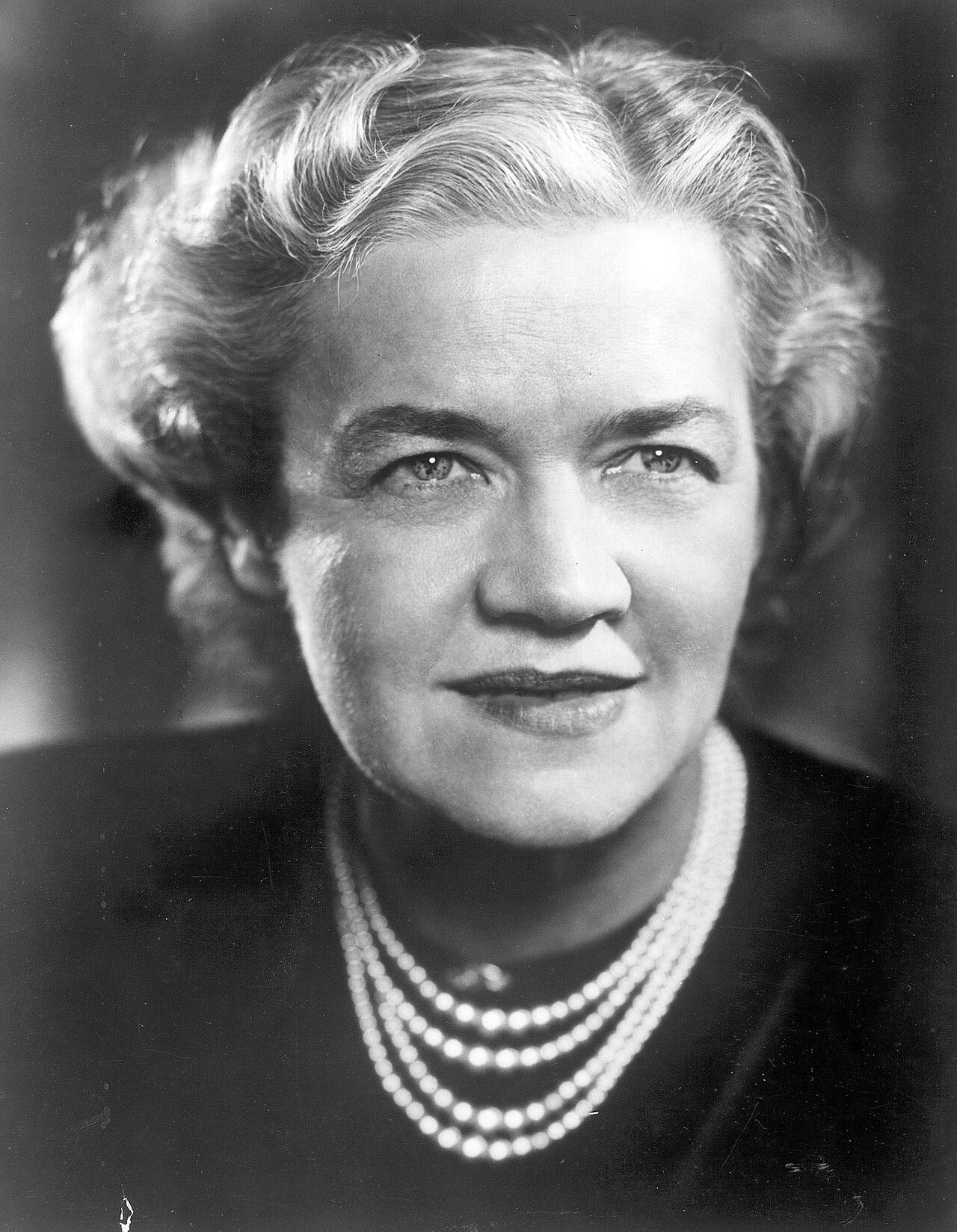
Gallup kept measuring the question through the 1950s, and the results moved with real hesitation. A 1956 survey of teenagers found nine out of ten high school boys thought the presidency was too demanding for a woman, while 42 percent of girls said they would back one if she had the stature of Eleanor Roosevelt, Margaret Chase Smith or Clare Boothe Luce. Wyoming had already elected the country’s first woman governor, Nellie Tayloe Ross, back in 1924, and by the mid 1950s a slim majority of adults nationally said they’d vote for a qualified woman for president.
A 1963 Gallup poll found the presidency still lagged behind other barriers Americans were willing to cross. Eighty four percent said they’d vote for a Catholic candidate and 77 percent for a Jewish one, compared with just 55 percent for a woman, and women polled were slightly more skeptical than men were. The survey ran the same month Margaret Chase Smith was weighing a run for the Republican nomination, which she announced two months later, becoming the first woman to actively campaign for a major party’s nomination.
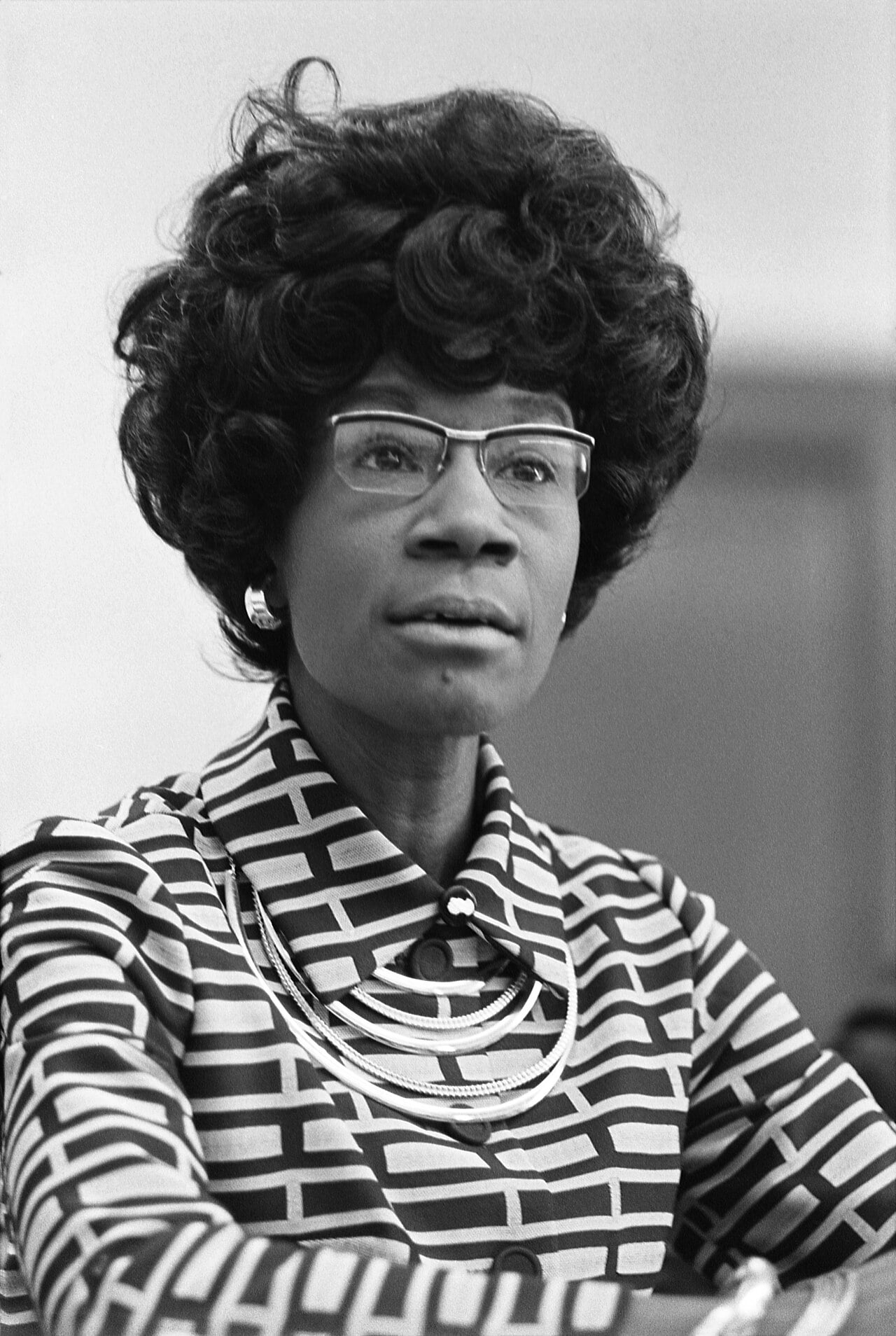
Shirley Chisholm followed in 1972, becoming the first woman to seek the Democratic nomination and the first Black candidate from either major party. Support for a woman president kept climbing through the decade, reaching 66 percent in 1971 and continuing upward as the women’s movement gained ground nationally.
By 1983, Ladies’ Home Journal ran a package asking whether the country was ready, with journalist Theodore White arguing it likely wasn’t yet and a separate item floating word that Republicans were considering Supreme Court Justice Sandra Day O’Connor for vice president in 1984. The magazine guessed wrong on both the party and the name. Geraldine Ferraro, not O’Connor, became the first woman nominated for vice president by a major party that year, joining Walter Mondale’s Democratic ticket.
VIDEO | Geraldine Ferraro accepts VP nomination at 1984 DNC

Support for a woman president crossed 80 percent by the late 1980s and topped 90 percent by the turn of the millennium, numbers that have held steady since. Hillary Clinton became the first woman nominated for president by a major party in 2016 and won the popular vote before losing the electoral college, and Kamala Harris became the first woman elected vice president in 2020 and the Democratic presidential nominee in 2024.
A woman president a possibility (1906)
Lane County Journal (Dighton, Kansas) April 27, 1906
By Mrs Alice Parker Lesser, Lawyer.
If I had to answer categorically the question, “Would a woman make a good president?” I should be obliged to say No, with the qualification that the comparison is with the kind of men whom we have chosen for the office in this country. But why would not woman make a good president? That is the important corollary of the answer that she would not. It is because woman by nature is unfitted for great administrative and executive responsibility? Obviously not, since the world’s history furnishes illustrious examples of the contrary.
A woman to-day would not make a good president for the identical reason that no man would make a good president who has been deprived, as woman has been and for as long as woman has been, of practically all participation in political life and all political responsibility.
VIDEO | History of Victoria Woodhull

Will there be women who will make good presidents? That is another question, and one to which I give the ready answer, Yes. Woman’s political capacity may be denied at the present time, but her capability is undoubted. There are many administrative functions in political life which she would perform far better than man; there are none which, as president of the United States, she would not perform as well, given the experience and practice which men enjoy.


I do not mean by this that the time will come when there will be so many women fitted for the office of president as there are men, but I believe that the exceptional woman of the future will compare favorably with the exceptional man, and I believe that the average woman of the future will be as competent to exercise all the rights and duties of average citizenship as the average man.
There are certain executive duties which, it may be granted, will always be more appropriately performed by man, but there are other administrative duties for which I believe woman better fitted than man. Why not a man and a woman president?
The idea of a woman president gains in favor
George Gallup, Abilene Reporter News (Texas) October 29, 1949
Princeton, NJ, Oct 28, 1949 — A woman for President of the United States? American voters are getting to like that idea better and better.
Twelve years ago, they turned thumbs down on it with a resounding NO in an Institute survey. Today, the cause of women’s rights has advanced to the point where opinion is evenly divided on the idea of a woman for President. A woman in the Vice-Presidential spot gets an even more favorable vote.
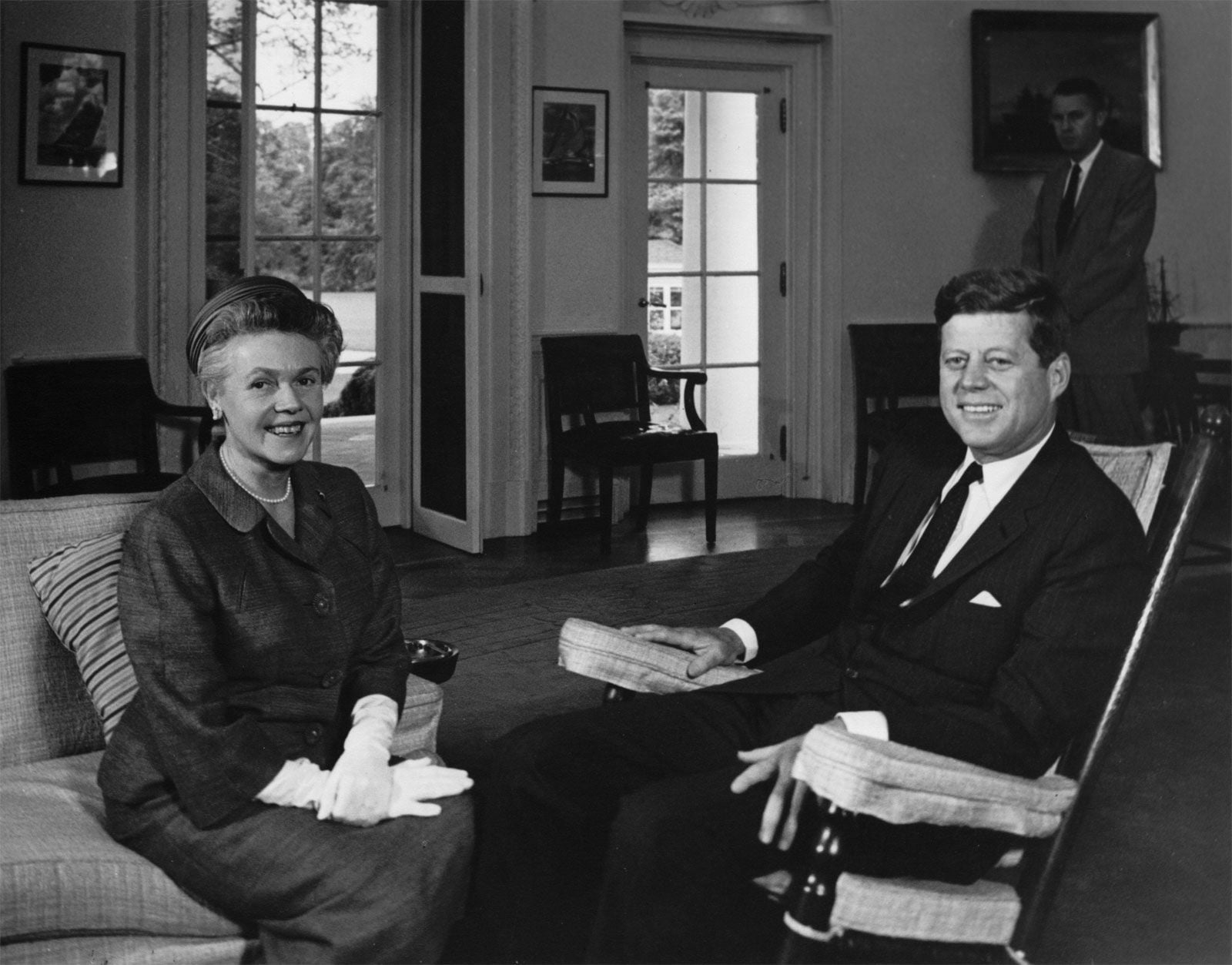
The importance of women in politics was highlighted this month when President Truman appointed America’s first woman ambassador — Mrs Eugenie Anderson of Red Wing, Minn — to be our envoy to Denmark. (Women have previously been appointed as ministers only). Having a woman for President was proposed recently by Vincent Sheean in a magazine article on the grounds that a woman as Chief Executive would be an “irresistible symbol” of America’s desire for peace.
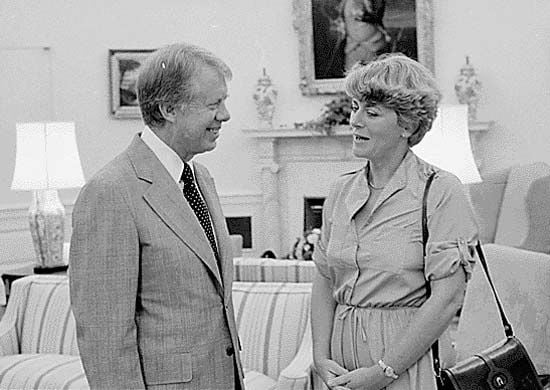
Voters questioned on the idea of a woman president
The idea of a woman in the White House was put before the nation’s voters by the Institute in interviews with a balanced cross-section in all states. Here are the results and a comparison with a similar survey in 1937:
“If the party whose candidate you most often support nominated a woman for President of the United States, would you vote for her if she seemed qualified for the job?”
Today [1949]
Yes: 48%
No: 48%
No opinion: 4%
1937
Yes: 33%
No: 63%
No opinion: 4%
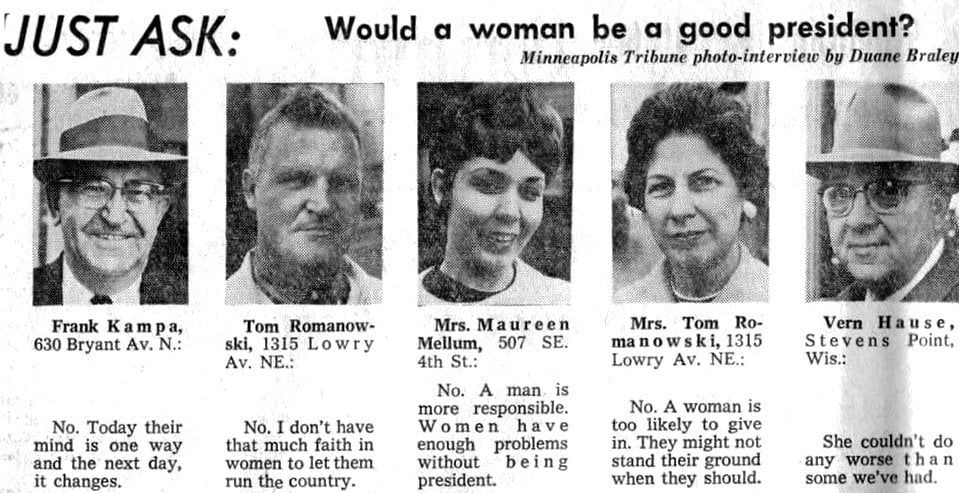
‘Mrs President’ is not in the cards, a survey of future voters indicates
Gilbert Youth Research Co – Logansport Press (Indiana) Oct 21, 1956
You’ll wait a long time for a woman president if teenagers — the voters of tomorrow — have their way.
Nine tenths of high school boys feel the job is too tough and too complex for a woman. And while many girls in the same age bracket believe a woman could handle the office all right, 58 percent say — for various reasons — that the ladies had better direct their political ambitions elsewhere.
To governorships, for example. Many more youngsters say women could make good governors. Or to the Supreme Court of the United States. Fifty-seven percent of the boys and 73 percent of the girls believe women could serve capably on the high tribunal.
These reactions turned up in our nationwide survey on the youngsters’ views of woman’s place in the higher spheres of public life and business.
The question of a woman president is often batted around in election years. Former President Harry S Truman has said that a woman may well occupy the White House someday. And President Eisenhower has said that women are competent for the office — though too smart to seek it.
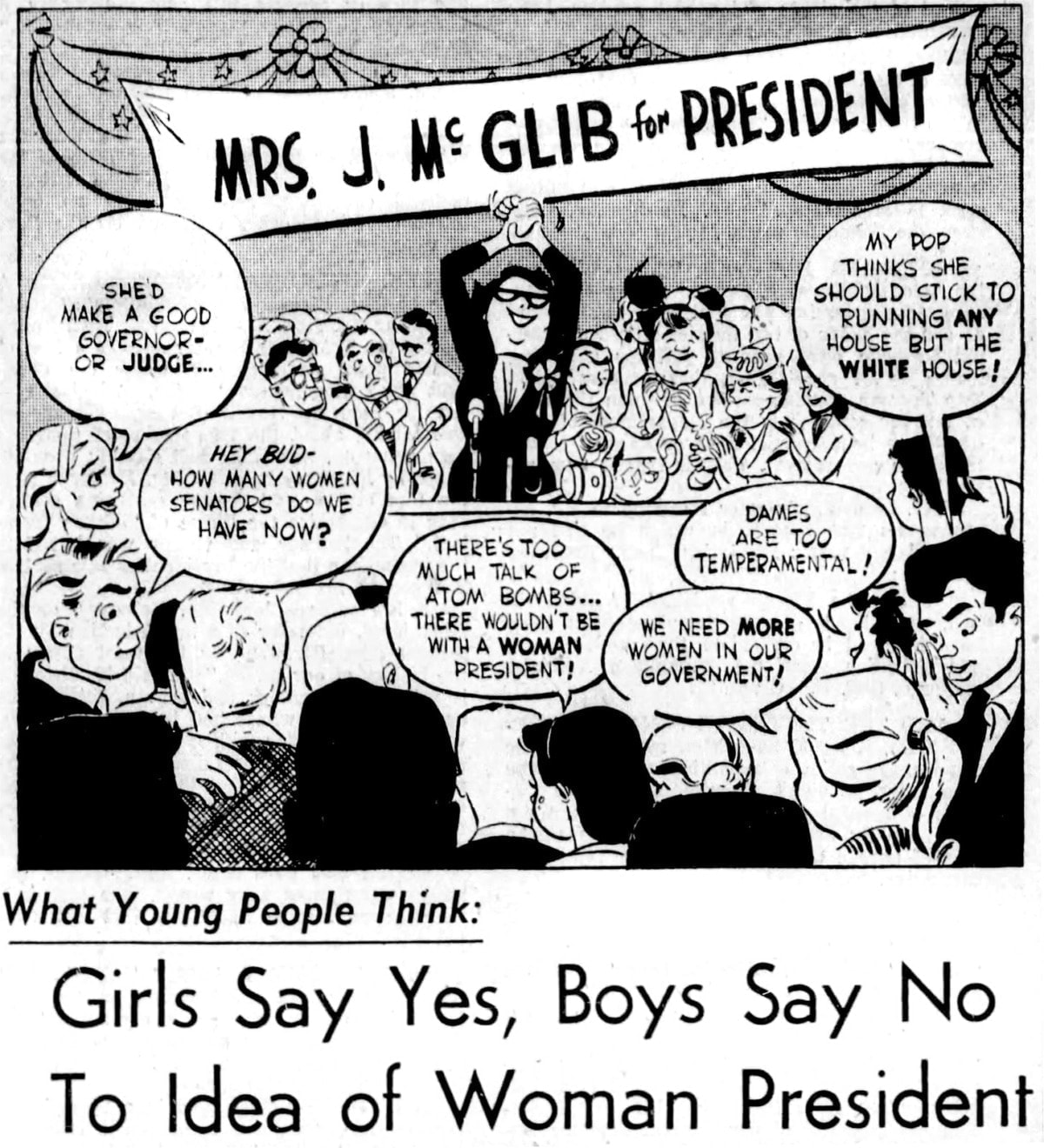
Too temperamental?
But 92 percent of the boys we queried disagree sharply. They’re convinced the presidency is a job well beyond a woman’s capacities.
“Dames,” as one Chicago youngster expressed it, “are too temperamental. The first thing you know they lose their tempers. Boy, the country will be in a real mess the day a woman president takes office.”
Our survey indicates that many boys strongly suspect a woman’s place is in the home — not on the political hustings. Here’s how a lad from Minneapolis, speaking in the authentic voice of the 19th century, viewed things:
“When women stop rearing children to go into politics, we will be in a sorry state. What will happen to the home without the mother influence? I don’t want to see it.”
Of course, women have been entering politics in increasing numbers. Sixteen served in the last session of Congress, including Sen. Margaret Chase Smith, the Maine Republican. They’ve held Cabinet posts and been ambassadors.
With this in mind, apparently 42 percent of the teen-aged girls we queried expressed themselves in favor of a woman President — provided the candidate was of the caliber of Mrs Eleanor Roosevelt, Senator Smith, or Clare Boothe Luce, the United States ambassador to Italy.
Girls fear war
In fact, many of the girls feel the country might be better off with a woman at the helm.
“If women were running the country,” a New Jersey girl said, “there wouldn’t be so much talk of wars.”
Distrust for male pugnacity was implied also in this response by a Kansas high school girl: “Women don’t want to go out and conquer the world. When we have a woman President, she will concentrate on ‘domestic tranquility’ and not on producing atom bombs.”
While most of the girls believe women are perfectly capable of handling presidential chores, 58 percent turned thumbs down on the idea. Among these, the thought predominated that ingrained male prejudices would make a feminine bid for the presidency largely a waste of time.
While no woman has ever been nominated for the presidency or the vice presidency by any major party, there have been women governors. The first was Nellie Tayloe Ross, elected in Wyoming in 1924.
Business women OK
And a much larger percentage of young people in our survey professed no objection to lady governors. Thirty-three percent of the boys and 55 percent of the girls thought women might make good chief executives of their states.
A Missouri girl said: “Women are especially good at the personal approach. I think that heading a state would require lots of this talent. Nothing is as important as getting on friendly terms with the inhabitants. And in this a woman could really excel.”
While youths are somewhat bearish on the talents of women for high public office, they’re apparently prepared to allow them greater latitude in the business world.
Some 76 percent of the teenagers, of both sexes, said the fact that a woman ran a company that employed them would not cause them to lose enthusiasm for their job.
Having a woman for an immediate superior, however, was a different question. But even here, 66 percent of the girls and 63 percent of the boys said they could see no objection.
One fervent minority report came from a 17-year-old youngster who had summer job experience with a lady boss. “That woman was the hardest taskmaster I’ve ever run into,” he complained. “No man would be that tough with us. I’ll take a man giving the orders any day.”
But if there was no strenuous opposition to women running business firms, there was marked division of opinion on their service on the boards of large corporations.
The girls — 75 percent of them — thought that women should be represented on the boards of every major corporation, particularly in view of women’s extensive stock ownership. Seventy-one percent of the boys failed to see much sense in this argument.
Gallup poll: Women lag in support for presidency
Star Tribune (Minneapolis, MN) November 15, 1963
If Sen. Margaret Chase Smith of Maine decides next month to run for the presidency, the Republican senator will encounter a prejudice of considerable proportions — from her own sex.
One of the greatest prejudices still to be found in politics today — a recent Gallup Poll indicates — is not religion, but sex.
Whereas 84 percent say they would vote for a well-qualified person for President if he were a Catholic and 77 percent say they would vote for a Jew, only 55 percent indicate that they would vote for a woman for this job.
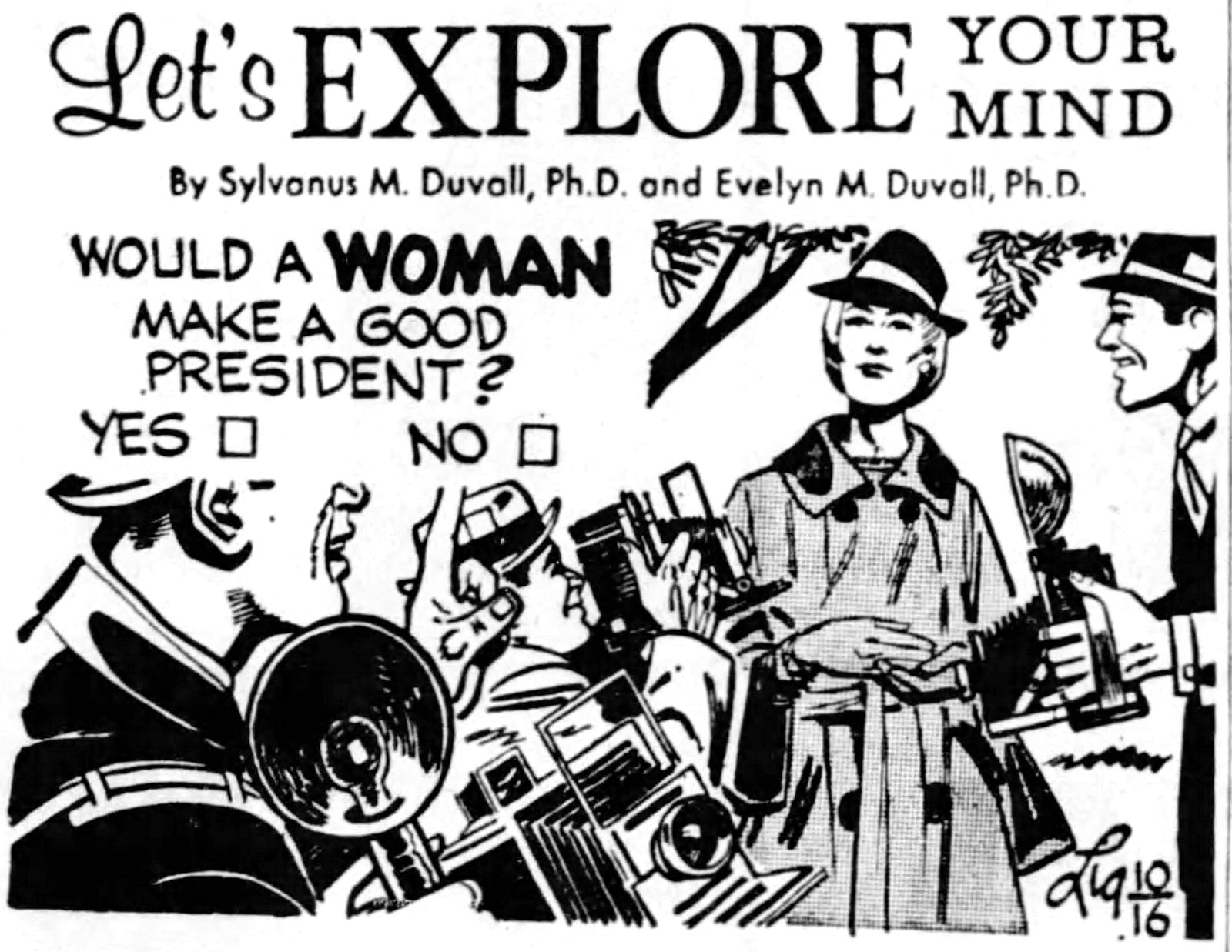
WHAT SEEMS strange in this era — when women are fighting for equal rights — is that women themselves are more opposed to a president of their own sex than are men.
Over the years, the Gallup Poll has regularly measured the prejudice of the American public in the area of politics by means of questions like the following:
“If your party nominated a woman for president, would you vote for her if she qualified for the job?”
In the last five years, greater proportions of the public than ever before say they would vote for a Jew, a Catholic, or a Negro, but only a slight decline in prejudice has been registered in the case of a woman over this period.
THE PRESENT findings, however, show a tremendous change from 26 years ago. A Gallup Poll in 1937 found opinion about two-to-one against having a woman as chief executive.
The following table compares the most recent figures with those of five and 26 years ago:
VOTE FOR WOMAN FOR PRESIDENT?
(With “No opinion” responses excluded)
1937 — Yes: 34%, No: 66%
1958 — Yes: 55%, No: 45%
1963 — Yes: 57%, No: 43%
With the “don’t knows” included, the 1963 results are: Yes—55 per cent, No—41 per cent, and No opinion—4 per cent.
Here is the vote by men and women in the latest [1963] survey:
Men — Yes: 58%, No: 37%, Don’t know: 5%
Women — Yes: 51%, No: 45%, Don’t know: 4%
Unlike today, men in 1937 were far more opposed to the idea of a woman as president than were women.
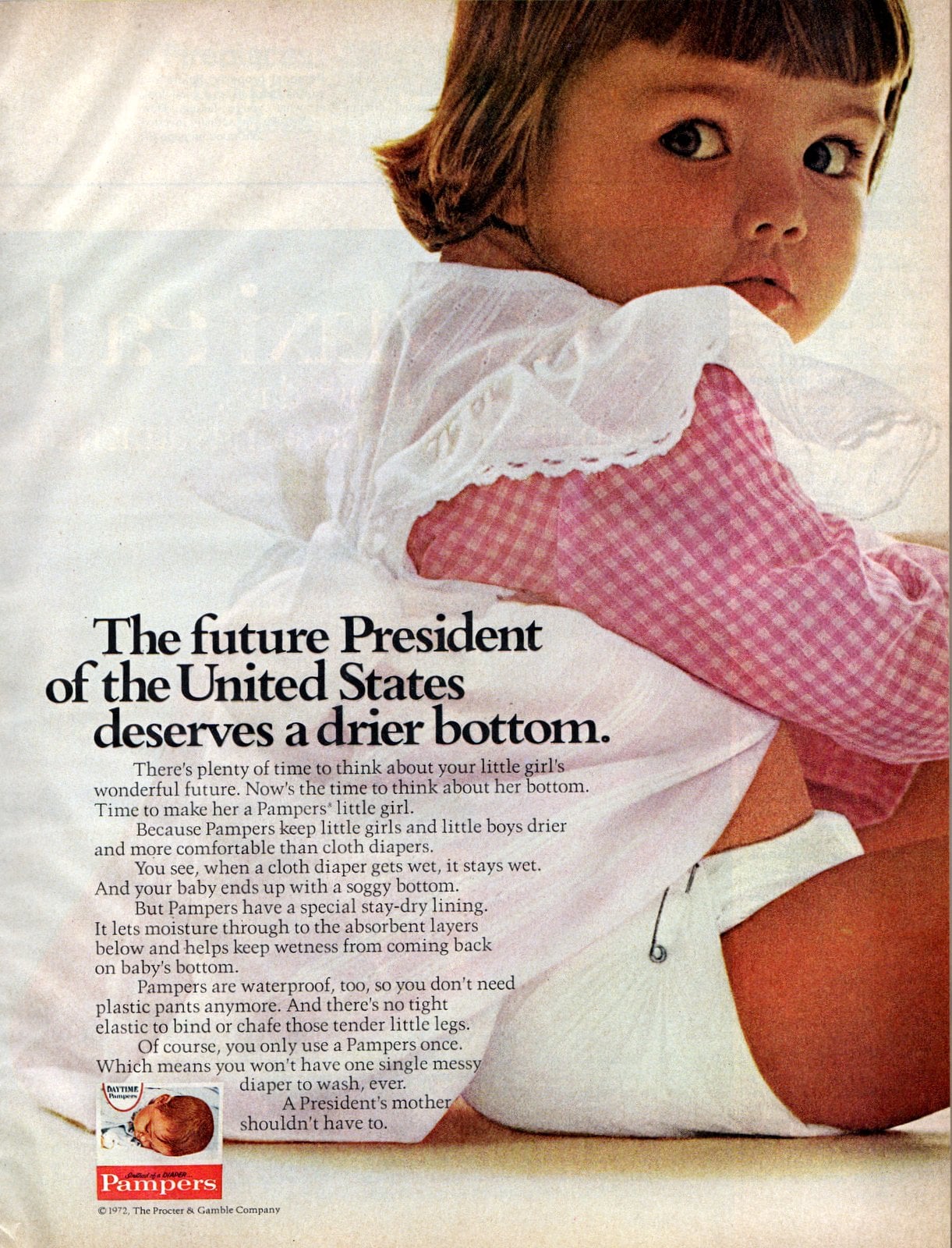
Old Pampers ad – Future President of the US (1972)
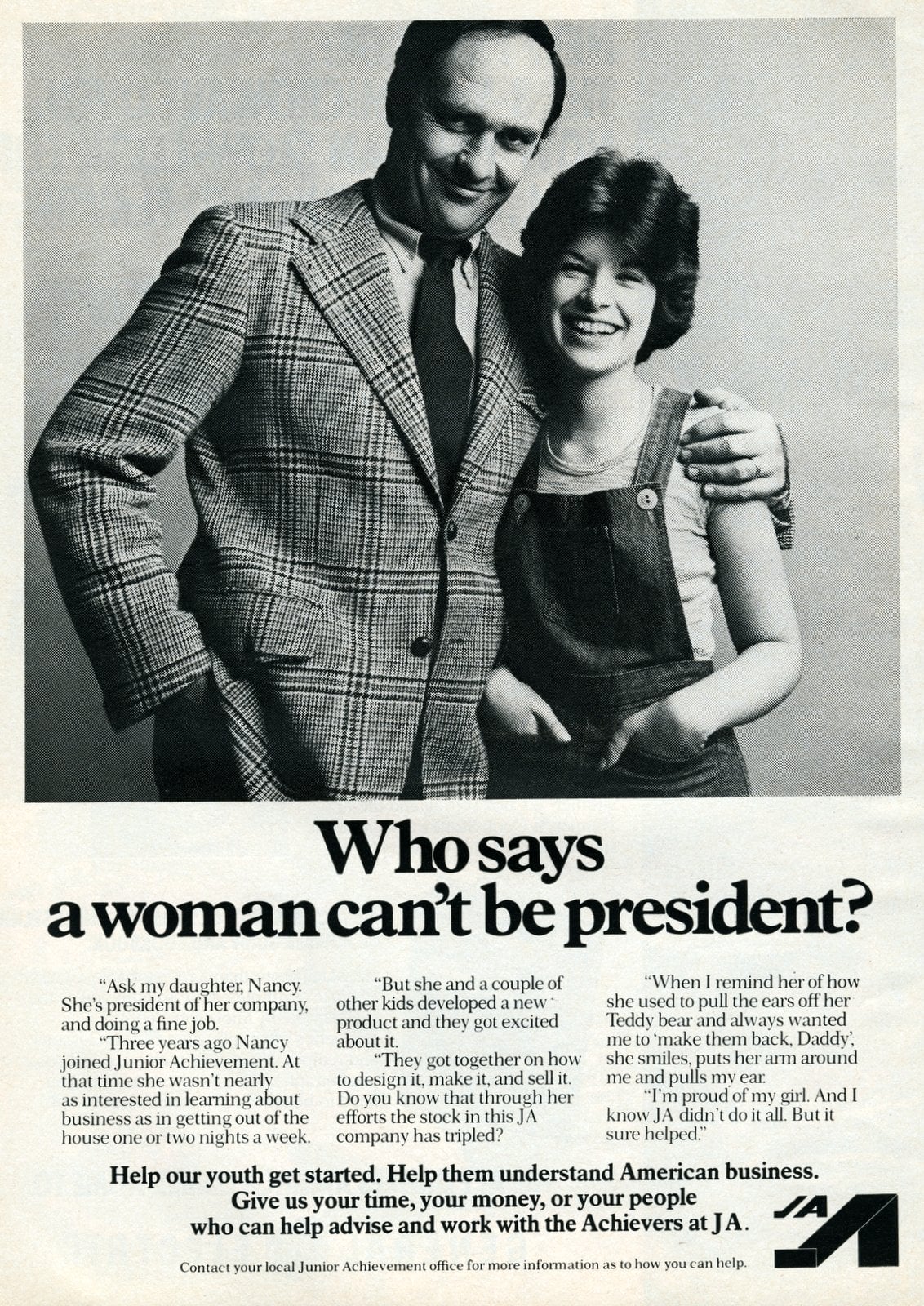
Who says a woman can’t be president? (1977)
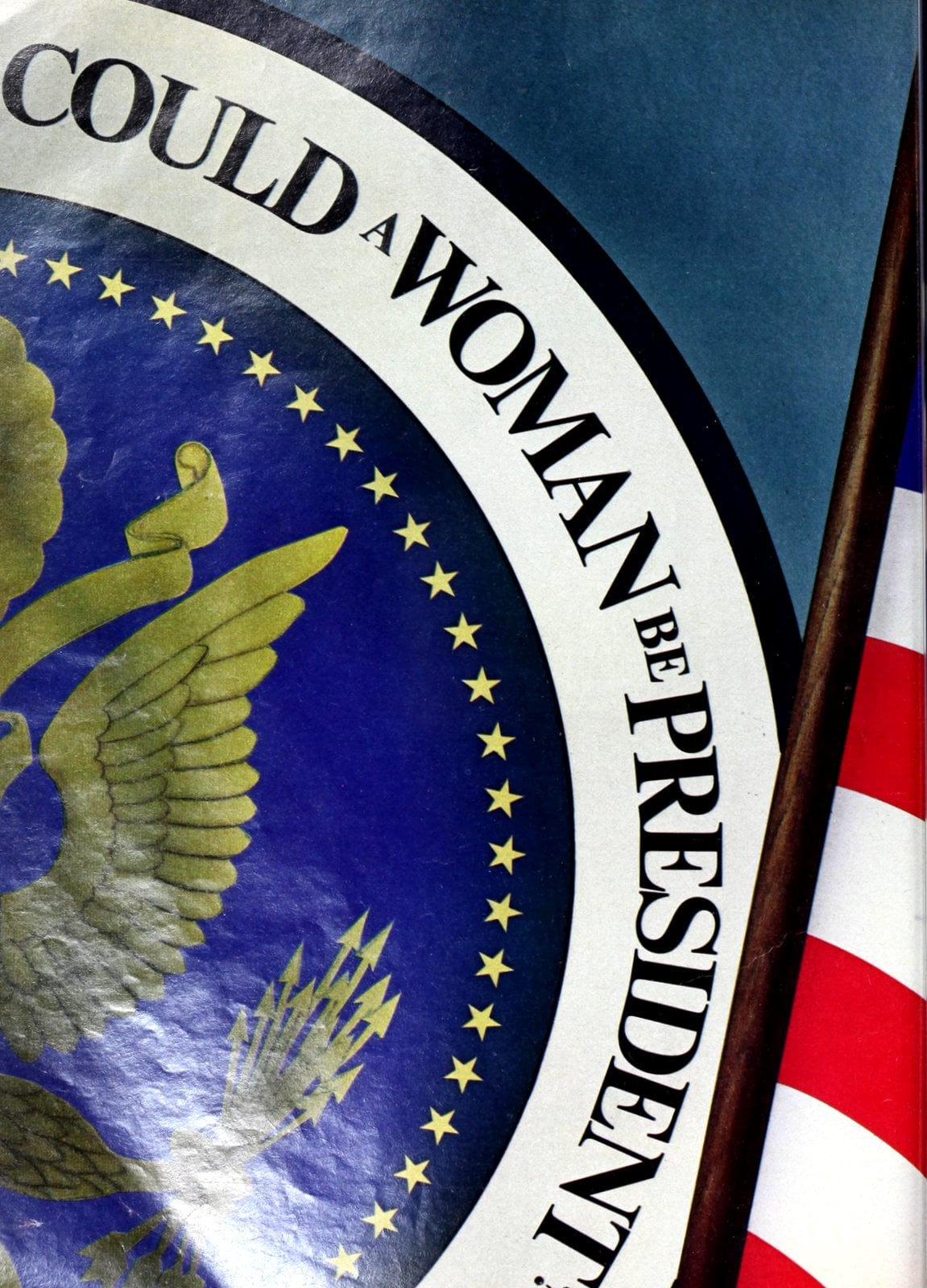
Could a woman be president? (1983)
From Ladies’ Home Journal (1983)
NOT YET!
SAYS THEODORE H. WHITE.
A LEADING POLITICAL WRITER TELLS WHY IT MAY TAKE YEARS TO PUT A WOMAN IN THE WHITE HOUSE.
Great happenings swell like deep waves. They roll unnoticed—until they burst in thundering crests.
One of the deepest swells rising in American history today is the phenomenal surge of women’s political power. And, so, a distant question beats insistently on the shores of our awareness: Can America expect to have a woman as President in the near future?
As someone who has been writing about national politics for thirty years, I should state my own position clearly. I do not care whether our President is black or white, Catholic, Protestant or Jew; nor, in the words of Good Queen Bess, do I care whether our President be “crested or cloven.” What I seek in a President is someone with a sense of history and a proven record of effective leadership, in or out of government. And I believe that these qualities can surface as well in women as in men… (Continued in magazine)
WHY NOT?
ASKS WILLIAM M. FINE.
HE POLLED A NUMBER OF WASHINGTON INSIDERS TO FIND THE MOST PROMISING CURRENT CANDIDATES.
In March, a New York newspaper reported the following item:
“Moderate Republicans are excitedly talking about a ‘dream ticket’ for the 1984 presidential elections. Should Ronald Reagan decide not to run for reelection, they propose nominating George Bush for President and Supreme Court Justice Sandra Day O’Connor for Vice-President.”
And the Republicans are not the only party with an eye on such a ticket. According to Mike Feldman, former White House counsel to President Kennedy, the Democrats may be due for a woman Vice-President in 1984. Feldman not only thinks the Democrats can win with a woman on the ticket, he thinks they are more apt to choose a woman than are the Republicans… (Continued in magazine)
WHAT DO YOU THINK?
ASKS MYRNA BLYTH, ED.-IN-CHIEF.
SINCE WOMEN ACCOUNT FOR MORE THAN HALF OF AMERICAN VOTERS, ISN’T IT TIME THEY MADE UP HALF OF OUR TOP LEADERSHIP? HERE’S HOW TO MAKE THIS HAPPEN.
Let’s be realistic. A woman probably could not be nominated for President during the next decade. But a woman could be nominated for Vice-President. Maybe… (Continued in magazine)