The first electric typewriter, featuring a printing wheel, was invented by Thomas Edison in 1872, though it went nowhere commercially. The concept sat mostly dormant until James Fields Smathers invented the first practical power-operated typewriter in 1914, and by 1925 Remington had released its first electric model based on Smathers’ design. Even then, adoption was slow.
IBM entered the picture in 1933 when it acquired Electromatic Typewriters, Inc. of Rochester, New York, and after significant investment in redesign, released the IBM Model 01 in 1935 — the first electric typewriter to achieve long-term commercial success in the United States. What made it useful in a practical sense was simple: each type bar hit the paper with the same force, and that force was more powerful than manual typewriters — particularly valuable in business settings where multiple carbon copies had to be produced at once and you needed that impact to go through all the layers.

- Ben'ary, Ruth (Author)
- English (Publication Language)
- 80 Pages - 04/19/1989 (Publication Date) - Tarcher (Publisher)
IBM kept refining the formula through the following decades. In 1941, the company announced proportional letter spacing for typewriters, though World War II delayed the actual product — the Executive model — until 1944. The Executive allowed skilled typists to produce output that looked closer to typeset text than anything a standard typewriter could manage, with four character widths instead of a fixed pitch. It was a genuinely different product category, aimed at offices that needed their correspondence to look polished.
By the late 1950s, IBM’s Model C Executive had added features like a decelerator mechanism for noise reduction, a carbon ribbon feed for cleaner printing, and an electric ribbon rewind — small improvements that added up to a much more capable machine than anything on the market a decade earlier.
Then came the Selectric. Introduced on July 31, 1961, the IBM Selectric replaced the conventional basket of individual typebars with a chrome-plated plastic element — frequently called a “typeball,” or less formally, a “golf ball” — that rotated and tilted to the correct position before striking the paper. When it debuted, the Selectric could print 186 words a minute, and six typefaces were available simply by substituting a different type element.
VIDEO | 1960s IBM Selectric commercial

The machine’s industrial design came from Eliot Noyes, an architect who served as IBM’s consulting design director for 21 years, and the result was available in eight color combinations. Sales in the first 30 days exceeded the six-month forecast — one IBM branch expected to sell 50 or 60 units and moved 500 to 600. Within a few years, the Selectric had become the standard piece of office equipment in the United States. By 1978, IBM held roughly 94% of the market for electric typewriters, thanks largely to the Selectric.
The Selectric also found a second life as one of the first computer terminals, functioning as keyboard input on the IBM System/360 — a preview of how thoroughly the office machine and the computer would eventually merge.
The Selectric III, the final model in the line, was sold in the 1980s with more advanced word processing capabilities and a 96-character printing element, before the brand was officially retired in 1986. By that point, more than 13 million machines had been made and sold.
VIDEO | 1980s IBM Selectric commercial

Personal computers and laser printers made the electric typewriter obsolete quickly enough that the transition was jarring — offices that had organized themselves around the Selectric for two decades had to relearn everything. The machine itself has held up in cultural memory, turning up in period productions set in mid-century offices and still sought out by collectors who find the tactile experience of typing on one genuinely different from anything a modern keyboard provides.
The photos and ads on this page offer a close look at IBM’s electric typewriter line as it stood in the mid-1960s — the Executive for offices that needed proportional spacing and a professional finish, the Selectric for everyone else who wanted the best machine on the market.
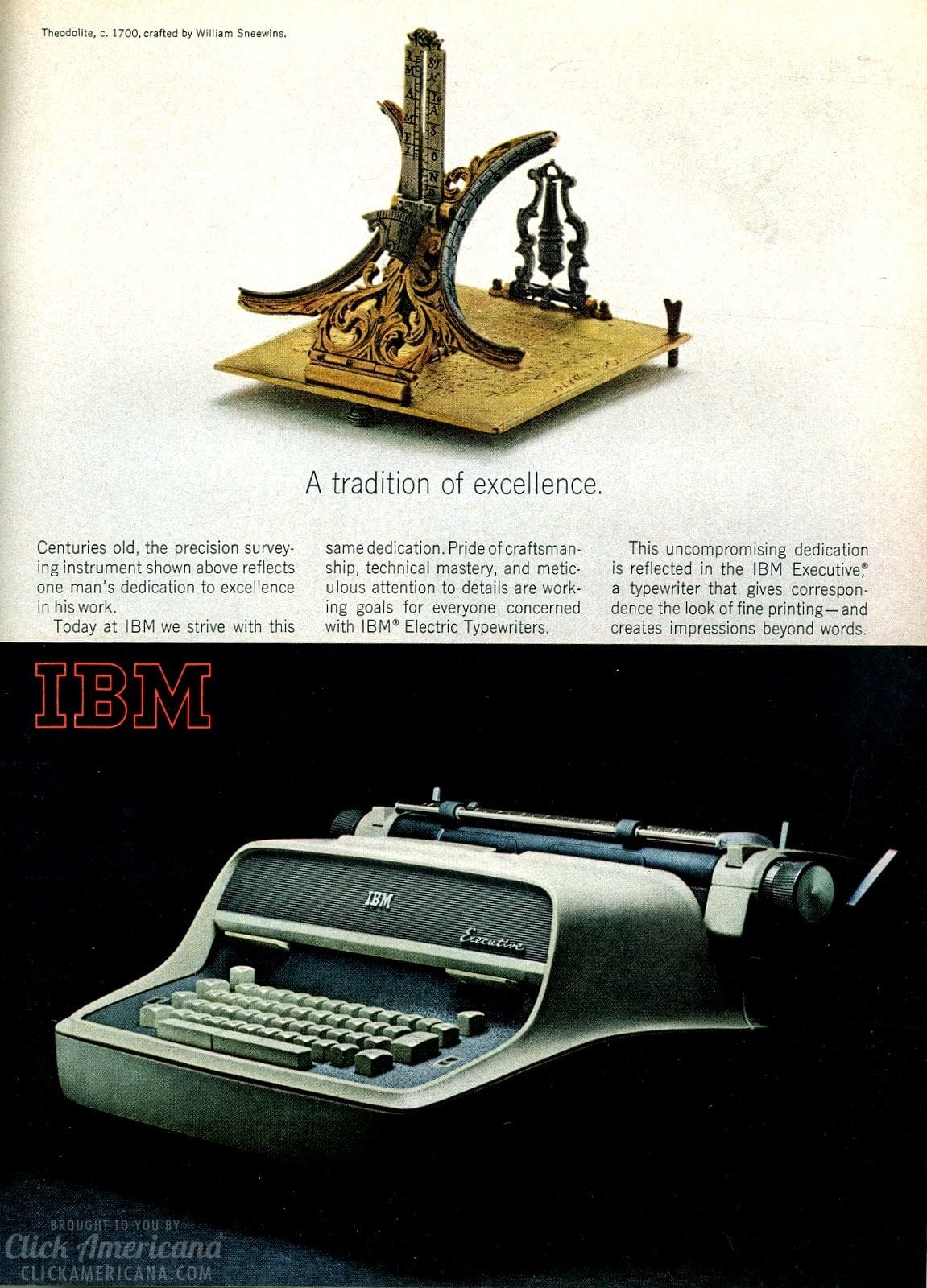
Old IBM electric typewriters – The Executive: A tradition of excellence (1965)
This uncompromising dedication is reflected in the IBM executive, a typewriter that gives correspondence the look of fine printing — and creates impressions beyond words.
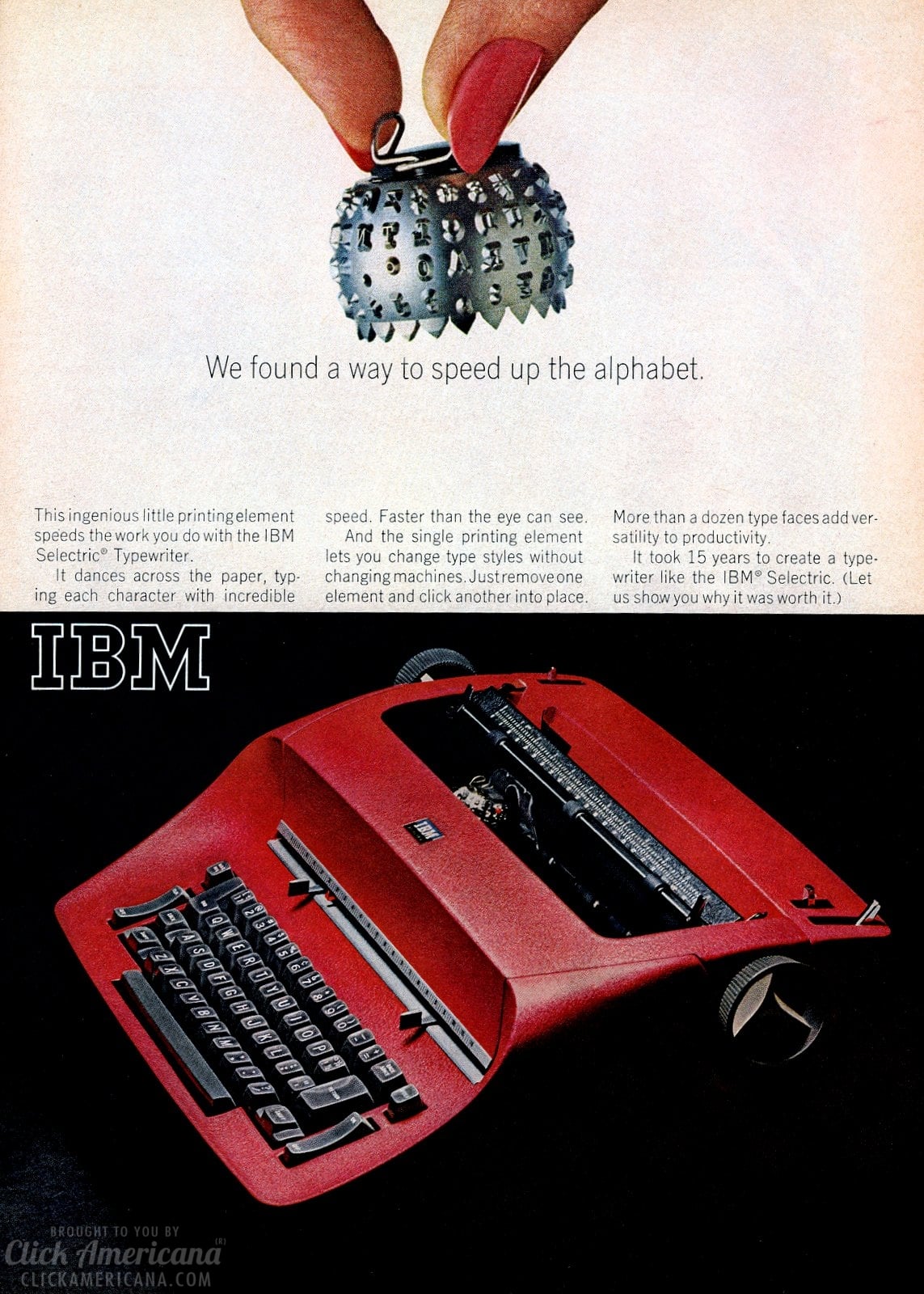
IBM Selectric typewriters: We found a way to speed up the alphabet (1965)
This ingenious little printing element speeds the work you do with the Selectric typewriter. It dances across the paper, typing each character with incredible speed. Faster than the eye can see.
And the single printing element lets you change type styles without changing machines. Just remove one element and click another into place. More than a dozen typefaces add versatility to productivity.
MORE: Vintage copy machines: See the kinds of old photocopiers that offices used to have
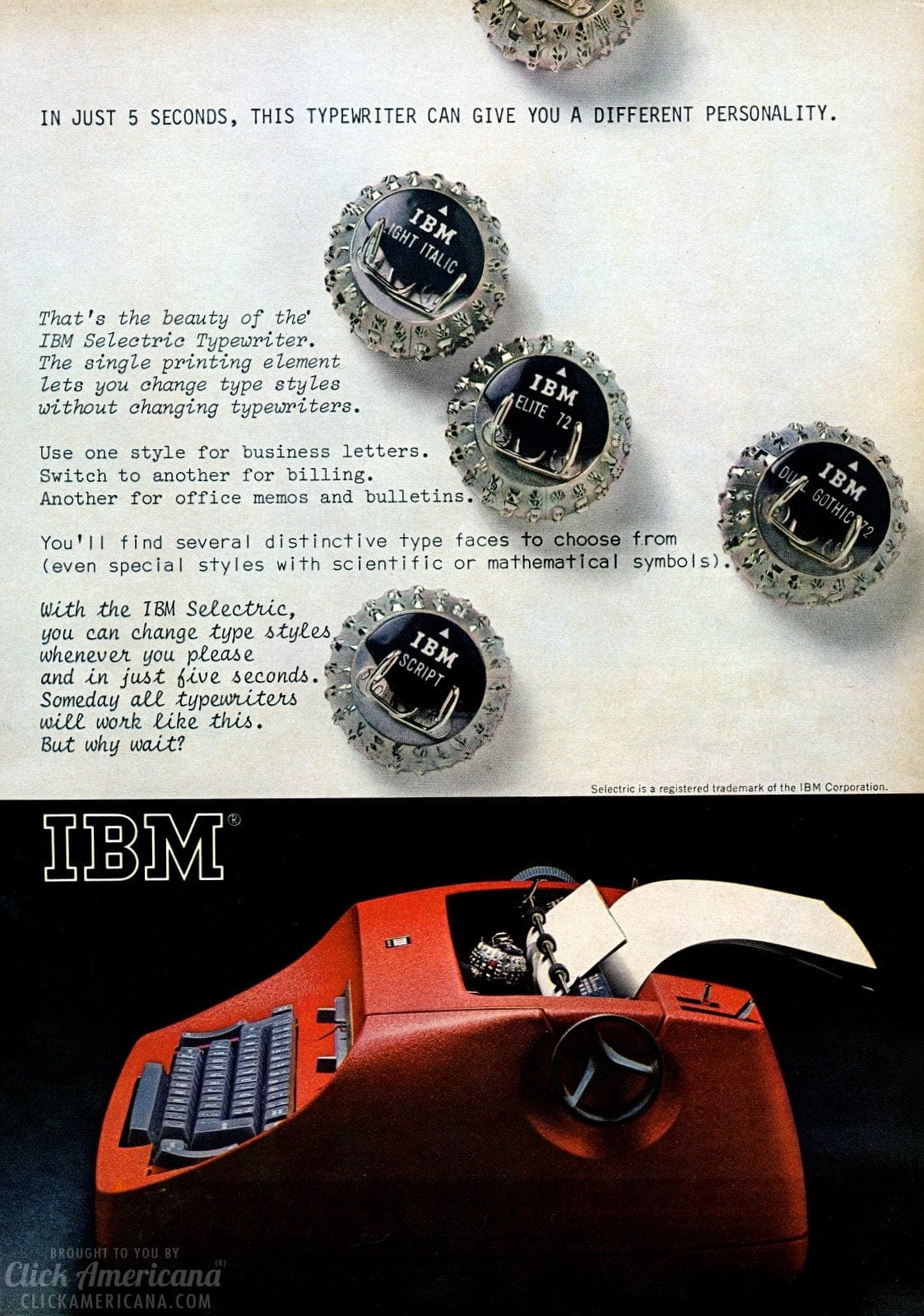
In just 5 seconds, this typewriter can give you a different personality (1966)
That’s the beauty of the IBM Selectric typewriter. The single printing element lets you change type styles without changing typewriters.
Use one style for business letters. Switch to another for billing. Another for office memos and bulletins.
You’ll find several distinctive type faces to choose from (even special styles with scientific or mathematical symbols).
With the IBM Selectric, you can change type styles whenever you please, and in just five seconds.
Someday all typewriters will work like this. But why wait?
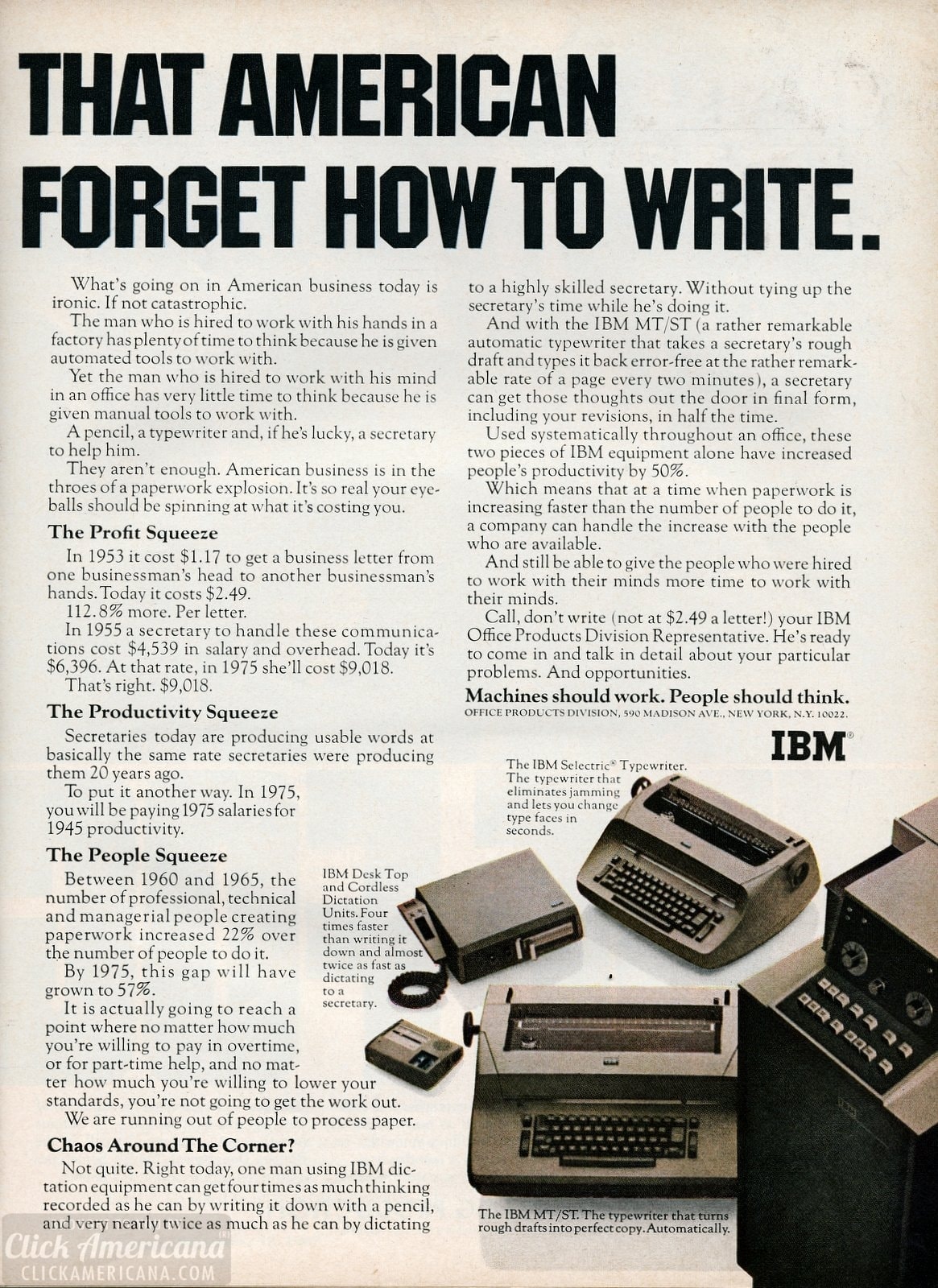
The cost of secretaries & vintage IBM electric typewriters: “That American forget how to write” (1967)
What’s going on in American business today is ironic. If not catastrophic.
The man who is hired to work with his hands in a factory has plenty of time to think, because he is given automated tools to work with.
Yet the man who is hired to work with his mind in an office has very little time to think, because he is given manual tools to work with.
A pencil, a typewriter and, if he’s lucky, a secretary to help him.
They aren’t enough. American business is in the throes of a paperwork explosion. It’s so real your eyeballs should be spinning at what it’s costing you.
The profit squeeze
In 1953, it cost $1.17 to get a business letter from one businessman’s head to another businessman’s hands. Today it costs $2.49.
112.8% more. Per letter.
In 1955, a secretary to handle these communications cost $4,539 in salary and overhead. Today it’s $6,396. At that rate, in 1975, she’ll cost $9,018.
That’s right. $9,018.
ALSO SEE: 50+ sexist vintage ads so bad, you almost won’t believe they were real
The productivity squeeze
Secretaries today are producing usable words at basically the same rate secretaries were producing them 20 years ago.
To put it another way. In 1975, you will be paying 1975 salaries for 1945 productivity.
The people squeeze
Between 1960 and 1965, the number of professional, technical and managerial people creating paperwork increased 22% over the number of people to do it.
By 1975, this gap will have grown to 57%.
It is actually going to reach a point where no matter how much you’re willing to pay in overtime. or for part-time help, and no matter how much you’re willing to lower your standards, you’re not going to get the work out.
We are running out of people to process paper.
Chaos around the corner?
Not quite. Right today, one man using IBM dictation equipment can get four times as much thinking recorded as he can by writing it down with a pencil, and very nearly twice as much as he can by dictating to a highly-skilled secretary. Without tying up the secretary’s time while he’s doing it.
And with the IBM MT/ST (a rather remarkable automatic typewriter that takes a secretary’s rough draft and types it back error-free at the rather remarkable rate of a page every two minutes), a secretary can get those thoughts out the door in final form, including your revisions, in half the time.
Used systematically throughout an office, these two pieces of IBM equipment alone have increased people’s productivity by 50%.
Which means that at a time when paperwork is increasing faster than the number of people to do it, a company can handle the increase with the people who are available.
And still be able to give the people who were hired to work with their minds more time to work with their minds.
Call, don’t write (not at $2.49 a letter!) your IBM Office Products Division Representative. He’s ready to come in and talk in detail about your particular problems. And opportunities.
Machines should work. People should think.
Electric typewriters you can buy today

- 13" Carriage
- 9" Typing width
- 45-Key, 17-function keyboard

- 45 Key, 17 Function Keyboard; 12 Character per Second Type Speed
- 10, 12, 15 Pitch; 1, 1.5, 2 Line Spacing; Impression Control
- Automatic Underlining, Bold Typing, Superscript & Subscript

- Bundle Includes: Nakajima WPT-150 Portable Electronic Typewriter and Nakajima NAKXC001 Nakajima Br Xc001 Ae-710 - 1-Sd Correct Film Ribbon
- Print Speeds: It has a 13-inch carriage, 9-inch print width and a 12 character-per-second print speed. It has 10, 12 and 15 pitch selections and 1-inch, 1.5-inch and 2-inch line spacing
- Make Corrections: Automatic centering, underlining and carriage return makes typing easy because you can make corrections right away

- Bundle Includes: Nakajima WPT-160 Electronic Portable Typewriter with Display and Memory and Nakajima XC001 Correctable Carbon Film Typewriter Ribbon (Black)
- Portable Typewriter: Use the Nakajima WPT-160 Electronic Portable Typewriter for fast and easy typing. With its full line correction memory, auto word, and line correction, you can plunge into typing...
- Speed and Spacing: The typewriter offers up to 12 characters per second speed and a selection of line spacing options of 1, 1.5, and 2 inch

- Portable electronic typewriter
- One-line correction memory
- Word and character erase
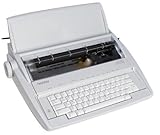
- Designed for the student, home user, or small business
- Professional touch keyboard
- 65-character correction memory